First Seen
2024-09-12T22:50:47.407220+00:00
detailed-analysis (gemma3_27b-it-q8_0)
Okay, let's break down this meme from the perspective of an "Anti-Billionaire" category, utilizing the requested theoretical frameworks where applicable.
Meme Analysis: Elon Musk as Embodied Critique of Billionaire Power
Visual Description:
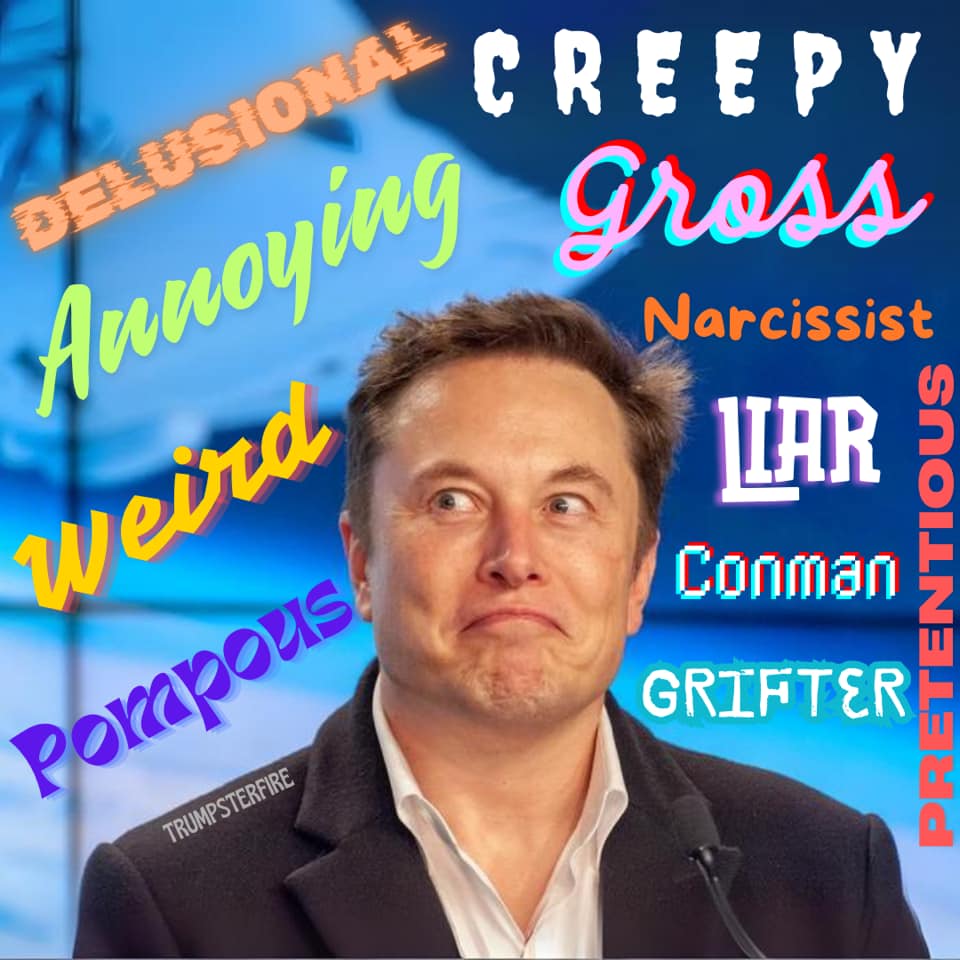
The meme centers around a close-up image of Elon Musk. His expression is slightly off-putting, perhaps conveying a sense of self-importance or detachment. Crucially, the image is saturated with negative descriptors, presented as brightly-colored text labels scattered all over it. These labels include “Delusional,” “Creepy,” “Gross,” “Narcissist,” “Liar,” “Conman,” “Grifter,” “Pompous,” “Weird,” “Pretentious,” and "Annoying." The watermark "TRUMPSTERFIRE" is visible at the bottom. The sheer volume and directness of the labels visually overwhelm the image, signifying a widespread and intense condemnation. The image doesn't aim for subtle satire; it’s a direct, forceful critique.
Foucauldian Genealogical Discourse Analysis:
From a Foucauldian perspective, this meme isn't merely expressing a personal dislike of Musk; it's participating in a contestation of power/knowledge. The labels aren’t objective truths, but rather fragments of a discourse emerging to challenge the dominant narrative surrounding billionaires like Musk. Historically, billionaires have been presented as innovators, philanthropists, and visionaries. This meme participates in a counter-discourse, actively deconstructing that narrative.
The labels themselves function as assertions of power. By defining Musk with these terms, the meme-creator (and those who share it) attempt to wrest control over the discourse surrounding him. The labels expose the techniques by which Musk maintains his power—through deception (“Liar,” “Conman,” “Grifter”), manipulation (“Narcissist”), and the cultivation of a self-aggrandizing image (“Pompous,” “Pretentious”). The emergence of this discourse suggests a growing resistance to the normalization of extreme wealth and the accompanying power imbalances.
Critical Theory:
The meme exemplifies a key tenet of Critical Theory: the critique of ideology. Musk, as a representative of the billionaire class, embodies a system of belief that naturalizes inequality. He is often presented as a "self-made" man, downplaying the systemic advantages (privilege, capital inheritance, favourable regulatory environments) that facilitated his success. The labels in the meme pierce through this ideological veneer. They expose the “dark side” of his supposed success, suggesting that it is built on exploitation, deception, and a disregard for social well-being.
The meme also addresses the “culture industry.” Musk deliberately crafts a public persona through social media and media appearances. The meme deconstructs this performance, rejecting the carefully curated image and revealing what the anti-billionaire perspective views as the underlying character flaws and exploitative practices.
Marxist Conflict Theory:
From a Marxist perspective, this meme is a clear expression of class conflict. Musk, as a capitalist and owner of means of production (Tesla, SpaceX, X/Twitter), represents the bourgeoisie. The labels reflect the resentment and antagonism felt by those who are exploited by the capitalist system. Terms like "Grifter" and "Conman" directly accuse Musk of profiting from the labour of others and misleading the public.
The meme’s virality signals a growing class consciousness. It’s a symbolic act of resistance, a collective rejection of the power and privilege enjoyed by the billionaire class. The meme suggests that Musk’s wealth is not the result of ingenuity and hard work, but of systemic exploitation and a rigged system.
Postmodernism:
The meme’s aesthetic – the overwhelming and fragmented collage of labels – can be interpreted through a postmodern lens. Postmodernism often rejects grand narratives and embraces the idea that truth is relative and constructed. The meme doesn't present a single, coherent argument; instead, it throws a multitude of subjective accusations at Musk, reflecting the fragmentation of contemporary discourse.
The directness and lack of subtlety can also be viewed as a rejection of traditional forms of critique. It's not a nuanced argument; it’s a raw, emotional outburst—a symptom of the postmodern condition where objective truth is increasingly questioned.
Conclusion:
This meme is a potent expression of anti-billionaire sentiment. It goes beyond simply disliking Musk as an individual and functions as a critique of the system that allows such extreme wealth and power to accumulate. By employing various critical frameworks, we can see how the meme participates in a larger struggle over power, knowledge, and the very definition of success in a profoundly unequal world. The watermark adds a layer of political positioning, connecting the critique to a broader countercultural or oppositional stance.
Disclaimer: This is an analytical interpretation based on the provided image and theoretical frameworks. The interpretation is informed by the request to analyze from an "Anti-Billionaire" perspective, and other interpretations are possible.
simple-description (llama3.2-vision_11b)
The meme is a photo of Elon Musk with a shocked expression, surrounded by a collage of words that describe him, such as "Dk" and "Weird". The image is captioned "Elon Musk's Twitter Bio" and is meant to poke fun at the eccentricities of the billionaire entrepreneur.
detailed-analysis (gemma3-27b-vision)
Okay, here's a breakdown of the image through several theoretical lenses, with sections only for those applicable. Given the image content, some lenses will be more prominent than others.
---
Visual Description
The image depicts a portrait-style photograph of Elon Musk, primarily focusing on his upper body. He's wearing a dark suit jacket and a white shirt, looking directly at the viewer. The background is blurred, appearing to be a dark blue. However, the most striking aspect is the abundance of colorful text labels superimposed over the image. These labels include negative descriptors like “Delusional,” “Annoying,” “Weird,” “Pompous,” "Creepy", "Gross", "Narcissist", "Liar", "Conman", "Grifter", and "Pretentious". The text is in various fonts, sizes, and colors, and seems designed to visually attack or denounce the subject. Additionally, the word "TRUMPSTERFIRE" is faintly visible in the bottom left corner.
---
Foucauldian Genealogical Discourse Analysis
This image is a fascinating example of how power operates through discourse. A Foucauldian analysis would move beyond simply labeling these descriptors as "true" or "false." Instead, it would ask how these labels have come to be associated with Elon Musk.
- Discursive Formation: The labels create a discursive formation around Musk—a system of thought, language, and practice that defines and categorizes him. These terms don't exist in isolation; they are drawn from broader societal discourses about power, wealth, and celebrity.
- Power/Knowledge: The image demonstrates the link between power and knowledge. Those creating and sharing this image exert power by defining Musk in these negative terms. This isn't about objective truth; it's about constructing a particular narrative. The labeling creates a reality in which Musk is seen as these things.
- Genealogy: A genealogical approach would trace the history of these labels. How have terms like "narcissist," "grifter," and "pretentious" been used historically? What social and political contexts gave these terms their current meaning? Examining this history would reveal how these labels were produced and how they function to marginalize or discredit Musk. The juxtaposition of "TRUMPSTERFIRE" suggests a linkage in the public imagination between Musk and the former President.
- Normalization/Discipline: The repeated use of these negative labels can contribute to a form of social discipline. It discourages certain behaviors and reinforces social norms, even if those norms are contested.
---
Critical Theory
This image lends itself to a Critical Theory analysis, particularly those stemming from the Frankfurt School.
- Culture Industry: The image itself can be seen as a product of the "culture industry." It’s a form of mass-produced critique, distributed through digital channels, that contributes to the construction of public opinion. While appearing as spontaneous expression, it is part of the larger communication systems that influence perceptions.
- Critique of Ideology: The labels function as a critique of the ideology surrounding wealth, power, and celebrity. The image suggests that Musk’s success isn’t just about innovation but is tied to exploitative or manipulative behaviors.
- Domination and Resistance: The image represents a form of resistance against the perceived dominance of Elon Musk. It's an attempt to deconstruct his carefully cultivated public persona and expose what its creators see as his negative qualities. However, the very act of labeling can also be seen as a form of control—defining him on their terms.
- Commodification: Musk's persona has been carefully constructed and commodified. This image is a response to that commodification, attempting to strip away the layers of branding and present a perceived "truth".
---
Marxist Conflict Theory
This image clearly reflects elements of Marxist Conflict Theory.
- Class Conflict: Musk, as a billionaire and CEO, represents the ruling class/bourgeoisie. The labels (“Grifter,” “Conman”) suggest an accusation of exploiting others to accumulate wealth. The image frames Musk as someone who profits from the labor of others or engages in deceptive practices.
- Ideological Struggle: The image is a form of ideological struggle. It challenges the dominant narrative that glorifies wealth and success without considering the social costs. The labels aim to expose what the creators see as the exploitative nature of Musk’s power.
- False Consciousness: The image implies that Musk's public image is a form of "false consciousness" – a way of masking the true nature of his exploitative practices. By exposing these practices, the image seeks to awaken a critical consciousness in others.
- Alienation: The labeling could be seen as a response to the alienation created by capitalism, where individuals are reduced to commodities and their true worth is obscured by wealth and power.
---
Postmodernism
A postmodern lens would emphasize the constructed nature of reality and the lack of objective truth.
- Deconstruction: The image is a form of deconstruction. It takes a seemingly solid figure (Musk) and dismantles his carefully constructed public image by attaching negative labels.
- Simulacra and Simulation: Musk’s public persona can be seen as a simulacra – a copy without an original. The image suggests that what we see of Musk is not "real" but a manufactured performance.
- Subjectivity: Postmodernism would emphasize the subjectivity of the labels. These terms are not objective truths but interpretations based on the creators' perspectives and biases.
- Rejection of Metanarratives: The image rejects any grand narrative about Musk as a visionary innovator. Instead, it focuses on the specific, perceived flaws in his character and behavior.
---
Queer Feminist Intersectional Analysis
While this image doesn't immediately scream "queer feminist," we can still apply an intersectional lens:
- Power Dynamics & Gender: Musk’s immense wealth and power create significant imbalances in social relationships. His actions (and perceived character) have impacts on various marginalized groups, and the image speaks to a challenge of that power.
- Exposure of Toxic Masculinity: The "narcissist" and "pompous" labels, in conjunction with his public persona, can be read as critiques of harmful forms of masculinity—the entitlement, lack of empathy, and dominance often associated with this ideology.
- Critique of Capitalist Patriarchy: The image, from an intersectional perspective, can be seen as a rejection of the structures of capitalist patriarchy that enable individuals like Musk to accumulate power and exploit others. The image speaks to the intersection of wealth, gender, and power dynamics.
Important Considerations:
- This analysis is based solely on the image itself. To gain a fuller understanding, we’d need to consider the context in which it was created and shared.
- These theoretical lenses are not mutually exclusive. They can be used in combination to offer a more nuanced and comprehensive interpretation.
Let me know if you'd like me to elaborate on any specific aspect of this analysis!
simple-description (llama3.2-vision)
This meme is a humorous image of Elon Musk with a shocked expression, surrounded by a collection of words that are often used to describe him in a negative or ironic way. The words include "delusional", "creepy", "gros", "narcissist", "liar", "conman", "grifter", "dumb", "incompetent", "inept", "incompetent", "incompetent", and "incompetent".