First Seen
2024-01-30T00:35:24.170971+00:00
simple-description (llama3.2-vision_11b)
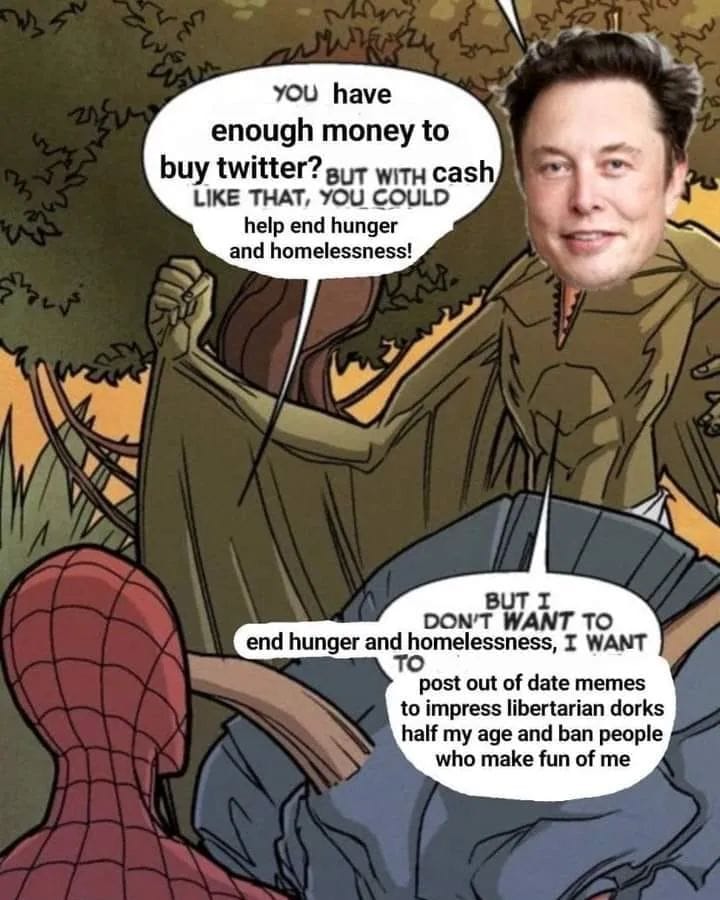
This meme is a humorous commentary on the contrast between Elon Musk's public persona and his actual behavior. The image shows a scene from the Spider-Man movie where Spider-Man is trying to make a deal with the villainous Norman Osborn (who is also the Green Goblin). However, in this meme, the dialogue has been altered to reflect Elon Musk's tweets and behavior. The text in the image reads: "You have enough money to buy Twitter, but you don't have enough empathy to stop hating people who are hungry." This meme is poking fun at Elon Musk's public image and his tendency to make inflammatory and divisive comments on social media.
detailed-analysis (gemma3-27b-vision)
Okay, let's break down this meme with the requested theoretical lenses. It's a layered image, ripe for analysis.
Visual Description
The image is a digitally manipulated comic book panel, seemingly referencing a classic Spider-Man scene. Spider-Man is in a distressed posture, hanging upside down, partially obscured by foliage, suggesting a struggle or feeling trapped. Above him, floating in a speech bubble, is a superimposed image of Elon Musk, with the text: "you have enough money to buy twitter? but with that, you could help end hunger and homelessness!" Below Spider-Man, another speech bubble contains his response: "But I DON’T WANT TO end hunger and homelessness. I WANT TO post out of date memes to impress libertarian dorks half my age and fan of me who make fun of me."
The overall aesthetic is intentionally jarring. The cartoon style clashes with the very contemporary and relevant subject matter (Elon Musk's acquisition of Twitter and the broader critique of wealth disparity). The visual composition also leans into the melodrama of comic book tropes, amplifying the sense of moral crisis.
Critical Theory
This meme is a pointed critique of the culture industry (Adorno & Horkheimer). The contrast between the potential for meaningful social change ("end hunger and homelessness") and the actual pursuit of frivolous validation ("post out of date memes") highlights the ways in which capitalist culture prioritizes superficiality over substance.
The meme suggests a form of false consciousness, where the focus is shifted away from systemic issues (hunger, homelessness) towards individual displays of power and influence (owning social media, gaining approval from a specific demographic). Spider-Man, as a traditionally heroic figure, becomes a symbol of this internalized contradiction. He knows he could use his resources for good, but actively chooses to engage in a self-serving and arguably meaningless activity.
Marxist Conflict Theory
The meme directly addresses the inherent conflict between the bourgeoisie (represented by Elon Musk and his wealth) and the proletariat (those suffering from hunger and homelessness). It’s a visual representation of how resources could be redistributed to alleviate suffering, but are instead hoarded or spent on vanity projects.
The focus on "libertarian dorks" is significant. Libertarianism, as an ideology, often champions individual freedom and minimal government intervention, which can, in practice, exacerbate wealth inequality and leave vulnerable populations unsupported. Spider-Man's desire to impress this demographic points to the ways in which power structures are reinforced by those who benefit from the status quo.
The central conflict isn't a physical battle, but a class conflict manifested in a moral dilemma. Spider-Man represents the potential for revolutionary change, but succumbs to the lure of maintaining his privileged position.
Postmodernism
The meme embodies many Postmodernist traits. The image deconstructs the traditional heroic narrative. Spider-Man is no longer a straightforward savior, but a flawed, self-absorbed character.
The use of irony and satire is central. The juxtaposition of serious social issues with the trivial pursuit of online validation creates a sense of absurdity. It challenges the notion of grand narratives or universal truths, suggesting that meaning is constructed and context-dependent.
The focus on meme culture itself is a distinctly Postmodern phenomenon. Memes, as fragmented and often nonsensical cultural artifacts, represent a break from traditional forms of communication and storytelling. Spider-Man’s desire to create and share memes highlights the ways in which identity and meaning are increasingly constructed through digital media.
Foucauldian Genealogical Discourse Analysis
A Foucauldian analysis would focus on the discourse surrounding wealth, power, and social responsibility. The meme doesn’t simply critique individual actions; it reveals the underlying power dynamics that shape those actions.
Elon Musk's wealth and its association with Twitter (a platform influencing public discourse) become sites of power. The meme challenges the legitimacy of a system where such resources are used for self-aggrandizement rather than addressing urgent social problems.
It reveals how "charity" and "social responsibility" are constructed as discourses – ways of talking about and understanding these concepts. By framing Musk's choices as a matter of personal preference ("I WANT TO post memes"), the meme highlights the ways in which the discourse obscures the systemic inequalities at play. It's not about Musk being charitable; it's about the power structures that allow him to choose not to be. The idea of "Libertarian dorks" becomes a symbol of a specific discourse which normalizes prioritizing individual gain over collective wellbeing.
Queer Feminist Intersectional Analysis
While not immediately obvious, a Queer Feminist Intersectional lens can offer some insights.
The prioritization of impressing a specific demographic ("libertarian dorks") can be read as a performance of masculinity – an attempt to assert dominance and status within a particular social group. This reinforces patriarchal structures and expectations.
The meme implicitly critiques the ways in which capitalist structures disproportionately impact marginalized communities, contributing to cycles of poverty, homelessness, and food insecurity. The fact that these issues are brushed aside in favor of self-promotion highlights the ways in which privilege and power operate at the expense of others.
The focus on online validation (memes) can be seen as a form of performative activism – a superficial engagement with social issues that prioritizes self-presentation over genuine change. This can be particularly harmful when it co-opts the language and concerns of marginalized communities without addressing the underlying systemic problems.
I hope this detailed breakdown helps illustrate the meme's multiple layers of meaning! Let me know if you'd like me to elaborate on any of these theoretical lenses further.
simple-description (llama3.2-vision)
The meme is a humorous take on the idea of using Twitter to make a donation to a charity that helps end hunger and homelessness. The image features a conversation between Spider-Man and Elon Musk, where Spider-Man asks if he has enough money to buy Twitter, and Musk responds with a humorous and satirical statement about wanting to use his money to end hunger and homelessness, but instead wants to use it to post out-of-date memes to impress libertarian dorks.
tesseract-ocr
co J a\’ fo 9 Y er a y yOU have el 3 enough money to f buy twitter? guy witu cash, LIKE THAT, YOU COULD help end hunger = and homelessness! i \ = af j P yf | 7S 3 , \e Pr | Y 4 7i~* BUT I DON’T WANT TO | end hunger and homelessness; T WANT | ' post out of date memes \ Ss to impress libertarian dorks . half my age and ban people who make fun of me