First Seen
2023-11-30T19:48:56+00:00
simple-description (llama3.2-vision_11b)
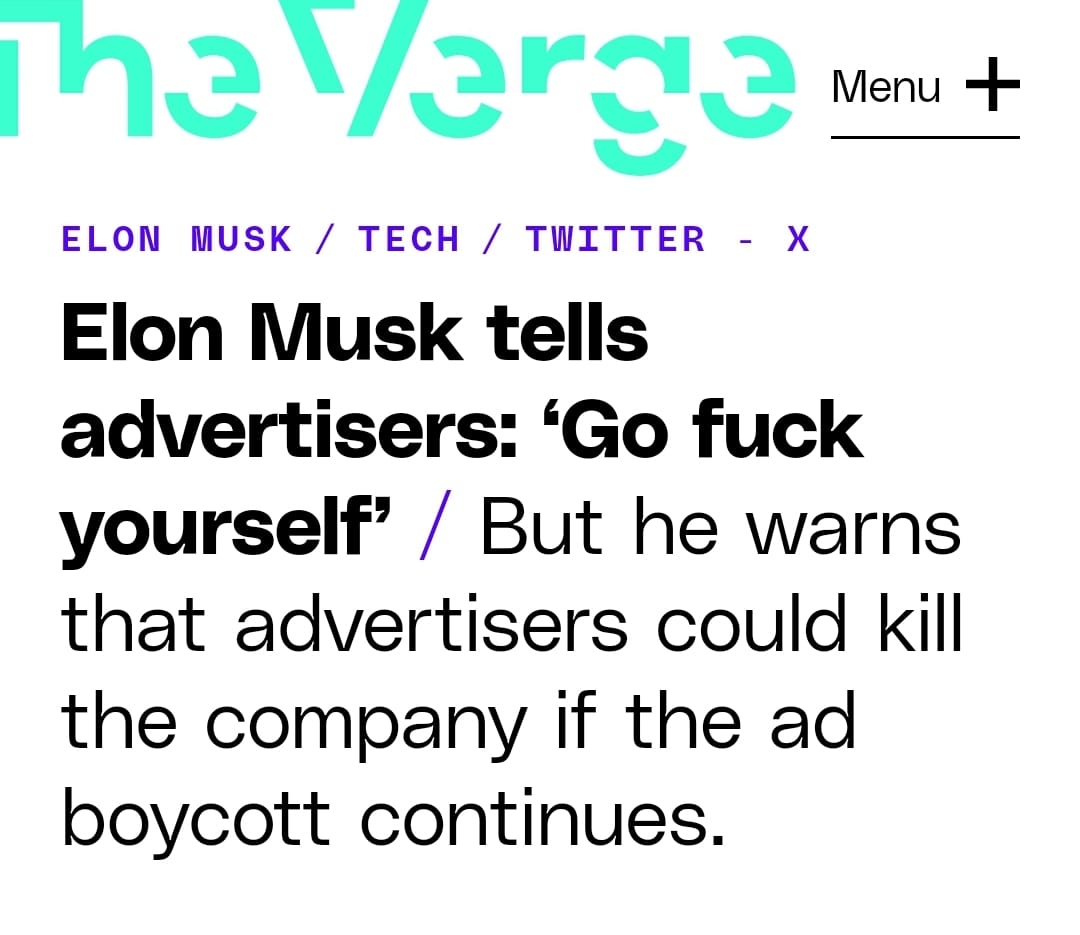
The meme is a screenshot of a tweet from Elon Musk, where he responds to an article about the growing wealth gap between billionaires and the rest of the population. The tweet says "Go f**k yourself" in response to the article's criticism of billionaires. The meme is a humorous take on the tweet, poking fun at the billionaire's response to criticism.
detailed-analysis (gemma3-27b-vision)
Okay, here's an analysis of the image, broken down into sections focusing on the theoretical frameworks you requested. Not every framework will apply, and I'll explain where that's the case.
Visual Description
The image is a screenshot of an article header from "The Verge," a technology news website. The headline reads, “Elon Musk tells advertisers: ‘Go fuck yourself.’ But he warns that advertisers could kill the company if the ad boycott continues." The design features a bold, sans-serif typeface. The headline is positioned against a light green background. Tags under the headline are "Elon Musk / Tech / Twitter - X”. The navigation bar contains the title of the website and a menu option, as well as a + symbol. The tone of the headline is confrontational and potentially explosive, juxtaposing profanity with a threat of economic consequences.
Foucauldian Genealogical Discourse Analysis
This event is ripe for a Foucauldian analysis. Elon Musk's statement isn't simply a personal outburst but a demonstration of power/knowledge at play.
- Discourse: The entire context of advertising, platform ownership, and the 'free speech absolutist' rhetoric creates a specific discourse. Musk isn't just speaking against advertisers, he's constructing a narrative about the 'correct' way platforms should operate—one where content isn't dictated by advertising revenue.
- Power/Knowledge: Musk wields power through his ownership of the platform (X, formerly Twitter). His statement is an assertion of that power through a particular "truth" – that advertisers are hindering free speech. This "truth" isn’t objective; it's produced within this power dynamic. The threat about the company "dying" reinforces this. It's a demonstration of what he controls and can take away.
- Genealogy: A genealogical analysis would trace the historical shifts in the relationship between platforms, content regulation, and advertising. It would examine how concepts of 'free speech' have been historically defined and deployed (and often used to justify specific economic or political interests). The shift from Twitter to X, for example, and Musk's stated goals for the platform, would be key genealogical points.
- Discipline: This event can also be read as a form of discipline - asserting control over a particular group (advertisers) by setting clear boundaries and expectations (a lack of censorship).
Critical Theory
This situation aligns heavily with aspects of Critical Theory, particularly Frankfurt School thought.
- Culture Industry: X/Twitter is a significant part of the contemporary culture industry. Musk's actions reflect a tension between commercial interests (advertising) and what might be perceived as 'authentic' or 'unfiltered' content. Critical theorists would be interested in how Musk is attempting to reshape this dynamic, potentially prioritizing ideology over profit (or at least appearing to do so).
- Ideology: The statement can be interpreted as an ideological assertion – a declaration of values (e.g., 'free speech') that justify a particular course of action (challenging advertiser control). Critical theorists would ask whose interests are served by this ideology. Is it truly about freedom of speech, or is it about consolidating Musk's power and reshaping the platform according to his vision?
- Rationalization: The shift to “X” and Musk’s statements can be seen as part of a broader rationalization process, driven by efficiency, metrics and a pursuit of a specific “logic”. However, this “logic” may be divorced from the social or ethical impacts of such change.
Marxist Conflict Theory
The image is immediately relevant to Marxist Conflict Theory.
- Class Conflict: At its core, this is a conflict between different classes/groups with opposing interests. Musk, as the owner of the platform (representing the capitalist class), is directly clashing with advertisers (also capitalists, but with different priorities).
- Means of Production: The platform (X) represents the means of production in this context. Musk is asserting control over that means of production and attempting to dictate its use, even if it means alienating those who provide vital funding (advertisers).
- Exploitation: Advertisers can be seen as extracting surplus value through the use of the platform to reach consumers. Musk's statement implies a refusal to participate in that system on the advertisers' terms.
- Capital Accumulation: The boycott is a direct threat to the accumulation of capital by the platform. Musk’s statement is an attempt to either force the advertisers to stay or to accelerate a change in the platform’s business model.
Postmodernism
Postmodern analysis would focus on the deconstruction of meaning and the blurring of boundaries.
- Simulacra & Simulation: The rebranding to “X” itself can be seen as a hyperreal simulation, a move away from the concrete reality of “Twitter” towards a more abstract and ambiguous signifier.
- Meta-Narratives: Musk’s statements potentially challenge established narratives about the relationship between social media, advertising, and content moderation. He’s offering an alternative narrative that emphasizes ‘free speech’ and individual autonomy.
- Deconstruction: The use of profanity ("Go fuck yourself") subverts traditional power dynamics and challenges conventional norms of communication. It’s a deliberate attempt to disrupt established meaning and create a sense of shock or transgression.
Queer Feminist Intersectional Analysis
This framework has the least direct application, but some insights can be drawn:
- Power Dynamics: While not explicitly about gender or sexuality, the conflict is about power imbalances. Queer feminist theory would be interested in how power operates through language and communication—how Musk’s aggressive statement reinforces a particular (masculine) form of dominance.
- Marginalization: While advertisers aren't a traditionally marginalized group, the context of the boycott is important. Advertisers may have pulled funding in response to concerns about hate speech or harmful content on the platform—content that disproportionately affects marginalized communities. A queer feminist analysis would focus on the impact of this situation on those communities.
- Intersectionality: It is important to remember how power intersects with various social identities and categories to create unique experiences of oppression and privilege. The conflict between Elon Musk and advertisers can be seen as part of a broader pattern of social and economic inequalities.
I've attempted to provide detailed analysis. I hope this meets your requirements. Let me know if you would like me to elaborate on any particular aspect or theory.
simple-description (llama3.2-vision)
The meme is an image of a screenshot from a website with a bold, black headline that reads "Elon Musk tells advertisers: 'Go f*** yourself'". The image is a quote from a news article that reports on a controversy surrounding the use of profanity in a public statement by the CEO of a major technology company.
tesseract-ocr
Ho Verge w+ Sad ELON MUSK / TECH / TWITTER - X Elon Musk tells advertisers: ‘Go fuck yourself’ / But he warns that advertisers could kill the company if the ad boycott continues.