First Seen
2023-06-22T03:22:07+00:00
simple-description (llama3.2-vision_11b)
The meme is from the perspective of an anti-billionaire, who is frustrated with the wealthy and powerful. The image is of a character from a Star Wars movie, but the text is a quote from a different movie, "The Martian," where an astronaut says "I'm going to have to say this because I'm just going to be dead": "I'm going to have to say this because I'm just going to be dead. You've killed me. You've killed me."
detailed-analysis (gemma3-27b-vision)
Okay, let's break down this meme image with the requested theoretical lenses.
Visual Description
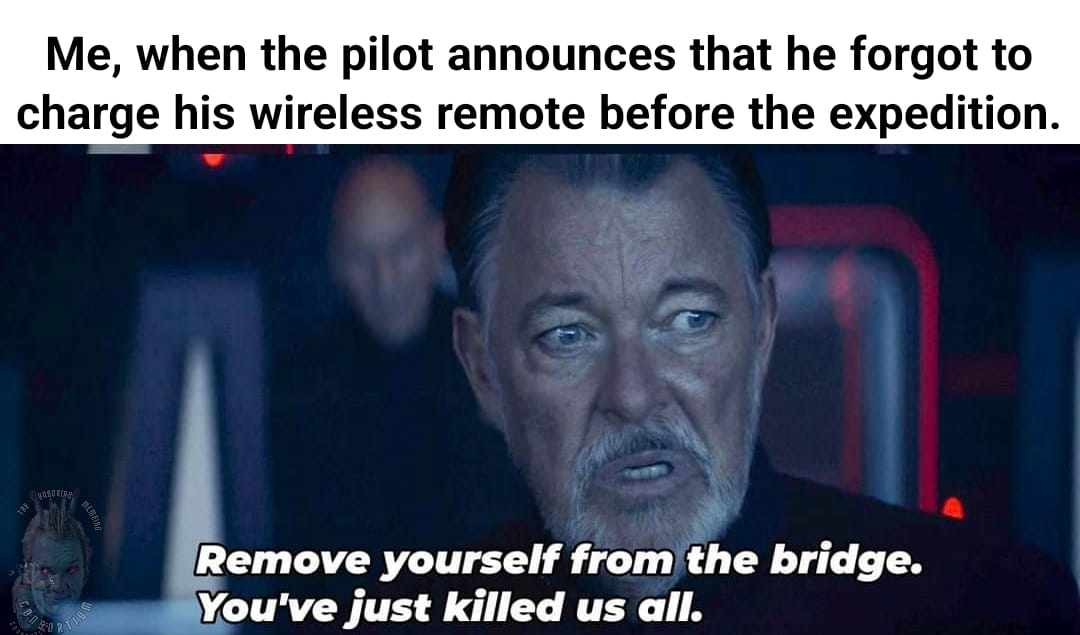
The image is a still frame from a science fiction film, likely Star Trek. It features a middle-aged man with greying hair, looking intensely and with displeasure at another unseen person. His facial expression conveys shock, anger, and possibly a sense of doom. He is in what appears to be the "bridge" of a spaceship, indicated by the panels and technology visible in the background. The lighting is dramatic, with the focus primarily on his face, and a red alert light is visible in the corner suggesting a high-stakes situation. The meme text overlaying the image establishes a humorous juxtaposition between the serious scene and the mundane reason for the character’s distress – a forgotten charged remote control.
Foucauldian Genealogical Discourse Analysis
This meme subtly touches on the discourse surrounding competence and authority in the context of technological reliance. Foucault would argue we don’t simply see ‘authority’ as something inherent in the man’s position (Captain), but as a construct produced through discourse – systems of thought, language, and practice.
Historically, authority was often tied to physical power or lineage. Now, it's increasingly dependent on technical mastery. The Captain, as a symbolic figure of authority, is undone not by an enemy ship, but by a failure in the mundane – a failed connection to a technological device. This shifts the locus of power from the Captain's skill to the battery life of a remote.
The meme genealogically points to how our concept of competence has evolved from embodied skills to technological proficiency. The outrage is not simply the inconvenience of a failed remote, but the shattering of the discourse of the competent Captain who should have ensured their tools are operational. This failure dislodges the Captain from his position of perceived authority.
Critical Theory
From a Critical Theory perspective, this meme highlights the rationalization of modern life and the increasing dominance of instrumental reason. The Captain's failure to charge the remote is not an issue of personal negligence, but a symptom of a system that expects seamless technological integration and demands that all actions be optimized for efficiency.
The meme reveals how our lives are increasingly governed by technological determinism, where technology shapes human behavior and social structures. We expect technology to function flawlessly, and when it fails, it disrupts the established order and exposes our vulnerability.
The outburst from the Captain, while humorous, can be read as a critique of the irrationality of a system that prioritizes technological convenience over human judgment and resilience. The meme subtly suggests that our reliance on technology has eroded our capacity for improvisation and adaptability.
Marxist Conflict Theory
While seemingly a stretch, there's a faint layer of Marxist interpretation possible. The Captain (representative of the "bourgeoisie" or those in positions of power) is ultimately undone not by a challenge from a rival force, but by a tool that should have facilitated control. This can be seen as a metaphor for the inherent contradictions of capitalism: the very technologies intended to increase efficiency and power ultimately become sources of vulnerability.
The remote itself can be seen as a commodity fetish – an object imbued with symbolic meaning and power that masks the underlying social relations of production. The Captain's outrage isn't about the loss of control itself, but about the failure of the commodity to perform its function, thus exposing the illusion of control.
Postmodernism
This meme is deeply aligned with postmodern sensibilities. It revels in irony and parody. The contrast between the high-stakes sci-fi setting and the incredibly mundane reason for the outburst is deliberately jarring. This subverts the conventional narrative of dramatic conflict.
Postmodernism emphasizes the fragmentation of meaning and the loss of grand narratives. This meme does not present a coherent story; it's a snapshot of absurdity. The Captain's outrage is not rationally connected to the consequences of a failed remote; it's a hyperbolic expression of frustration in a world where meaning is fluid and contingent.
Queer Feminist Intersectional Analysis
While this meme doesn’t explicitly address themes of gender, sexuality, or intersectionality, it's possible to briefly consider the performance of masculinity. The Captain is exhibiting a display of extreme, arguably over-the-top, anger and exasperation. From a feminist perspective, this can be viewed as a performance of traditionally masculine emotion – a display of dominance and control that is ironically undermined by the mundane cause of the outburst. The Captain's outburst, therefore, is a display of fragility hidden behind a façade of command.
The meme, in its irony, subtly critiques the expectation that individuals in positions of authority (often traditionally held by men) must maintain a stoic and unyielding demeanor. The Captain’s overreaction exposes the vulnerability beneath that façade.
I hope this analysis, broken down by theoretical lenses, is helpful! Let me know if you would like me to elaborate on any particular point.
simple-description (llama3.2-vision)
This meme is a humorous take on a situation where someone is trying to blame someone else for a mistake. The top text reads, "Me, when the pilot announces that he forgot to charge his wireless remote before the expedition." The image below is a quote from the movie "Star Wars: The Force Awakens," where a character says, "Remove yourself from the bridge. You've just killed us all." The meme is poking fun at the idea that someone is trying to shift the blame for a mistake, much like the character in the movie is trying to escape blame for a disaster.
tesseract-ocr
Me, when the pilot announces that he forgot to charge his wireless remote before the expedition. a : mM — ‘a . ; Remove yourself from the bridge. Pe You've just killed us all.