First Seen
2023-05-24T22:39:06+00:00
simple-description (llama3.2-vision_11b)
The meme is a satirical image that pokes fun at the wealth disparity between the ultra-rich and the general population. It features a screenshot of a tweet from Elon Musk, where he claims that the value of his wealth is a mere $200 billion, down from his previous estimate of $200 billion plus.
detailed-analysis (gemma3-27b-vision)
Here’s an analysis of the provided Twitter exchange, broken down into the requested theoretical frameworks. It’s worth noting that applying all of these frameworks to a single tweet is a somewhat academic exercise, but helps to demonstrate how different theoretical lenses can illuminate a single phenomenon.
Visual Description
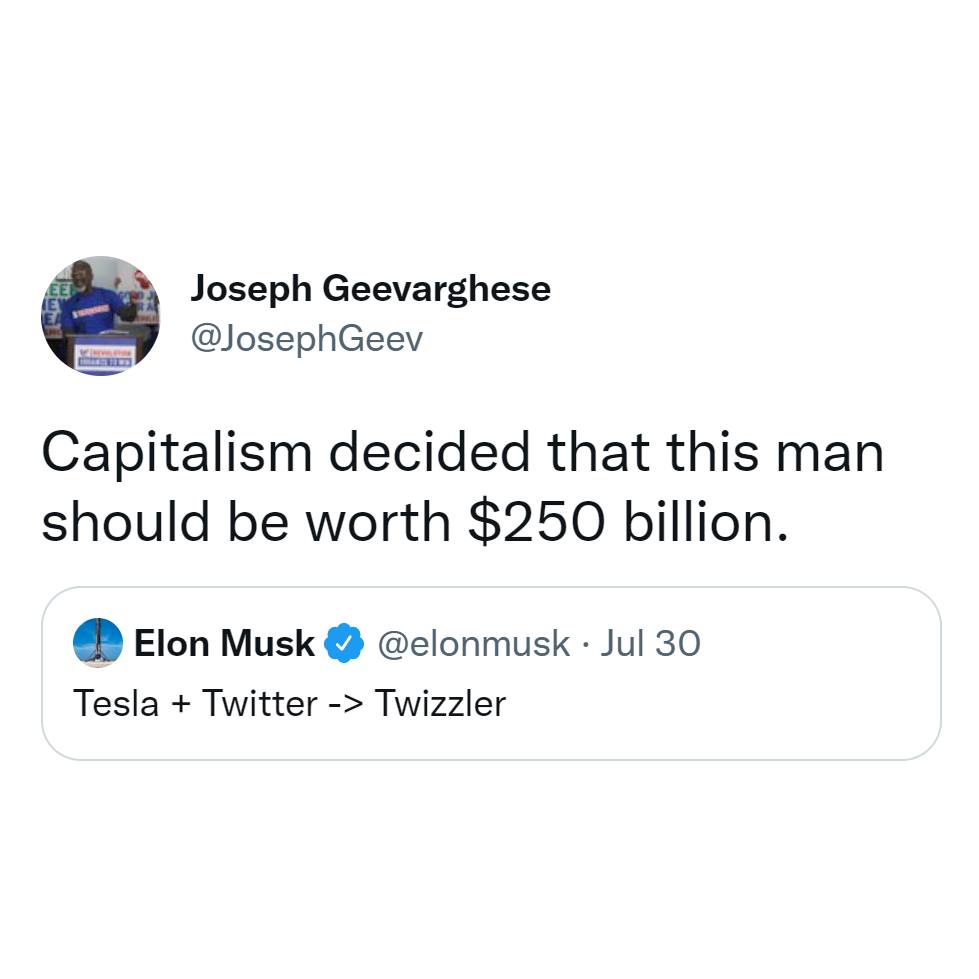
The image is a screenshot of a Twitter exchange. It features the profile picture and username of Joseph Geevarghese (@JosephGeev), followed by a tweet stating, "Capitalism decided that this man should be worth $250 billion." Below is a tweet from Elon Musk (@elonmusk), verified with a blue checkmark, stating, “Tesla + Twitter -> Twizzler.”
The color scheme is predominantly white, typical of Twitter's interface. The profile pictures are relatively small but visible. The framing suggests a direct response/commentary dynamic. The image itself is a fairly straightforward example of social media communication.
Foucauldian Genealogical Discourse Analysis
This exchange is ripe for a Foucauldian analysis. The tweet by Joseph Geevarghese isn’t just stating a fact; it’s framing wealth as produced by the discourse of capitalism. It’s not simply that Elon Musk has $250 billion, but that "Capitalism decided." This implicitly points to the power dynamics inherent in the system: capitalism, as a power/knowledge regime, constructs value, assigning worth to individuals and their creations.
The genealogical approach asks how this "decision" came to be. What historical conditions, specific practices, and ways of thinking led to the construction of Elon Musk's wealth as legitimate and even inevitable? We could trace the discourse of innovation, entrepreneurship, "disruption," and the relentless pursuit of profit – all central to the capitalist worldview.
Elon Musk’s reply, while seemingly frivolous, also operates within a discourse. “Tesla + Twitter -> Twizzler” is a playful attempt at re-branding – a manifestation of the capitalist drive for control over narratives and the construction of brand identity. It highlights the increasing power of technology moguls to redefine not just products but even language and meaning.
Critical Theory
From a Critical Theory perspective, this exchange is emblematic of the alienation and reification inherent in late capitalism. Joseph Geevarghese's tweet points to the absurd disconnect between vast wealth accumulation and genuine human need. The "$250 billion" figure isn’t connected to actual value created for society, but to abstract financial calculations and the power dynamics of the market. It's a sign of a system prioritizing profit over people.
Elon Musk's response, though seemingly trivial, reinforces the notion of individual entrepreneurial genius as the driving force of progress, obscuring the systemic inequalities and exploitation that underpin wealth accumulation. It aligns with the "cult of personality" often surrounding tech CEOs, reinforcing their perceived power and authority.
Critical Theory would ask: Whose interests are served by this system? Who benefits from the concentration of wealth in the hands of a few? How does this system perpetuate itself through ideology and control?
Marxist Conflict Theory
The core of Conflict Theory is the struggle between classes. Geevarghese's tweet is a clear statement of class inequality. It highlights the massive accumulation of capital by a single individual while millions struggle with poverty, precarity, and lack of access to basic resources. The "$250 billion" isn't merely a number; it represents the exploitation of labor and the extraction of surplus value.
Musk's tweet, viewed through this lens, can be seen as a distraction, a way to further solidify his brand and reinforce his position of power. It's an example of how the ruling class maintains its dominance through cultural control and the manipulation of narratives.
The conflict isn't simply economic; it's also ideological. The dominant narrative celebrates entrepreneurial success and individual wealth, obscuring the systemic inequalities that make such accumulation possible.
Postmodernism
From a Postmodern perspective, the exchange highlights the instability of meaning and the constructed nature of reality. The "$250 billion" isn't an objective measure of worth; it's a social construct, a symbol created by the game of finance.
Musk's tweet exemplifies the playful deconstruction of signs. He's taking established brands (“Tesla”, “Twitter”) and combining them into something new (“Twizzler”), demonstrating the fluidity and malleability of language and identity. It reflects a world where branding and image often overshadow substance.
Postmodernism would question the very notion of objective truth and highlight the subjective interpretations that shape our understanding of wealth, power, and success. The tweet encourages us to deconstruct the narratives surrounding these concepts.
Queer Feminist Intersectional Analysis (potentially applicable, with a stretch)
This is the least immediately applicable framework, but a nuanced reading is possible. While neither tweet explicitly addresses issues of gender or sexuality, an intersectional approach can shed light on the power dynamics at play.
The concentration of wealth in the hands of a few (predominantly white, male tech CEOs) perpetuates systemic inequalities that disproportionately affect marginalized communities. The power structures that allow for this wealth accumulation are inherently patriarchal and often intersect with racial and class oppression.
Musk’s control over social media platforms and his use of branding and narrative control contribute to the marginalization of dissenting voices and the reinforcement of dominant ideologies. The playful brand shift in his tweet could be seen as a manifestation of the arbitrary power dynamics that marginalize voices.
An intersectional analysis would ask: Who is excluded from the benefits of this wealth? How do intersecting systems of power contribute to this inequality? What are the consequences for marginalized communities?
It's important to remember that these are just interpretations, and the analysis can be nuanced further. Each theoretical lens offers a unique perspective on this seemingly simple exchange.
simple-description (llama3.2-vision)
This meme is a play on the idea that capitalism is based on the value of a person's worth being determined by their wealth. The original tweet from Elon Musk is being responded to with a quote that is a play on the idea of a person's worth being determined by their wealth, with the quote saying "Capitalism decided that this man should be worth $250 billion." The response is a satirical take on the idea that someone's worth is determined by their wealth, and is being used to poke fun at the idea that someone's worth is determined by how much money they have.
tesseract-ocr
SS Joseph Geevarghese es @JosephGeev Capitalism decided that this man should be worth $250 billion. @ Elon Musk @ @elonmusk - Jul 30 Tesla + Twitter -> Twizzler