First Seen
2024-09-16T20:09:38.688804+00:00
detailed-analysis (gemma3_27b-it-q8_0)
Okay, let's break down this image and statement from an Anti-Authoritarian perspective, utilizing the requested theoretical lenses where relevant.
Image Description
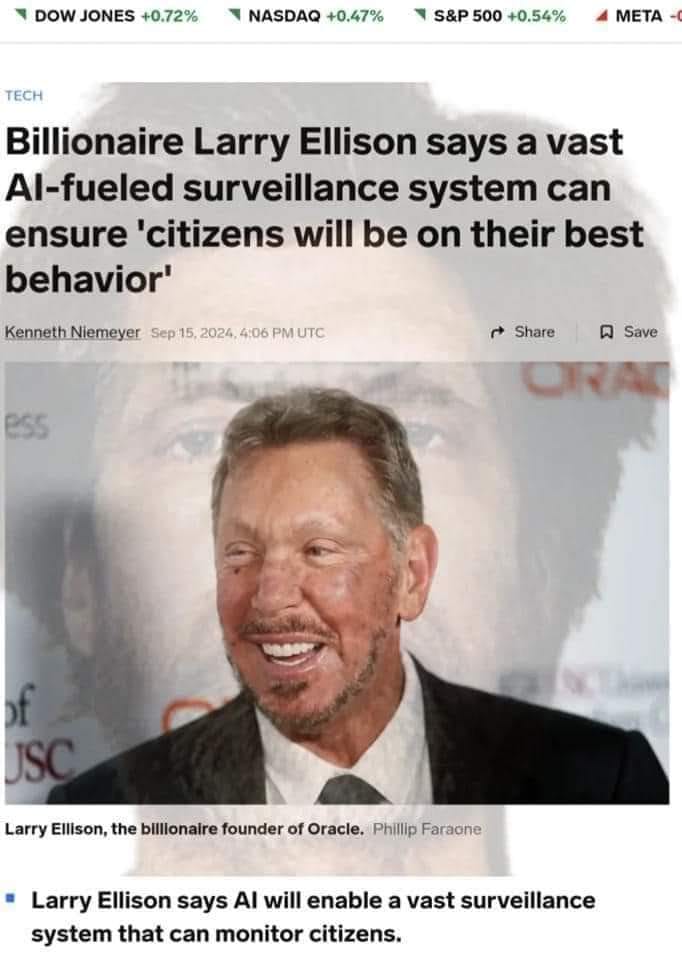
The image features Larry Ellison, the billionaire founder of Oracle, a technology company specializing in database software and cloud systems. He is depicted in a standard headshot – smiling, looking directly at the viewer, in a formal suit. The background is slightly blurred, with Oracle branding visible. The overall presentation conveys an image of power, success, and authority. It is paired with a headline and subheadline stating Ellison believes AI can enable a vast surveillance system to monitor citizens and ensure 'best behavior'.
Foucauldian Genealogical Discourse Analysis
This image and statement are highly resonant with Michel Foucault's work on power, surveillance, and discourse.
- Panopticism: Ellison’s statement directly evokes the Panopticon, the prison design theorized by Jeremy Bentham (and explored by Foucault). The idea is that if individuals believe they are constantly under surveillance, they will self-regulate their behavior. Ellison is proposing a technological version of this - AI-driven monitoring that potentially achieves the same behavioral control.
- Discipline & Punish: Foucault argued that modern power operates less through overt repression (like physical punishment) and more through disciplining – subtle, normalizing techniques that shape individuals to fit societal norms. The call for citizens to be on their “best behavior” is a classic example of this disciplinary logic. It suggests a standardization of behavior, a defining of what’s “acceptable” and what isn't, enforced through the threat of observation.
- Genealogy of Power: From a genealogical perspective, this isn’t a new form of control, but rather an evolution of older techniques. Surveillance has always existed (think of traditional policing, social gossip, religious authorities), but now, it's being amplified and automated by technology. The statement reveals a desire to extend power/knowledge over the population through a technological infrastructure.
- Power/Knowledge: The concept of power/knowledge is pivotal here. The ability to know what citizens are doing (through AI surveillance) is power. This knowledge isn't neutral; it’s used to enforce specific norms and to marginalize those who deviate.
Critical Theory
This scenario aligns strongly with Critical Theory's concerns about the instrumentalization of reason and the erosion of individual autonomy.
- The Enlightenment Project & Its Discontents: Critical theorists (like Horkheimer and Adorno) were skeptical of the Enlightenment's promise of progress through reason. They argued that reason can be used not to liberate, but to dominate. Ellison’s reliance on AI, presented as a tool for social improvement, can be seen as an example of this—a supposedly rational technology deployed to enforce a specific (and potentially oppressive) social order.
- Technological Rationality: Critical Theory would question the “rationality” of such a system. Is it truly rational to sacrifice privacy and freedom in exchange for a perceived increase in order? The emphasis on ‘best behavior’ suggests a value judgment about what constitutes a good citizen, imposed through technological control.
- Commodification of Social Life: Oracle, as a corporation, benefits financially from selling and implementing such surveillance technology. This reveals how surveillance can be commodified—turned into a product for profit, with potentially detrimental effects on social life.
Marxist Conflict Theory
From a Marxist perspective, this situation is indicative of the ruling class utilizing technology to maintain its power and control over the proletariat.
- Ideology & False Consciousness: The idea of ensuring ‘best behavior’ serves as an ideological tool to reinforce the status quo. It presents surveillance not as a tool of control, but as a benevolent mechanism for social harmony. This can contribute to “false consciousness,” where individuals internalize beliefs that are detrimental to their own interests.
- Means of Production & Control: Oracle (and other tech companies) control the "means of production" in this case, the technology that enables surveillance. This gives them significant power over society.
- Class Conflict: Surveillance is rarely applied equally. It is more likely to be targeted at marginalized communities or those deemed “undesirable” by the ruling class. This exacerbates existing inequalities and reinforces class conflict.
Postmodernism
A postmodern perspective would critique the idea of a singular, objective ‘best behavior.’
- Deconstruction of Grand Narratives: The idea that AI can lead to a society of "best behavior" relies on a grand narrative – a universal, objective standard of conduct. Postmodernism challenges such narratives, arguing that they are socially constructed and often serve to legitimize power structures.
- Simulacra & Simulation: The idea of "best behavior" itself could be seen as a simulacrum – a copy without an original. It’s a constructed ideal that doesn’t necessarily reflect authentic human behavior.
- Local Narratives and Resistance: Postmodernism emphasizes the importance of local narratives and resistance. Anti-authoritarian movements would utilize these tools to critique the idea of universal 'best behavior' and challenge the surveillance system's legitimacy.
Summary (from an Anti-Authoritarian Perspective)
This image and statement represent a troubling trend: the increasing use of technology to control and discipline populations. From an Anti-Authoritarian standpoint, it's a clear example of power seeking to extend its reach into every aspect of our lives. It raises serious concerns about privacy, freedom, and the erosion of individual autonomy. The statement's implicit assumptions about “best behavior” are viewed as attempts to impose conformity and suppress dissent. This situation calls for critical awareness, resistance, and the development of alternative technologies and social structures that prioritize freedom and self-determination.
Let me know if you’d like me to elaborate on any of these points!
simple-description (llama3.2-vision_11b)
The meme is a screenshot of a news article with the title "Billionaire says AI will replace humans in 20 years" and a quote from the billionaire, "I don't want to be replaced by a machine." However, the article actually says "I don't want to be replaced by a machine... I want to be replaced by a machine that is better than me." This is a play on the idea that the billionaire is being ironic and actually wants to be replaced by a machine that is better than him, which is a commentary on the theme of anti-authoritarianism, where individuals reject the idea of authority and power structures, and instead seek to create their own systems and structures.
detailed-analysis (gemma3-27b-vision)
Okay, here's an analysis of the provided image and headline, broken down into sections according to the requested theoretical frameworks, and only including sections where the framework applies meaningfully.
Visual Description
The image shows Larry Ellison, the billionaire founder of Oracle, smiling broadly. He is an older white man, wearing a blue dress shirt and dark jacket. He’s captured in a medium close-up shot, slightly off-center. The background is blurry and appears to be a wall with indistinct writing on it. The overall impression is of a powerful, confident figure. The composition and framing give the impression that he is being presented as a figure of authority. The accompanying headline, visible at the top, sets the context of the image.
---
Foucauldian Genealogical Discourse Analysis
This article headline provides a prime example for analysis through a Foucauldian lens. Foucault's ideas on power/knowledge and disciplinary societies are deeply relevant.
- Power/Knowledge: Ellison's statement isn’t just about technology; it's a discourse about the proper subject – the 'citizen'. The claim that AI surveillance can "ensure 'citizens will be on their best behavior'" represents a specific regime of truth. This implies a certain definition of ‘good’ behavior is being enforced through the power of technology. This definition is not neutral; it reflects the values and interests of those who control the surveillance system (like Ellison and Oracle). The “knowledge” produced is not objective truth but a constructed understanding that serves to maintain existing power structures.
- Panopticism: The idea of a “vast surveillance system” evokes the panopticon—the prison design where inmates are potentially watched at all times, leading to self-regulation. Even if not everyone is actually watched, the potential for surveillance is enough to shape behavior. The AI system acts as a "generalized architect" – the omnipresent power that constructs and monitors the self.
- Disciplinary Power: This isn't about overt repression but about shaping individuals into compliant subjects. The goal isn't just to punish bad behavior, but to produce “good” citizens through the internalization of norms. The surveillance system aims to regulate behavior before it deviates, creating a self-policing population.
- Genealogy: Tracing the historical development of surveillance technologies (from traditional policing to digital monitoring) reveals how the forms of power and control have evolved, becoming more subtle and pervasive. The headline reflects the latest iteration of this historical trend.
---
Critical Theory
The statement within the headline, taken in context, speaks to the core concerns of Critical Theory, particularly around the idea of technological rationality and the potential for technology to be used for social control.
- Instrumental Reason: The headline exemplifies the concept of "instrumental reason" (Horkheimer & Adorno). Ellison frames AI surveillance as a means to an end – namely, ensuring "good" behavior. This focuses on efficiency and control, disregarding the ethical or societal consequences of such a system. The value of “good behavior” is accepted without critical examination.
- Technological Determinism (Critique): While Ellison’s statement suggests technology is the driving force of social change, a critical theory perspective would question this assumption. Technology isn’t neutral; it's shaped by social, economic, and political forces. The development and implementation of this surveillance system are driven by the interests of companies like Oracle and the desire for greater control.
- Ideology: The framing of "best behavior" could be understood as ideological. What constitutes "best" behavior isn't universal; it’s socially constructed and reflects the dominant norms and values of those in power. The surveillance system reinforces these norms, potentially masking inequalities and suppressing dissent.
---
Marxist Conflict Theory
This situation is easily analyzed through a Marxist lens, as it clearly highlights issues of class power and control.
- Means of Production & Control: Oracle, as a technology company, controls the “means of production” in the context of surveillance technology. This gives them significant power to shape how society functions and to control information.
- Bourgeois Control: Ellison, as a billionaire, represents the capitalist class (bourgeoisie). His statement reflects a desire to maintain social order and protect the interests of the ruling class. Surveillance technologies can be used to suppress labor movements, monitor political opposition, and maintain the status quo.
- Class Conflict: The implementation of such a surveillance system can be seen as a form of class warfare. It’s a way for the ruling class to control and monitor the working class, ensuring their compliance and preventing social unrest. The “best behavior” is likely defined in a way that benefits the capitalist system.
---
Note: The provided material does not lend itself meaningfully to Postmodernism or Queer Feminist Intersectional Analysis. While those frameworks could be applied conceptually, they don't naturally arise from the core themes of the headline and image.
Let me know if you’d like me to elaborate on any of these points or explore other theoretical perspectives!
simple-description (llama3.2-vision)
This meme is a screenshot of a news article with a headline that reads "Billionaire Larry Ellison says a new AI-powered surveillance system will ensure 'citizens will be on their best behavior'". The image is a photo of Larry Ellison, but it has been edited to replace his face with a cat's face, with the caption "Larry Ellison says AI will ensure citizens will be on their best behavior" written below. The tone is humorous and ironic, implying that the billionaire's statement is absurd and humorous.