First Seen
2025-03-04T18:06:29+00:00
detailed-analysis (gemma3_27b-it-q8_0)
Here's an analysis of the meme through the lens of the "Anti-Anti-vaxx" category, broken down into relevant theoretical sections. It's a complicated meme that draws on a lot of interwoven cultural anxieties, so the analysis will be relatively detailed.
Visual Description
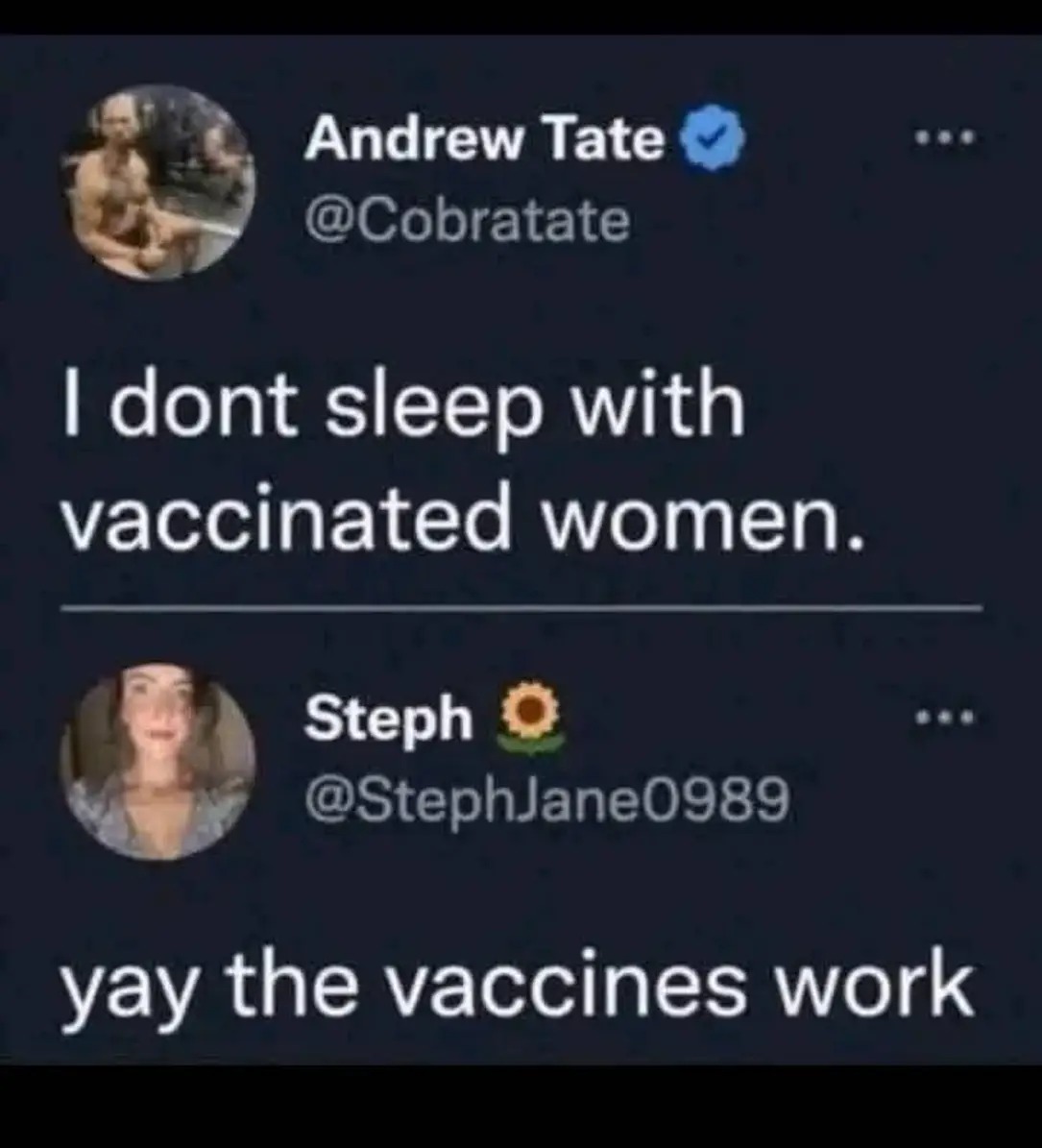
The meme consists of two Twitter posts displayed as screenshots. The top post is from Andrew Tate, a controversial internet personality known for highly conservative, misogynistic, and often conspiratorial views. It reads: "I dont sleep with vaccinated women." This is accompanied by his profile picture, showing him shirtless. The bottom post is from a user named Steph (@StephJane0989) with a profile picture showing a woman. Her response is: "yay the vaccines work."
The humor (and the strength of the meme) resides in the complete inversion of Tate’s intention. His statement is clearly meant to be a statement of 'purity' and control, intended to align with anti-vaccine sentiment and to reinforce his perceived status. Steph’s response cleverly turns his statement into tacit approval of vaccine efficacy, suggesting the vaccines’ effectiveness is so high that he finds vaccinated women undesirable.
Foucauldian Genealogical Discourse Analysis
This meme demonstrates a battle within a discursive field concerning health, sexuality, and power. Foucault’s genealogical method would trace the historical construction of “health,” “immunity,” and “purity.”
- Biopower: The vaccine debate is fundamentally about biopower – the ways in which modern states seek to regulate and control the population’s biological life. Tate attempts to exercise a form of localized biopower over potential partners, attempting to enforce a 'purity' standard based on his anti-vaccine beliefs.
- Discursive Struggle: The meme highlights a struggle over dominant discourses. Tate attempts to impose a discourse framing vaccination as a sign of 'contamination' or moral failing. Steph's reply subverts this discourse, reframing the very effectiveness of the vaccine (a desired outcome of biopower’s health initiatives) as the reason for Tate’s rejection.
- Genealogy of Purity: The meme plays on long-standing discourses around bodily purity and contamination, often intertwined with anxieties about reproduction and societal decay. Tate's statement taps into these anxieties, presenting vaccination as a form of pollution.
Critical Theory
From a Critical Theory perspective (particularly drawing on the Frankfurt School), this meme reveals the operation of ideology and the reproduction of power dynamics.
- Instrumental Reason: Tate’s statement exemplifies the dangers of instrumental reason – prioritizing a single, narrow goal (avoiding vaccinated women) over broader considerations of public health, social responsibility, and empathy.
- Culture Industry: Tate is a product of the “culture industry,” producing and disseminating content that reinforces pre-existing power structures and anxieties. His views normalize misogyny and anti-scientific thinking.
- False Consciousness: The meme’s effectiveness lies in exposing the absurdity of Tate’s position and potentially disrupting the ‘false consciousness’ of those who might be susceptible to his ideology. Steph’s reply forces viewers to confront the irrationality inherent in his claim.
Marxist Conflict Theory
While not directly about economic class, Marxist Conflict Theory can be applied to understand the underlying power dynamics at play.
- Ideological Struggle: The vaccine debate, as portrayed in this meme, is a form of ideological struggle. Different groups are vying to impose their worldview on others. Tate's view aligns with a broader rejection of scientific authority and institutional power, which can be seen as a manifestation of resistance to established social order (though a deeply reactionary one).
- False Needs: The idea that one needs to avoid vaccinated people is a “false need” created by ideology. This distracts from addressing systemic issues that cause vulnerability (like lack of access to healthcare) and instead focuses on individual choices based on misinformation.
- Hegemony: Steph's reply challenges the hegemonic power of anti-vax narratives by undermining the logic of a prominent figure promoting them.
Postmodernism
A postmodern reading highlights the deconstruction of meaning and the instability of truth claims.
- Simulacra and Simulation: Tate’s entire persona is a manufactured “simulacrum” – a copy without an original. His stance on vaccines is likely more about cultivating a controversial brand than genuine belief.
- Meta-Narratives: The meme challenges the grand narratives of “health” and “purity” by revealing their constructed nature. Vaccination is not inherently “good” or “bad,” but rather a practice embedded in a complex web of social, political, and scientific forces.
- Irony and Parody: The meme relies heavily on irony and parody. Steph’s response deliberately misinterprets Tate’s statement, exposing the absurdity of his worldview.
Queer Feminist Intersectional Analysis
This analysis acknowledges the intersection of gender, sexuality, and social power as central to understanding the meme.
- Misogyny & Control: Tate’s statement is deeply misogynistic, exercising control over women’s bodies and reproductive choices. It reinforces the idea that women's value is tied to their perceived "purity" and adherence to his standards.
- Bodily Autonomy: The vaccine debate itself is deeply connected to questions of bodily autonomy. The meme flips the script, suggesting that the efficacy of vaccination is precisely what makes women less desirable to Tate, subtly defending the right to choose.
- Challenging Heteronormativity: While not explicit, the meme implicitly challenges heteronormative expectations. Tate's limited view of sexuality (dictating who is "worthy" of his attention) is exposed as absurd and restrictive.
- Intersection of Health & Gender: Women often face greater scrutiny regarding their health choices and are more likely to be subjected to harmful misinformation. Tate’s statement preys on these existing vulnerabilities.
In conclusion, the meme is a potent example of how online culture can be used to deconstruct harmful ideologies and expose the contradictions within them. Its effectiveness lies in its clever inversion of logic and its skillful deployment of irony, making it a powerful piece of "Anti-Anti-vaxx" propaganda within the context of social media discourse.
simple-description (llama3.2-vision_11b)
This meme is a screenshot of a Twitter conversation between Andrew Tate and a user named @StefanBlom. The user claims that Andrew Tate doesn't sleep with vaccinated women, and Andrew Tate responds with a sarcastic comment, implying that he does sleep with vaccinated women. The user's comment is likely a joke, and the meme is meant to be humorous.