First Seen
2024-12-03T21:08:52.918796+00:00
detailed-analysis (gemma3_27b-it-q8_0)
Okay, let's break down this meme from an Anti-Anti-Union perspective, employing the requested theoretical frameworks where applicable. This meme is demonstrably part of a pro-union push, mocking employer anti-union messaging.
Visual Description
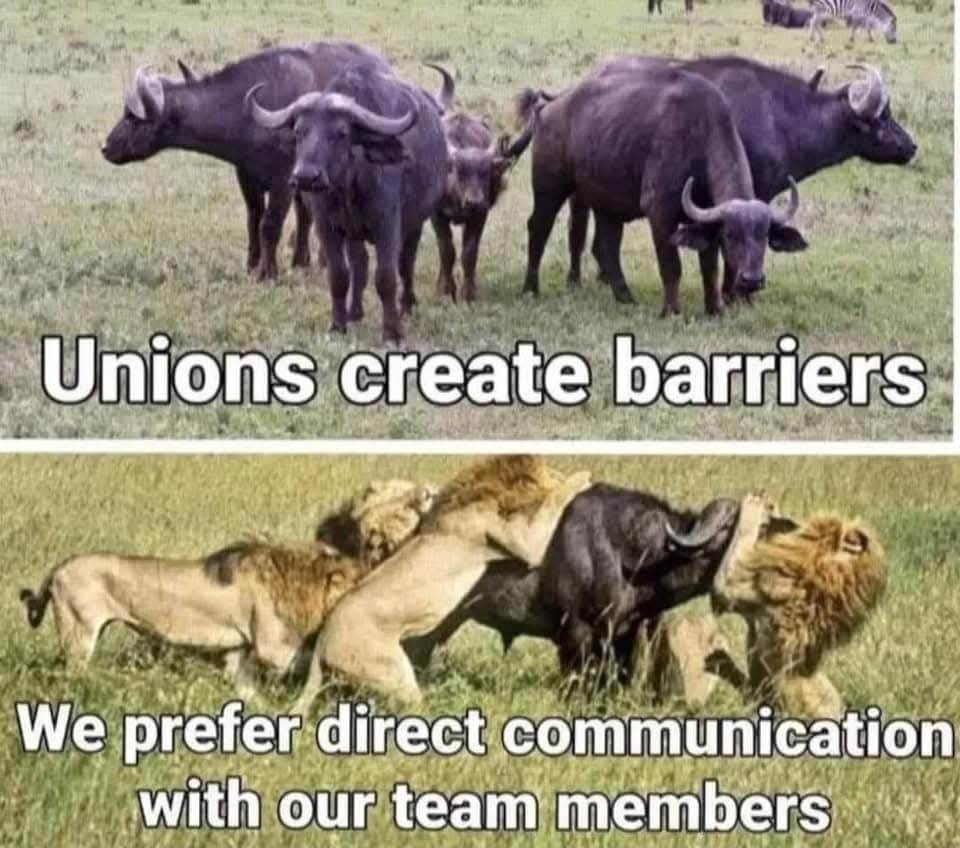
The meme is a two-panel comparison. The top panel shows a herd of buffalo (or wildebeest) moving together in a relatively peaceful, coordinated manner. The text above reads: "Unions create barriers." The bottom panel shows lions actively attacking a buffalo. The text states: “We prefer direct communication with our team members.” The implication is that the "direct communication" preferred by management is predatory and violent, and not the smooth and organic coordination the unions support.
The imagery plays on animal metaphors: buffalo representing workers collectively, and lions representing management/capital. It is a pointed reversal of typical anti-union narratives.
Marxist Conflict Theory
This meme is heavily rooted in Marxist conflict theory. The fundamental premise of this theory is that society is characterized by class struggle—in this case, between the bourgeoisie (management/owners, represented by the lions) and the proletariat (workers, represented by the buffalo).
- Exploitation: The lions' attack embodies the exploitative relationship inherent in capitalism. The “direct communication” isn’t about collaboration; it's about dominating and extracting value from the workers. The lions don’t ask for a share of the buffalo’s resources, they take them by force.
- False Consciousness: The top panel and the text "Unions create barriers" speak to a common employer tactic of portraying unions as unnecessary intermediaries. Marxist theory argues this is a deliberate attempt to maintain “false consciousness,” preventing workers from recognizing their collective interests and their true class position. By removing the "barrier" (the union), management asserts it can directly access and control the workforce.
- Collective Action: The buffalo herd represents the power of collective action. Their coordinated movement implies strength in numbers and mutual support. The union is a barrier, but a protective one, shielding workers from the predatory behaviors of capital. It highlights how unions create solidarity, not barriers to positive employer/employee relations.
- Alienation: The attack signifies the alienation of labor under capitalism. Workers are not treated as equals or valued contributors but as resources to be consumed.
Foucauldian Genealogical Discourse Analysis
Michel Foucault’s work examines how power operates not just through repression, but through discourse—the ways we talk about things, the language we use, and the knowledge systems it creates.
- Power/Knowledge: The meme deconstructs the power/knowledge relationship surrounding unions. Management attempts to define unions as "creating barriers" to exert control over the narrative. This definition is presented as objective truth, masking the inherent power dynamic. The meme challenges this definition by showing what "direct communication" actually looks like: predation.
- Discursive Shift: The meme aims to disrupt the dominant discourse around unions. Instead of accepting the claim that unions are obstructive, it re-frames the situation. It exposes the violent undercurrent beneath the seemingly innocuous language of “direct communication.”
- Genealogy: Looking at the history of anti-union rhetoric (the “genealogy” of the discourse) reveals a consistent attempt to demonize unions as outside forces interfering in a natural, harmonious relationship between employer and employee. This meme unearths that narrative and shows the underlying reality.
Critical Theory
Critical Theory, broadly, examines how societal structures perpetuate inequality and domination.
- Ideology Critique: The meme is an example of ideology critique—exposing the hidden assumptions and power dynamics embedded in seemingly neutral statements. “Direct communication” sounds positive, but the imagery reveals its underlying intention to control and exploit.
- Emancipation: Critical Theory strives for emancipation (liberation). By exposing the predatory nature of unchecked managerial power, the meme implicitly advocates for worker empowerment through unionization.
- Reason and Domination: The idea of "direct communication" can be seen as an appeal to "rationality" and efficiency. However, Critical Theory points out that reason can often be a tool of domination, used to justify exploitation and control. The meme challenges this notion by showing the irrationality and violence inherent in the "rational" pursuit of maximizing profits.
Postmodernism
While not the primary lens, a postmodern reading can be applied.
- Deconstruction: The meme deconstructs the binary opposition of “union vs. direct communication.” It doesn’t accept the framing that these are equally valid options. Instead, it reveals that “direct communication” is a mask for an exploitative power relationship.
- Meta-Narratives: The meme rejects the meta-narrative of "harmonious employer-employee relations." It challenges the idea that management's interests are naturally aligned with those of the workers. It exposes the constructed nature of this narrative.
Queer Feminist Intersectional Analysis
While the meme itself doesn't explicitly engage with these themes, they can be brought in to enrich the analysis:
- Power Dynamics: The lion/buffalo dynamic can be viewed as mirroring patriarchal and colonial power structures. The lions, as dominant apex predators, represent those in power, while the buffalo symbolize marginalized groups.
- Intersectional Exploitation: Workers who are already marginalized based on race, gender, or other identities are likely to experience the “predatory communication” depicted in the meme even more acutely. A union can offer a crucial layer of protection against these compounded forms of exploitation.
- Challenging Hierarchies: The meme challenges the hierarchical structure of the workplace and calls for a more egalitarian relationship between employers and employees, aligning with feminist goals of dismantling patriarchal structures.
In conclusion, this meme is a potent piece of anti-anti-union propaganda. It skillfully uses visual metaphor and theoretical concepts to expose the power dynamics inherent in the employer-employee relationship, and to argue that unions are a necessary safeguard against exploitation and control. It’s a direct attempt to flip the anti-union narrative on its head and reveal the often-brutal reality behind the facade of “direct communication.”
simple-description (llama3.2-vision_11b)
The meme is a humorous commentary on the perceived divide between labor unions and anti-union groups, often referred to as "anti-union" or "union-busting" organizations. The image juxtaposes two contrasting scenarios, with the top image featuring a group of wild buffalo (representing unionized workers) standing together against a common threat, while the bottom image shows a group of lions (representing anti-union groups) attacking and scattering the buffalo, implying that anti-union groups are more aggressive and threatening to the collective interests of workers.
The text "Unions create barriers" is a common anti-union slogan, implying that unions are somehow limiting or restrictive, while the text "We prefer direct communication with our team members" is a tongue-in-cheek response, implying that anti-union groups are more interested in "direct" communication with their "team members" (i.e., workers) rather than actually engaging with them as a collective unit.
detailed-analysis (gemma3-27b-vision)
Okay, let's break down this image meme using the lenses you've requested. It’s a fairly charged image with clear ideological undertones, so there's a lot to unpack.
Visual Description
The image is a split meme, presented as a "before & after" comparison.
- Top Panel: Depicts a herd of African buffalo standing together in a field. They are huddled relatively close, forming a visual block.
- Bottom Panel: Shows a group of lions aggressively attacking a lone buffalo. The lions are surrounding and physically dominating the buffalo.
- Text: "Unions create barriers" appears above the buffalo image, while "We prefer direct communication with our team members" is placed above the lion/buffalo image. The implication is that unions (represented by the buffalo herd) impede direct interaction, while a predatory, hierarchical structure (lions attacking a buffalo) is presented as a positive alternative.
Foucauldian Genealogical Discourse Analysis
This image meme is rich with the deployment of power/knowledge dynamics, central to Foucault’s work.
- Discourse: The meme establishes a discourse around labor relations and communication styles. It positions "unions" as inherently obstructive and "direct communication" as optimal. This framing is not neutral; it constructs these concepts in specific ways.
- Power/Knowledge: The image relies on pre-existing understandings of buffalo and lions. Lions are culturally positioned as strong, assertive leaders, and predators, while buffalo are seen as herd animals, possibly slow, and potentially lacking individual agency. This established "knowledge" reinforces a power dynamic that favors top-down, hierarchical control (lions). The image performs power by visually associating unions with a lack of agency and "barriers", and direct communication with dominance and control.
- Genealogy: A genealogical analysis would trace how these associations – lions with leadership, buffalo with collective identity – have developed historically. How did these animals become symbolic of these concepts in the context of labor relations? The meme isn't about literal animals; it's about the historical construction of these symbolic meanings.
- Disciplinary Power: The meme promotes the idea that direct communication (and thus the absence of union representation) leads to a more efficient and productive team. This promotes a form of disciplinary power where individuals are expected to operate under the direct control of management, with no buffer or collective negotiation.
Critical Theory
The meme’s message can be dissected through the lens of Critical Theory.
- Ideology: The meme is a clear example of ideological work. It presents a specific vision of how labor relations should be, masking its own inherent bias. It frames unions as a problem, rather than analyzing the conditions that create the need for unions in the first place (e.g., exploitation, unfair wages, unsafe working conditions).
- Domination/Emancipation: The image implicitly endorses a model of domination, where "direct communication" is a euphemism for unchecked authority. It actively prevents the possibility of emancipation, or worker empowerment, by suggesting that collective bargaining is a hindrance, and reinforcing an unequal power dynamic.
- Rationalization: The promotion of "direct communication" as efficient and logical aligns with Max Weber’s concept of rationalization. It presents a seemingly neutral, objective preference, obscuring the political implications of suppressing collective organization.
- False Consciousness: The meme encourages a false consciousness among those who might believe that direct communication is the ideal scenario. It ignores how direct communication can be a tool for managers to exert control and silence dissent.
Marxist Conflict Theory
From a Marxist perspective, the meme is a clear articulation of class interests.
- Class Struggle: The meme explicitly positions unions (representing the working class) as obstacles to the interests of those in power (implied by “we” – management). It depicts a struggle between the collective power of workers and the individual/small-group power of management.
- Exploitation: By demonizing unions, the meme implicitly defends the conditions that lead to worker exploitation. Unions exist, in part, to protect workers from unfair practices and to ensure fair compensation.
- Hegemony: The meme attempts to establish hegemony – the dominance of a particular worldview – by framing unions as a negative force. It encourages viewers to accept the notion that direct communication is superior, even if it comes at the expense of worker rights.
- Alienation: The meme subtly reinforces the alienation of labor. By promoting a hierarchical structure (lions/buffalo), it implies that individual workers are subordinate to the will of management, rather than being valued as collaborative partners.
Postmodernism
While not the most obvious lens, postmodern thought can offer some insights.
- Deconstruction: One could deconstruct the image by challenging the binary opposition it establishes: unions vs. direct communication. Are these truly mutually exclusive concepts? Can direct communication exist within a unionized environment?
- Simulacra and Simulation: The image operates as a simulation of reality. It presents a romanticized, simplified view of labor relations. The "lions" and "buffalo" are stand-ins for complex social realities.
- Rejection of Grand Narratives: The meme implicitly defends a "grand narrative" of efficiency and control. It asserts that a specific organizational structure is inherently superior, dismissing alternative models.
- Power of Representation: The image highlights the power of representation. The choice of animals is not arbitrary; it carries symbolic weight and reinforces existing power dynamics.
Queer Feminist Intersectional Analysis
This lens is particularly potent in uncovering subtle yet significant power imbalances.
- Intersectionality: The meme doesn’t explicitly address intersectionality, but it’s important to note that the power dynamics it reinforces (hierarchical control, suppression of collective action) are likely to disproportionately impact marginalized workers (e.g., women, people of color, LGBTQ+ individuals).
- Power and Control: The imagery of predatory lions dominating a buffalo resonates with patterns of gender-based violence and control. The metaphor reinforces the idea that dominance and aggression are acceptable forms of leadership.
- Challenging Hierarchies: Queer and feminist thought emphasize the need to dismantle hierarchies and create more egalitarian structures. This meme actively defends a hierarchical model.
- Collective Care and Solidarity: Unions historically serve as spaces for collective care and solidarity, especially for marginalized workers. The meme demonizes this function, implying that collective action is undesirable.
In conclusion, this meme is a carefully constructed piece of propaganda that reinforces existing power structures and suppresses worker agency. Each of these theoretical lenses offers a different, but complementary, perspective on the image's underlying ideology and implications.
simple-description (llama3.2-vision)
This meme is a humorous comparison between the strength and effectiveness of two types of organizations: unions and teams. The top image shows a single, powerful buffalo, implying that a union can be a strong and effective force. The bottom image shows a group of lions, but instead of attacking, they are all just sitting on the buffalo, implying that a team can be just as effective, but in a more relaxed and collaborative way. The text "Unions create barriers" and "We prefer direct communication with our team members" is used to contrast the two approaches.