First Seen
2025-06-26T01:57:45.132555+00:00
detailed-analysis (gemma3_27b-it-q8_0)
Okay, let's break down this meme from the perspective of the "Anti-Anti-Marxism" category. This is a fascinating example, ripe for layered analysis. "Anti-Anti-Marxism" generally refers to a position that defends Marxism against its critics, often engaging in ironic or deliberately provocative humor to challenge neoliberal assumptions and highlight class conflict. It frequently manifests online with a playful, meme-centric aesthetic.
Here’s an analysis, structured as requested, focusing on the relevant theoretical lenses. I'll indicate where a section isn't applicable.
Visual Description
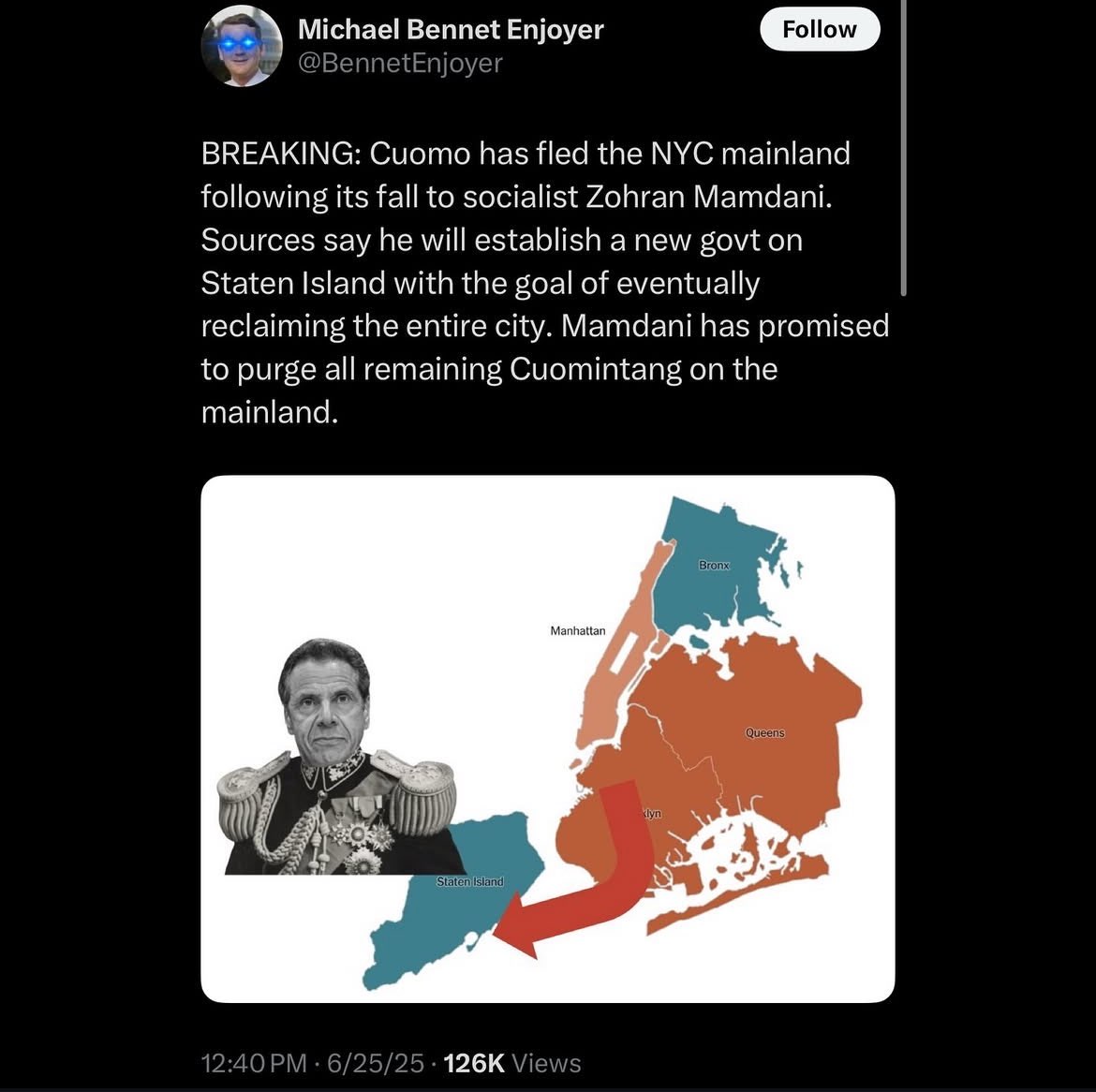
The image features a map of New York City, with the boroughs colored in red except for Staten Island, which is left uncolored. Staten Island is highlighted as an enclave. A picture of former New York Governor Andrew Cuomo, wearing what appears to be a military uniform and a regal-looking hat, is superimposed on the left side of the image. The tweet's text states that Cuomo has “fled” to Staten Island to establish a new government after a hypothetical takeover by “Zohran Mamdani,” identified as a socialist, with promises to “purge all remaining Cuomintang on the mainland.” (Cuomintang is a historical Chinese nationalist party, and the use is clearly ironic.) The post has a timestamp and a significant number of views.
Marxist Conflict Theory
This is the primary theoretical framework at play here, and arguably the driving force behind the meme's creation.
- Class Struggle: The entire premise hinges on a narrative of class conflict. Zohran Mamdani, framed as a socialist, represents the forces of a potential worker/popular uprising. Andrew Cuomo (a symbol of the Democratic establishment and, ultimately, capitalist interests) represents the overthrown regime. The "purge" of the "Cuomintang" (a deliberately absurd reference) is a stand-in for the elimination of counter-revolutionary forces.
- Historical Materialism: The framing subtly suggests a historical progression – a move towards a socialist state replacing a capitalist one. The map visually represents this: the red (associated with socialism) consuming the city, with Staten Island as the last bastion of the old order.
- State Apparatus & Revolution: The meme toys with the idea of a revolution and the establishment of a new state. Mamdani’s actions are presented as the establishment of a new state apparatus.
- Ironic Deployment: The Anti-Anti-Marxist element is crucial. The absurdity of Cuomo, a thoroughly conventional politician, cast as a counter-revolutionary figure is key. It's not a literal call for revolution; it's a satirical exaggeration meant to point out the inherent contradictions of capitalist power structures and the perceived hypocrisy of the Democratic Party. The over-the-top framing of a "purge" mocks the hyperbolic rhetoric used by right-wing critics of socialism.
Foucauldian Genealogical Discourse Analysis
This meme engages with power dynamics through discourse, and Foucault provides a lens to examine how these dynamics operate.
- Power/Knowledge: The meme constructs a specific narrative that defines "socialism" and "counter-revolution." It positions Mamdani’s actions as legitimate (from the meme’s perspective) and Cuomo's as reactionary. This is a struggle over defining these concepts and their associated meanings. The meme utilizes the historical context of Mamdani being a democratic socialist, but exaggerates it.
- Discursive Formation: The tweet creates a new “discursive formation” – a way of talking about New York politics, framing it as a revolutionary situation. The use of terms like "purge" and "Cuomintang" deliberately disrupt established political discourse.
- Genealogy of “Cuomintang”: The ironic appropriation of “Cuomintang” is a prime example of genealogical investigation. It’s not about historical accuracy; it’s about disrupting the expected associations and exposing the underlying power dynamics. It implies that Cuomo's allies are clinging to an outdated, authoritarian ideology.
Postmodernism
Elements of postmodernism are at play, particularly in the use of irony and the blurring of reality and fiction.
- Hyperreality: The meme creates a hyperreal scenario – a simulation of political struggle that exaggerates and distorts real events. It's not meant to be taken literally, but it feels “real” in the context of online political discourse.
- Deconstruction: It deconstructs the image of Andrew Cuomo. He’s presented not as a conventional politician, but as a deposed leader clinging to power, almost a caricature. The meme challenges the dominant narratives around him.
- Intertextuality: The reference to the Cuomintang is a clear example of intertextuality, drawing on a historical context to create a new meaning within the meme.
Critical Theory
Critical Theory can help us understand the meme’s underlying critique of power structures.
- Ideology Critique: The meme is a form of ideology critique. It challenges the dominant neoliberal ideology by suggesting that the current political order is vulnerable to challenge and that alternative systems (like socialism) are possible.
- Cultural Hegemony: The meme implies that the cultural hegemony of capitalist ideology is breaking down, opening up space for alternative ideologies to emerge.
Queer Feminist Intersectional Analysis
This theoretical lens is not directly applicable to the meme’s core content. While it’s possible to read into the meme’s implications for marginalized groups (e.g., how a socialist government might address issues of inequality), these interpretations aren’t inherent in the meme itself. It doesn't address gender, sexuality, or intersectionality directly.
In Summary:
This meme operates within the “Anti-Anti-Marxism” sphere by employing satire, irony, and a deliberately provocative narrative to critique capitalist power structures and the political establishment. It utilizes Marxist conflict theory as its core framework, while also drawing on Foucauldian discourse analysis and postmodern techniques to deconstruct political narratives and challenge dominant ideologies. It is a deliberately absurd and provocative piece of online political commentary, intended to stimulate discussion and challenge conventional thinking.
Disclaimer: This analysis is based on the assumption of the context provided ("Anti-Anti-Marxism"). Interpretations can vary depending on individual perspectives and broader political understanding.
simple-description (llama3.2-vision_11b)
The meme is a satirical image that compares the current situation in New York City to a hypothetical scenario where President Biden's administration is replaced by a socialist government. The meme uses a quote from a 2023 article to highlight the absurdity of such a scenario.
detailed-analysis (gemma3-27b-vision)
Okay, let's break down this image/tweet with the requested theoretical lenses. It's a complex and rather loaded piece of online content, so we'll need to go into some detail.
Please note: This is an interpretive analysis, and others might arrive at different conclusions. The content is also fictional (based on the names mentioned), adding layers of complexity.
---
Visual Description
The image is a digitally constructed graphic depicting a map of New York City, specifically the five boroughs. Staten Island is highlighted in red, with a photo of Andrew Cuomo superimposed onto the red area. The remaining boroughs (Manhattan, Brooklyn, Queens, and the Bronx) are colored in what looks like a muted grey-brown hue. The map uses a simplified, almost cartoonish style, with clear labeling of the boroughs. The overall aesthetic is stark and symbolic, particularly the juxtaposition of the red Staten Island with the "rest" of the city. The time stamp on the tweet indicates the content was posted on June 25, 2023. The Tweet is also reported to have 126k views.
---
Foucauldian Genealogical Discourse Analysis
This tweet/image is a powerful example of how discourses construct reality and exert power. We can analyze it through a Foucauldian lens by examining the discourses at play and how they shape understandings of power, governance, and the city itself.
- Discourse of Governance & "The Fallen": The language ("fled," "establish a new govt," "purge") immediately evokes discourses of political crisis, rebellion, and authoritarianism. Cuomo, portrayed as "fallen," represents a previous order that is being challenged. The narrative establishes a binary of "us" (the new government on Staten Island) vs. "them" (the “Cuomintang” on the mainland). This constructs an “other” that is seen as an enemy that needs to be purged.
- Discourse of Spatiality & Control: The highlighting of Staten Island isn’t just geographical; it’s a spatial claim to power. It designates Staten Island as the center of the “new” regime and implicitly positions the rest of the city as territory to be reclaimed. This is a powerful act of spatial governance – the attempt to control and define space to reinforce power dynamics.
- Genealogical Tracing: A genealogical approach would look for the historical roots of these discourses. For instance, the term "Cuomintang" intentionally invokes the Chinese Nationalist Party, layering a complex historical association onto a seemingly local political conflict. This use of historical reference serves to construct an enemy, and associate them with authoritarianism.
- Power/Knowledge: Foucault argued that power and knowledge are inseparable. This tweet/image produces knowledge about a political situation (even if fictional) and, in doing so, exercises power by shaping perceptions and potentially mobilizing action. It creates a narrative that demands a response.
---
Critical Theory
From a Critical Theory perspective, this tweet is a representation of power dynamics and social control. It can be viewed through several key CRITICAL THEORY LENSES:
- Hegemony: The tweet operates as an attempt to establish a counter-hegemony. The "new govt" on Staten Island is presented as a challenge to the established order, attempting to redefine what constitutes legitimate political power. The invocation of “Cuomintang” could be seen as an attempt to frame any opposition as inherently authoritarian.
- Ideology: The language used isn't neutral. Terms like "purge" and "reclaim" carry strong ideological weight, framing the conflict as a necessary and justifiable struggle. The framing encourages the viewer to accept the legitimacy of the new government’s actions.
- The Culture Industry: The tweet/image itself is a product of the contemporary culture industry (social media). This suggests that political narratives are increasingly constructed and disseminated through mediated channels, which can be manipulated and used for various purposes.
- Emancipatory Potential: From a critical perspective, the tweet can also be interpreted as representing a desire for social change and resistance against existing power structures. The “new govt.” could be seen as a manifestation of a grassroots movement aiming to challenge the status quo.
---
Marxist Conflict Theory
A Marxist reading of this image emphasizes the inherent conflict between social classes and the struggle for control of resources and power.
- Class Struggle: The tweet can be interpreted as a symbolic representation of class conflict. The “new govt.” on Staten Island might be seen as representing a marginalized group or a new class seeking to overthrow the established order. The “Cuomintang” on the mainland could represent the ruling class or the existing power structure.
- Revolution & Counter-Revolution: The narrative of “reclaiming” the city suggests a revolutionary struggle – a conflict between opposing forces vying for control of the means of governance and the territory itself. The “purge” is a classic element of revolutionary violence – the elimination of opposing forces.
- Control of the Means of Communication: The tweet/image itself is a form of communication used to mobilize support for the “new govt.” In Marxist terms, this represents a struggle for control of the means of communication – the ability to shape public opinion and legitimize one’s own power.
- Material Conditions: It’s important to note that, in a Marxist analysis, the underlying material conditions (economic inequalities, social injustices, etc.) that drive the conflict are often absent or obscured in the image. The image focuses on the political struggle, without fully acknowledging the deeper economic factors at play.
---
Postmodernism
A postmodern reading highlights the instability of meaning, the fragmentation of reality, and the deconstruction of grand narratives.
- Simulacra & Simulation: The tweet/image can be seen as a simulacrum – a copy without an original. It's a fabricated political narrative that exists primarily as a digital construct, detached from any concrete reality. The use of the term “Cuomintang” and a fictionalized event contributes to this sense of unreality.
- Deconstruction of Power: The narrative challenges traditional notions of power and governance. By presenting a “new govt.” emerging from a marginalized borough (Staten Island), it disrupts the established hierarchy and questions the legitimacy of the existing power structure.
- Fragmentation of Reality: The image presents a fragmented and chaotic vision of the city, divided between the “new govt.” and the “Cuomintang.” This reflects a postmodern sensibility that rejects grand narratives and embraces complexity and ambiguity.
- Intertextuality: The use of the term “Cuomintang” (referencing the Chinese Nationalist Party) is an example of intertextuality – the referencing of other texts and cultural references to create new meanings.
---
Queer Feminist Intersectional Analysis
While not immediately central to the image's initial presentation, a Queer Feminist Intersectional reading can reveal layers of meaning related to power, identity, and exclusion.
- Spatial Politics of Exclusion: The highlighting of Staten Island (historically a conservative and largely white borough) as the center of the “new govt.” raises questions about spatial politics and exclusion. It suggests that this “new govt.” may be exclusionary in its own right, potentially marginalizing or excluding communities of color, LGBTQ+ individuals, or other marginalized groups.
- Deconstruction of Traditional Authority: The emergence of a “new govt.” from an unexpected location challenges traditional notions of authority and leadership. This can be seen as a potentially empowering act that disrupts patriarchal and heteronormative power structures.
- Intersectional Power Dynamics: The conflict between the “new govt.” and the “Cuomintang” could be interpreted as a manifestation of intersectional power dynamics – the ways in which different forms of oppression (e.g., racism, sexism, classism) intersect and reinforce one another.
- Challenging Dominant Narratives: By presenting an alternative political narrative, the tweet/image challenges dominant narratives about power, governance, and identity. This can be seen as a potentially transformative act that opens up space for marginalized voices and perspectives.
---
Important Disclaimer: This analysis is based on interpretation, and other readings are possible. The fictional nature of the content adds complexity. The intent is to demonstrate how different theoretical lenses can be applied to a single piece of media to reveal multiple layers of meaning.
simple-description (llama3.2-vision)
This meme is a satirical commentary on the New York City (NYC) mainland's alleged flight to Staten Island, a New York City borough. The image features a photo of New York City Mayor Eric Adams, who is often referred to as "Cuomintang" in a play on words, referencing former New York Governor Andrew Cuomo. The meme implies that the entire NYC population is abandoning the mainland to escape the perceived social and economic challenges of living in New York City. The text above the image reads: "BREAKING: Cuomo has fled the NYC mainland following its fall to socialist Zohran Mamdani. Sources say he will establish a new government on Staten Island with the goal of eventually reclaiming the entire city. Mamdani has promised to purge all remaining Cuomintang on the mainland." The image also features a map of New York City with a red arrow pointing to Staten Island, which is labeled as the new "Cuomintang" government. The image is meant to be humorous and satirical, rather than taken seriously.