First Seen
2025-10-17T19:03:47.252665+00:00
simple-description (qwen3.5_2b-q8_0)
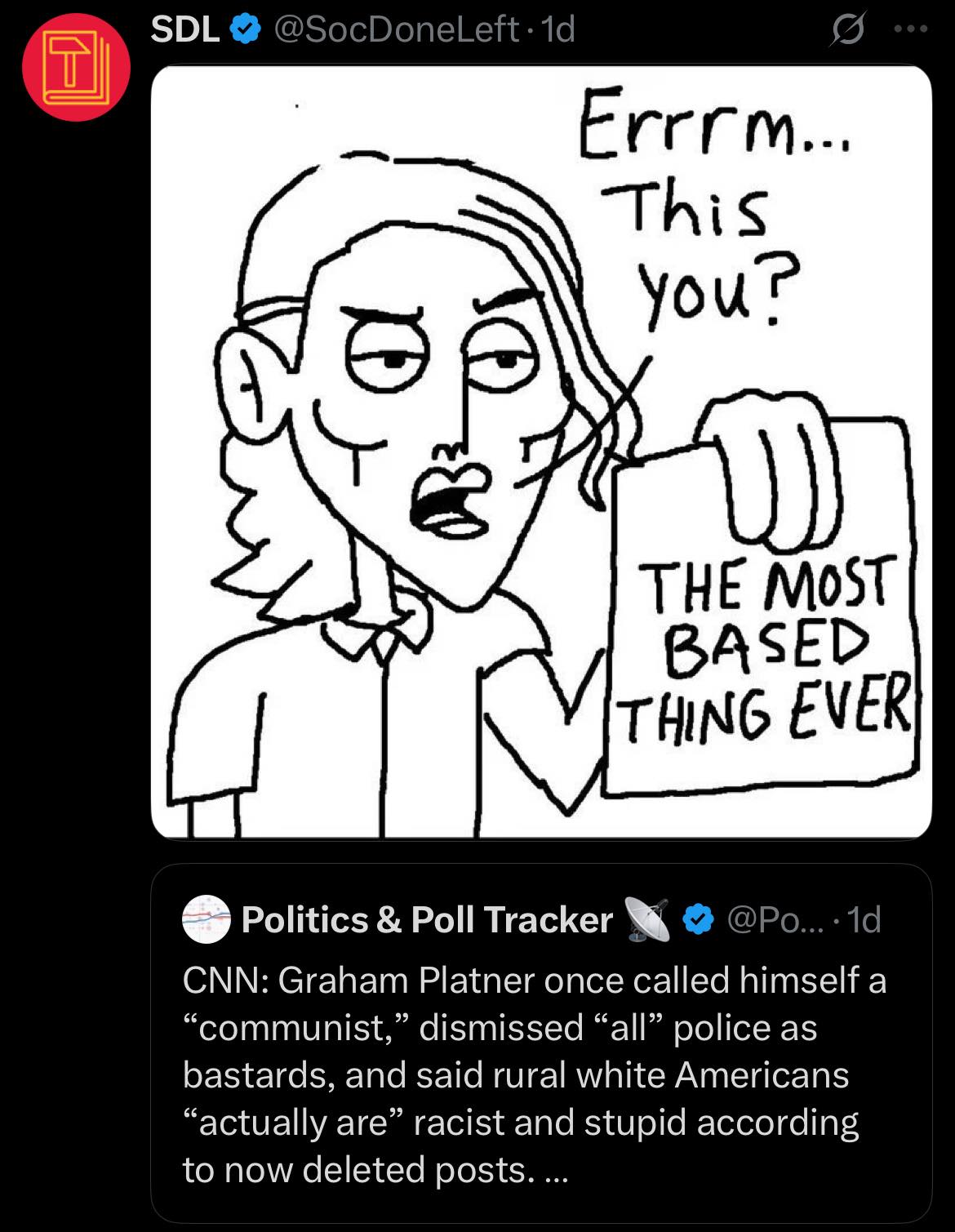
This cartoon shows a confused character holding up a sign that reads "THE MOST BASED THING EVER" while asking, "Errrrm... This you?" In the context of anti-anti-Marxism (which often mocks conspiracy theories and hidden agendas), this is a satire on how easily we accept false claims. It implies that whatever claim is being made—even if it's an absurd sign—has nothing to do with actual reality or truth, suggesting that such labels are inherently delusional. The character's bewildered look highlights that holding up a sign for a "base" concept doesn't make it more authentic than the rest of the world.
detailed-analysis (gemma3_27b-it-q8_0)
Okay, let's break down this meme through the lens of "Anti-Anti-Marxism," applying relevant theoretical frameworks where appropriate. This is a complex meme, so the analysis will be detailed.
Understanding the Core: Anti-Anti-Marxism
Before diving in, it's crucial to understand "Anti-Anti-Marxism." This isn’t necessarily a staunch endorsement of classic Marxism. Instead, it’s a reaction against the widespread, often superficial, rejection of Marxist thought. It criticizes the tendency to dismiss Marxism out of hand, often without engaging with its complex ideas. Those aligning with this view often aim to rehabilitate aspects of Marxist thought, update them for modern contexts, and challenge liberal and conservative critiques. They often see the critique of Marxism as serving to protect existing power structures.
1. Visual Description
The image is a simple black and white cartoon drawing of a person with exaggerated, stereotypically “online leftist” features (long hair, slightly disheveled appearance). The figure is speaking, hesitantly ("Errrm...") and appears to be presenting something, gesturing towards the right with their hand. Beside their hand is a box containing the phrase "THE MOST BASED THING EVER."
The overall aesthetic is deliberately amateurish and reminiscent of internet culture, particularly memes. The "Errrm..." suggests nervousness or uncertainty, a common trope in online spaces representing hesitant articulation of controversial opinions.
2. Foucauldian Genealogical Discourse Analysis
Foucault’s work is incredibly relevant here. The meme engages in a form of discourse surrounding "based" as a concept. “Based” originated in internet subcultures (initially on 4chan) as a term of approval for someone who doesn't care about social norms and speaks their mind, even if it's controversial. However, its meaning has been co-opted and shifted. Originally, it wasn’t inherently ideological. Now, especially within the context of online political discourse, it's frequently used by those on the right—and even ironically by those on the left—to signal alignment with conservative or reactionary views.
From a Foucauldian perspective, this meme deconstructs the power/knowledge relation surrounding “based.” It satirizes the way the term has become a marker of identity within online political spheres. The nervous “Errrm…” can be read as questioning the unquestioning adoption of the "based" label, hinting at a concern that it has become a form of self-identification rather than a genuine expression of conviction. The meme challenges the assumption of “based” as inherently positive, suggesting it can be a form of conformity within specific online circles.
The framing of "THE MOST BASED THING EVER" as a potentially awkward presentation implicates the very act of seeking validation through this label. It's a critique of the performance of political identity.
3. Marxist Conflict Theory
This meme operates within the framework of ideological struggle. The text accompanying the meme (“CNN: Graham Platner…”) reveals a conflict between competing ideologies. Platner’s past statements (identifying as a communist, criticizing the police, and questioning the intelligence of rural white Americans) represent a challenge to dominant power structures—a critique of class, authority, and racial hierarchy.
The backlash against Platner, highlighted by CNN’s reporting, exemplifies the ideological defense mechanisms of the status quo. The meme acts as a commentary on this conflict. The presentation of Platner’s views as "THE MOST BASED THING EVER" is ironic, suggesting that genuine leftist or anti-establishment thought is often derided or misrepresented by mainstream media and the dominant ideology. It frames the “based” label as a reductive attempt to dismiss complex political ideas.
From a Marxist perspective, the meme aims to expose the way power operates through discourse, discrediting genuine critique and reinforcing the existing order. The irony is aimed at disrupting the narrative constructed by the media.
4. Postmodernism
The meme employs elements of postmodern irony and self-awareness. The amateurish art style, the deliberate use of internet slang (“based,” “Errrm…”), and the self-referential nature of the meme all point to a postmodern sensibility. It rejects grand narratives and embraces fragmentation and pastiche.
The meme undermines the notion of a singular, coherent truth. It doesn't offer a direct argument but rather questions the way arguments are constructed and presented in the digital age. It reflects a distrust of authority and a skepticism towards easy answers. The nervous tone suggests a deconstruction of the confidence often associated with political pronouncements. It points towards the constructedness of "based," and thus by extension, of political stances.
5. Critical Theory
This meme reflects the critical theory focus on the "culture industry" and the commodification of ideas. The "based" label has become a kind of cultural currency within online spaces, used to signal status and belonging. The meme critiques this process, suggesting that genuine political thought is being reduced to a superficial marker of identity.
The presentation of a controversial viewpoint (“THE MOST BASED THING EVER”) implies a critique of the way media narratives shape public perception. It suggests that complex political issues are often oversimplified and reduced to sound bites or easily digestible slogans. The meme can be seen as a form of resistance against this process of ideological manipulation.
In summary: From the perspective of Anti-Anti-Marxism, this meme isn't just a joke. It's a nuanced critique of online political discourse, the co-option of language, and the attempts to discredit genuine leftist thought. It leverages irony and self-awareness to expose the power dynamics at play in the digital age and challenge the dominant narratives surrounding political identity. The meme is aimed at those already somewhat familiar with the intricacies of these online subcultures, acting as an “inside” joke with a subversive undertone.
Let me know if you’d like me to elaborate on any of these points or explore other potential interpretations.
simple-description (llama3.2-vision_11b)
The meme is a satirical commentary on the tendency of some individuals to present themselves as anti-Marxist or anti-Communist, while actually being proponents of the very ideologies they claim to oppose. The image depicts a person holding a sign that says "I'm not a [insert derogatory term], I'm a [insert opposite of derogatory term]" while the text below reads "I'm actually a [insert derogatory term]". The meme pokes fun at the hypocrisy of some individuals who claim to be anti-Marxist or anti-Communist, but are actually just the opposite.