First Seen
2025-06-27T06:00:59.691423+00:00
detailed-analysis (gemma3_27b-it-q8_0)
Okay, let's break down this meme from the perspective of an "Anti-Anti-Marxism" category. This is a particularly nuanced position, often associated with figures on the more explicitly anti-woke/anti-cultural Marxist right, who see themselves as defending traditional Western values against what they perceive as a neo-Marxist cultural revolution. Here's an analysis, section by section, as requested, focusing on how this meme functions within that ideological context.
Understanding "Anti-Anti-Marxism" – Crucial Context
Before diving in, it's important to clarify this category. "Anti-Anti-Marxism" isn't necessarily pro-Marxism. Instead, it’s a reaction against the perceived overreach of cultural Marxist ideas (identity politics, critical race theory, gender ideology) in Western institutions. It often argues that these ideas are harmful, divisive, and are being used to undermine traditional societal structures. It sees the “anti-Marxists” of the mid-20th century as having won that battle, only for a new “Marxist” threat to emerge through cultural means. They often view the Left as being manipulative, engaging in ideological subversion, and wielding "power" through concepts like "oppression" and "systemic injustice."
---
Visual Description
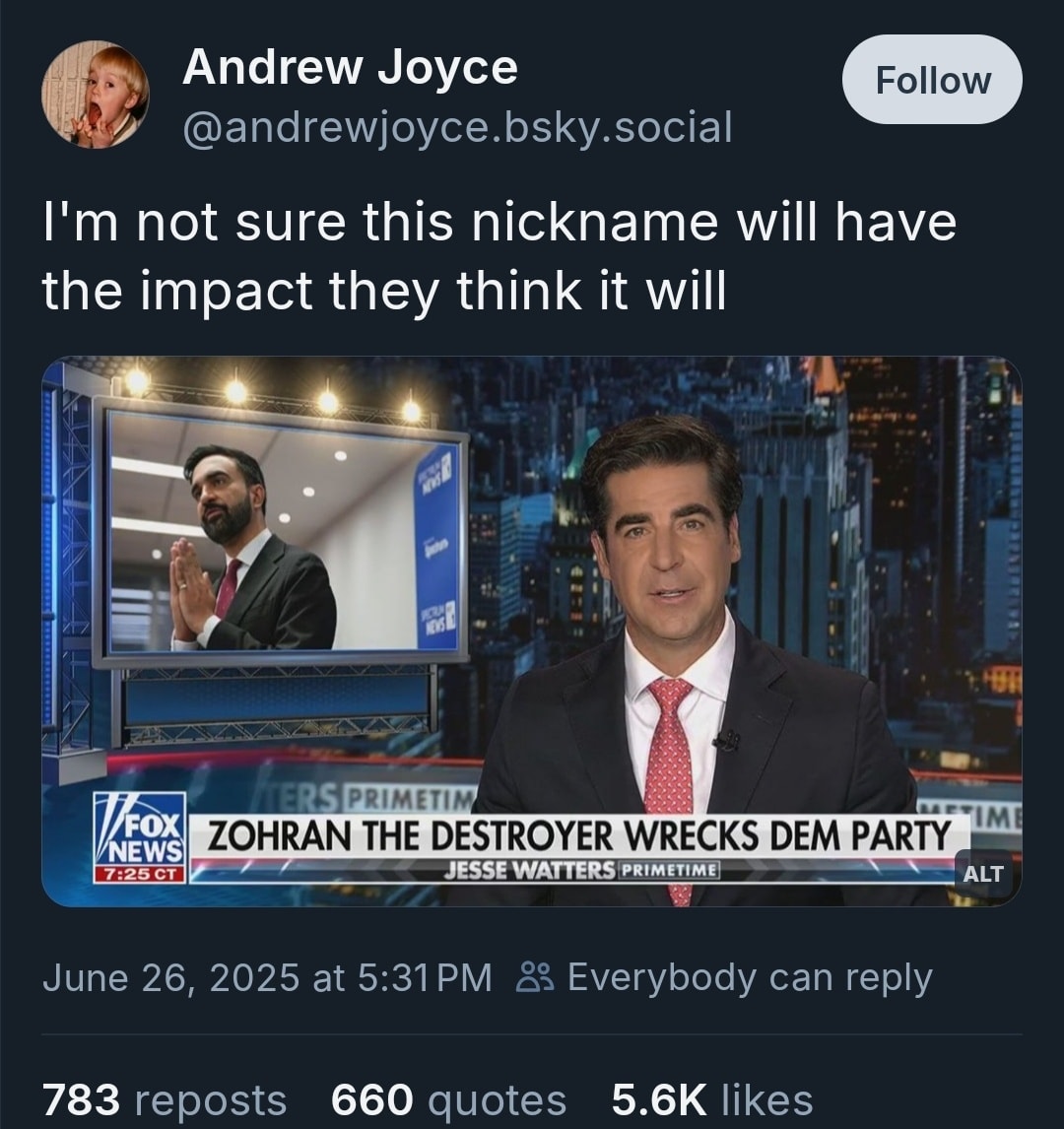
The image is a screen capture of a Fox News broadcast featuring Jesse Watters. A graphic behind Watters reads: "ZOHRAN DESTROYER WRECKS DEM PARTY". The graphic is purposefully styled to look like a sensationalized headline, using bold colors and dramatic font. A separate, smaller screen within the broadcast shows a picture of a man, Zohran Mamdani, who is a Democratic politician. The composition is typical of cable news, emphasizing immediacy and emotional impact. The overall aesthetic contributes to a sense of deliberate provocation and partisan messaging.
---
Foucauldian Genealogical Discourse Analysis
This meme is highly relevant to a Foucauldian analysis. The "Anti-Anti-Marxist" frame sees "Zohran Destroyer" as a constructed power/knowledge relationship. Foucault would argue that this nickname isn't a neutral descriptor; it's an active production of meaning, a way of framing Zohran Mamdani (and by extension, the Democratic Party) within a specific discourse of conflict and threat.
- Genealogy: The "Anti-Anti-Marxist" perspective traces the genealogy of this "destruction" narrative. They believe it's part of a longer historical project—a deliberate attempt to dismantle Western societal norms and replace them with a new ideological order. The language of "wrecking" aligns with the idea of a cultural or societal collapse they are trying to prevent.
- Power/Knowledge: The meme operates within a system of power/knowledge where Fox News (and figures like Watters) have the power to define the terms of the political debate. By labeling Mamdani as a "Destroyer," they attempt to legitimize certain critiques and delegitimize his political positions. This is a clear demonstration of how discourse shapes reality.
- Discipline & Normalization: The act of labeling and demonizing the "other" (Mamdani/Democrats) serves a disciplinary function – attempting to enforce a specific ideological boundary and punish those who transgress it. It subtly reinforces a "normal" (conservative) worldview.
---
Critical Theory
From a Critical Theory perspective (as understood within the "Anti-Anti-Marxism" frame), the meme represents a counter-hegemonic attempt to expose what they see as the "true" agenda of the Left.
- Hegemony: The “Anti-Anti-Marxists” believe the Left has achieved a cultural hegemony, dominating the narrative and controlling the flow of information. The meme is a direct attempt to break this hegemony by offering a counter-narrative—portraying Democrats as destructive forces.
- Ideology Critique: The “Anti-Anti-Marxists” view progressive ideologies (including CRT, DEI, and intersectionality) as tools of oppression. The "Destroyer" label attempts to de-mask these ideologies by exposing their supposedly harmful consequences.
- False Consciousness: They would likely argue that many Americans are suffering from "false consciousness," unaware of the supposed threat posed by the Left. The meme is meant to awaken people to this perceived reality.
---
Marxist Conflict Theory
Interestingly, while "Anti-Anti-Marxism" is against what it perceives as neo-Marxism, Marxist Conflict Theory can still be used to understand how this meme functions.
- Class Struggle (Reinterpreted): The "Anti-Anti-Marxists" reinterpret class struggle. They see the conflict not as primarily between the bourgeoisie and the proletariat, but as a clash between traditional Western values and a new "cultural elite" who are attempting to overthrow the existing order. The Democrats, in this view, are tools of this "cultural elite."
- Superstructure: The meme reflects the Marxist concept of the "superstructure" (culture, media, etc.). They believe Fox News is part of a counter-superstructure that challenges the dominant, Left-leaning ideological apparatus.
- False Consciousness & Ideology: As with Critical Theory, they see progressive ideologies as tools used to manipulate the masses and maintain the power of the "cultural elite.”
---
Postmodernism
While "Anti-Anti-Marxism" often rejects postmodernism (seeing it as undermining objective truth), aspects of postmodern thought can still illuminate the meme.
- Deconstruction: The "Destroyer" label is a form of deconstruction—taking apart the carefully constructed image that Democrats attempt to present.
- Meta-Narratives: "Anti-Anti-Marxists" reject what they see as the Left's “meta-narrative” of systemic oppression. They create their own counter-narrative—the narrative of a cultural war.
- Simulacra and Simulation: The meme itself is a simulacrum—a representation of a representation. It’s not a direct engagement with Zohran Mamdani’s policies, but rather a hyper-stylized, sensationalized image designed to evoke a specific emotional response.
---
Queer Feminist Intersectional Analysis
This is the least applicable lens, but still relevant given the ideological battles it’s responding to.
- Backlash & Reaction: From this perspective, the meme represents a backlash against the gains made by marginalized groups. It's a response to the increasing visibility of queer, feminist, and anti-racist ideas.
- Essentialism: The "Anti-Anti-Marxists" often favor a more essentialist view of identity. They may criticize queer/feminist theories of social construction, arguing for fixed and natural categories.
- Weaponization of "Victimhood": They may accuse the Left of “weaponizing victimhood” and using identity politics to gain power.
---
In Conclusion:
This meme is a potent example of how ideological battles are fought in the digital age. From the perspective of “Anti-Anti-Marxism,” it’s not just a humorous jab at a politician; it’s a deliberate attempt to disrupt a dominant narrative, mobilize a counter-movement, and defend what they see as traditional Western values. It’s a performance of ideological resistance, using the tools of sensationalism and polarization. The layers of meaning are far more complex than the simple image suggests, revealing a deeper conflict over power, knowledge, and the future of Western culture.
simple-description (llama3.2-vision_11b)
This meme is a screenshot of a news headline that reads "Zohran the Destroyer Wrecks Dem Party" and is accompanied by a photo of Zohran's face with a caption "I'm not saying I'm the destroyer of the Democratic Party, but...". The meme is a joke about Zohran's name being similar to "Zohan the Destroyer" and the phrase "Wrecks Dem Party" being a play on words.
detailed-analysis (gemma3-27b-vision)
Okay, here's an analysis of the provided social media post, broken down into sections as requested. I'll only include sections where the analysis applies.
Visual Description
The image is a screenshot of a Fox News broadcast. On the right is a white male host, Jesse Watters, wearing a red tie and a suit jacket. He's looking directly at the camera. A smaller inset screen to the left displays a Black male figure in a suit. Overlayed on the broadcast are bold, red graphics reading "ZOHRAN THE DESTROYER WRECKS DEM PARTY" and "JESSE WATTERS PRIMETIME." The broadcast shows a crowd of people in the background. The post includes a social media user's profile, name, and caption as well as the count for reposts, quotes, and likes.
Foucauldian Genealogical Discourse Analysis
This post, and the Fox News broadcast it depicts, is ripe for Foucauldian analysis. The "nickname" "Zohran the Destroyer" is not inherently meaningful; its power comes from the discourse surrounding it. A genealogy would trace how this labeling and framing developed.
- Power/Knowledge: The broadcast employs a very specific power/knowledge relationship. The host, Jesse Watters, positioned as an authoritative voice, uses the nickname to construct a particular understanding of Zohran (presumably a political figure). The nickname is not a description but a performance of meaning that seeks to control how Zohran is perceived.
- Disciplinary Power: The "destruction" framing implies a threat, invoking a disciplinary power that aims to marginalize Zohran and his perceived influence within the Democratic Party. The language of "wrecking" taps into a fear of chaos and loss of control.
- Normalization: The normalization of such inflammatory language and labeling is crucial. Repeated use of such language desensitizes the audience, making it seem acceptable to demonize opponents.
- Subject Formation: The broadcast aims to shape the subject of the viewer, positioning them as someone who fears "Zohran the Destroyer" and aligns with the Fox News perspective.
Critical Theory
This post is a perfect example of how media functions within the context of critical theory.
- Culture Industry: The broadcast itself, and this post highlighting it, exemplifies the culture industry as described by Adorno and Horkheimer. The seemingly objective news broadcast is actually a commodity produced for consumption, designed to reinforce existing power structures and ideological norms.
- Ideology: The "nickname" isn’t about actual actions; it's a vehicle for spreading a specific ideology. It frames Zohran as a villain and portrays the Democratic Party as vulnerable, potentially reinforcing conservative narratives.
- Hegemony: The broadcast attempts to contribute to a hegemonic worldview. By repeatedly portraying Zohran in a negative light, it seeks to establish a dominant understanding of him and his political objectives, effectively silencing alternative perspectives.
- Commodification of Discourse: The framing of political actors like Zohran is reduced to soundbites and sensationalist nicknames (“Zohran the Destroyer”), commodifying complex political discourse into easily digestible, yet deeply biased, content.
Marxist Conflict Theory
Through the lens of Marxist conflict theory, the post reveals underlying class and power dynamics.
- Class Struggle: The framing of "Zohran the Destroyer" can be seen as a tactic used by those in power (represented by Fox News and its audience) to demonize an opposing figure (Zohran). The intention isn't necessarily about policy disagreements, but about maintaining the existing power structure.
- False Consciousness: The broadcast potentially contributes to “false consciousness” among viewers, leading them to internalize beliefs that serve the interests of the dominant class rather than their own.
- Ideological Control: By shaping the narrative around Zohran, the broadcast attempts to exert ideological control and suppress challenges to the status quo.
- Political Polarization: The inflammatory language ("wrecks," "destroyer") contributes to political polarization, reinforcing divisions and making constructive dialogue more difficult.
Postmodernism
A postmodern reading would focus on the destabilization of meaning and the performative nature of reality.
- Simulacra and Simulation: The nickname itself ("Zohran the Destroyer") is a simulacrum – a copy without an original. It's a constructed label that bears little relation to Zohran’s actual actions or beliefs. The broadcast relies on the simulation of conflict and threat.
- Deconstruction of Language: The language used is intentionally hyperbolic and sensationalist. A deconstructive approach would expose the underlying assumptions and power dynamics embedded within the seemingly simple phrase "Zohran the Destroyer."
- Relativism: The broadcast presents a specific interpretation of Zohran, but acknowledges the existence of other perspectives (even if it dismisses them). It suggests that truth is relative and constructed through discourse.
Queer Feminist Intersectional Analysis
While not immediately obvious, a queer feminist intersectional analysis can be applied, though it requires a bit of interpretation.
- Othering & Demonization: The framing of "Zohran the Destroyer" could be read as a tactic of othering. By demonizing Zohran, the broadcast constructs him as an "outsider," reinforcing existing social hierarchies and power dynamics.
- Reinforcing Dominant Narratives: The broadcast potentially reinforces patriarchal and conservative narratives by portraying Zohran as a threat to the established order.
- Intersectionality (potential): If Zohran is a member of a marginalized group (e.g., a person of color, LGBTQ+), the demonization could intersect with existing forms of oppression and discrimination. The framing could tap into and amplify pre-existing biases and prejudices. (This is reliant on knowing more information about Zohran).
Let me know if you would like me to elaborate on any specific aspect of this analysis!
simple-description (llama3.2-vision)
This meme is a screenshot of a tweet that pokes fun at the use of the term "Zohran" as a nickname for a politician. The tweet is accompanied by a photo of a news anchor reporting on the politician's actions, with a caption that reads, "I'm not sure this nickname will have the impact they think it will." The image is meant to be humorous and ironic, suggesting that the politician's efforts to brand themselves with a catchy nickname may not be as effective as they hope.