First Seen
2025-06-27T03:18:27.294652+00:00
detailed-analysis (gemma3_27b-it-q8_0)
Okay, let's break down this image as a meme within the "Anti-Anti-LGBT" category, using the requested theoretical lenses where applicable.
Visual Description
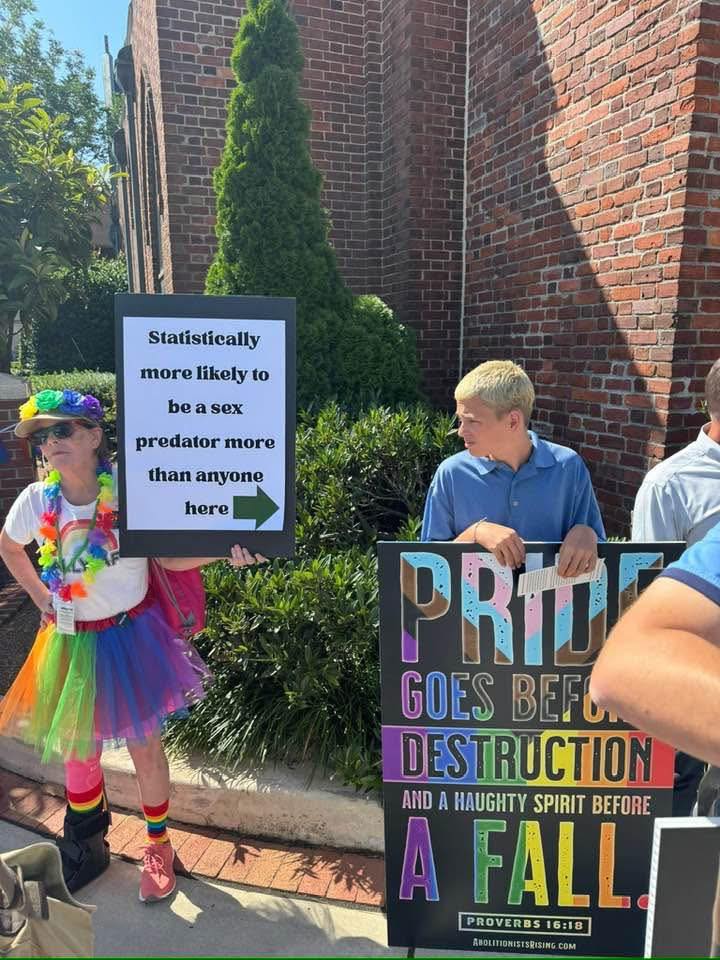
The image shows a scene at what appears to be a Pride event or demonstration. On the left, a person in vibrant, colorful clothing – likely participating in the celebration – is positioned in front of a sign reading "Statistically more likely to be a sex predator than anyone here." The arrow directs towards the individual. On the right, a man stands holding a large sign stating "PRIDE GOES BEFORE DESTRUCTION AND A NAUGHTY SPIRIT BEFORE A FALL," referencing Proverbs 16:18. The background features a brick building. The composition juxtaposes the joyous celebration of LGBTQ+ identity with what appears to be a direct accusation and moral condemnation.
Foucauldian Genealogical Discourse Analysis
From a Foucauldian perspective, this image vividly illustrates the construction of discourses around sexuality and danger. The sign on the left engages in a disciplinary practice by associating LGBTQ+ identity with predation. This isn't based on intrinsic truth, but rather on a historical power/knowledge formation.
Historically, discourses (ways of talking and thinking) have often pathologized and criminalized same-sex desire. This framing, visible in the sign, is a continuation of that historical trajectory, linking queerness to deviance and threat.
The genealogy would trace how this association developed, looking at its origins in religious morality, legal systems, and medical classifications. It reveals that the "truth" of this association isn't inherent but produced through power relations.
The man holding the Proverbs sign reinforces the normalization of religious moral discourse as a source of authority. His sign is essentially invoking a long-standing discourse that defines certain behaviors as “naughty” and deserving of punishment.
Critical Theory
This meme operates as a clear demonstration of how dominant ideologies (in this case, heteronormativity and often religious conservatism) use fear tactics to maintain power. The claim about "sex predators" is a thinly veiled attempt to stigmatize LGBTQ+ people, preventing their full participation in society.
Critical Theory highlights the role of ideology in obscuring the real sources of social problems. Instead of addressing systemic issues that contribute to sexual violence (like patriarchal structures, power imbalances, and societal norms that enable abuse), the meme redirects blame toward a marginalized group.
The meme is a prime example of how "othering" – creating a sense of difference and threat – is used to justify discrimination and oppression.
Queer Feminist Intersectional Analysis
This image is particularly potent when analyzed through a queer feminist intersectional lens.
- Queer Theory: The meme directly targets queer individuals, relying on stereotypes and harmful assumptions about their inherent nature. It exposes how heteronormativity continues to define queerness as aberrant and dangerous.
- Feminist Analysis: The narrative of “sex predators” is deeply tied to patriarchal structures where male sexuality is often viewed as inherently aggressive. By associating LGBTQ+ identities with predation, the meme reinforces harmful gender stereotypes and distracts from the reality that the vast majority of sexual violence is perpetrated by heterosexual men.
- Intersectional Analysis: The meme doesn’t exist in a vacuum. The experience of queer individuals is further complicated by factors like race, class, disability, and other identities. For example, queer people of color may face increased scrutiny and discrimination based on these intersecting identities.
In Summary (From an Anti-Anti-LGBT Perspective)
The meme functions as a powerful illustration of the prejudice and misinformation used to justify anti-LGBTQ+ sentiment. The "Anti-Anti-LGBT" stance would view the image as a clear example of how bigoted rhetoric relies on fearmongering, historical power structures, and the misrepresentation of statistical information to vilify and marginalize queer people. The image is evidence of the continued need to challenge these harmful narratives and advocate for LGBTQ+ equality and liberation.
Disclaimer: I am an AI and my analysis is based on the information provided and general knowledge. The application of these theories can be subjective and open to interpretation.
simple-description (llama3.2-vision_11b)
The meme is a photo of a person holding a sign that says "Category context: Anti-Anti-LGBT" with a sarcastic tone. The sign is likely being held up at a protest or rally, and the person is making a humorous comment about the category of anti-LGBTQ+ activists. The image is likely being used to poke fun at the idea of categorizing and labeling people based on their views on LGBTQ+ issues.
detailed-analysis (gemma3-27b-vision)
Okay, let's break down this image with the requested analytical lenses. It's a complex scene that invites multiple interpretations.
1. Visual Description
The photograph depicts two primary subjects against a backdrop of a brick building. On the left, a young person (appears to be a child or teenager) is dressed in brightly colored, flamboyant clothing – a layered, multi-colored tutu-like skirt, striped knee-high socks, and bright orange sandals. They are holding a sign that reads, "Statistically more likely to be a sex predator than [arrow pointing right]." This is a very jarring statement.
On the right, a middle-aged white man, dressed in a light blue button-down shirt and khakis, stands behind a large sign that reads, “PRIDE GOES BEFORE DESTRUCTION AND A NAUGHTY SPIRIT BEFORE A FALL” with a citation to Proverbs 16:18, and the URL “abolitionistrising.com.” The man appears to be engaged in some form of protest or counter-demonstration.
The setting seems to be a public space, possibly near a building with architectural detail. Green foliage is visible in the background, suggesting an outdoor environment. The overall composition sets up a stark contrast between the vibrant, celebratory expression on the left and the somber, judgmental messaging on the right.
2. Foucauldian Genealogical Discourse Analysis
Foucault would be interested in how power operates through discourse and how seemingly neutral statements can be used to regulate and control.
- Discourse & Power: The signs are examples of discourse aimed at constructing particular understandings of "Pride" and sexual behavior. The signs attempt to establish a "truth" – that Pride leads to destruction and implicitly, links LGBTQ+ individuals to predation. This construction isn’t based on inherent fact, but a particular way of talking and categorizing that serves a power structure.
- Genealogy: Examining the history of the concepts "Pride" and "sexual deviance" reveals how these terms have been defined and used to marginalize certain groups. The citation to Proverbs demonstrates an attempt to legitimize the current discourse by grounding it in religious tradition – tracing a lineage of judgment.
- Normalization & Discipline: The statement on the sign about "sex predators" attempts to normalize fear and suspicion toward potentially anyone, but can be read as targeting LGBTQ+ individuals. It’s an act of disciplinary power, attempting to control behavior by instilling fear and shame. The “abolitionistrising.com” URL suggests a specific ideology, potentially related to abolishing a certain set of beliefs or practices (e.g. modern liberalism).
- Panopticism: The implicit surveillance suggested by the sign ("statistically more likely") evokes a panoptic dynamic – a sense of being constantly watched and judged.
3. Critical Theory
Critical Theory, stemming from the Frankfurt School, would focus on how this image reflects broader societal structures of domination.
- Ideology: The signs are examples of ideological work – attempts to naturalize certain power relationships. The message implies that LGBTQ+ expression is inherently destructive and linked to harmful behavior, reinforcing heteronormative values and structures.
- Domination & Resistance: The image sets up a clear conflict between those expressing LGBTQ+ pride and those opposing it. The brightly colored clothing could be seen as a form of resistance to oppressive norms, while the sign represents an attempt to maintain the status quo.
- Commodification of Identity: While less explicit in the image, the context of Pride parades (if this is one) raises questions about how LGBTQ+ identities can be commodified and incorporated into capitalist systems, potentially obscuring the deeper systemic issues.
4. Marxist Conflict Theory
While the image doesn't directly portray economic exploitation, a Marxist lens can reveal underlying class dynamics.
- Ideological Struggle: The conflict between the two individuals can be seen as an ideological struggle – a battle over the dominant worldview. The sign-holder is attempting to impose a particular moral framework that reinforces traditional power structures.
- Hegemony: The message on the sign is an attempt to maintain the hegemony (dominance) of certain values (e.g., traditional religious morality) over others.
- Distraction from Material Conditions: This kind of moralizing can be seen as a distraction from the real material conditions of inequality and exploitation.
5. Queer Feminist Intersectional Analysis
This is a particularly strong lens for analyzing the image.
- Intersectionality: The image highlights the intersection of sexuality, gender, and religious/moral frameworks. The sign-holder’s message implicitly targets LGBTQ+ individuals, often conflating sexual orientation with immorality and danger.
- Heteronormativity & Compulsory Heterosexuality: The sign represents a form of heteronormative backlash against LGBTQ+ rights and visibility. It reinforces the idea that heterosexuality is the "natural" and "correct" way to be.
- Pathologization of LGBTQ+ Identities: The connection made between Pride and potential harm can be seen as a form of pathologization – portraying LGBTQ+ identities as inherently problematic or dangerous.
- Gender Performance: The individual on the left, with their flamboyant clothing, is engaging in a deliberate act of gender performance, challenging traditional gender norms and expressing their identity in a visible and unapologetic way. This act of defiance is directly countered by the messaging on the sign.
- Safety & Violence: The statement about "sex predators" is particularly problematic in a context where LGBTQ+ individuals are already disproportionately vulnerable to violence and discrimination. It can contribute to a climate of fear and hostility.
6. Postmodernism
A postmodern interpretation would focus on the deconstruction of meaning and the rejection of grand narratives.
- Deconstruction of Truth: The image highlights the constructed nature of "truth." Both signs present claims that are not necessarily objective facts, but rather interpretations based on specific ideological frameworks.
- Rejection of Grand Narratives: The image challenges the idea that there is a single, universal morality or truth. It shows the coexistence of conflicting ideologies and perspectives.
- Simulation & Hyperreality: The display of signs could be seen as a form of simulation, creating a hyperreal image of conflict. The signs themselves become symbols of a larger ideological struggle.
In conclusion, this photograph is a complex and layered image that invites multiple interpretations through different analytical lenses. It’s a powerful visual representation of the ongoing conflict between LGBTQ+ rights and conservative ideologies.
Let me know if you’d like any of these sections expanded upon!
simple-description (llama3.2-vision)
The meme features a person dressed in rainbow attire, holding a sign that reads, "Statistically more likely to be a sex predator than anyone here." They are surrounded by other individuals, one of whom is holding a sign that says, "PRIDE GOES BEFORE DESTRUCTION AND A HAUGHTY SPIRIT BEFORE A FALL." The image is likely intended to be humorous or ironic, as it juxtaposes the celebratory atmosphere of Pride Month with a message that is often associated with religious or conservative viewpoints. The contrast between the two signs creates a sense of irony and playfulness, making the image a humorous commentary on the intersection of Pride Month and religious or conservative values.