First Seen
2025-05-13T19:17:54.158594+00:00
detailed-analysis (gemma3_27b-it-q8_0)
Okay, let's break down this tweet from Scott Walker through the lens of the category "Anti-Anti-Intellectualism," and explore it using the requested theoretical frameworks where relevant.
Core Understanding – Anti-Anti-Intellectualism
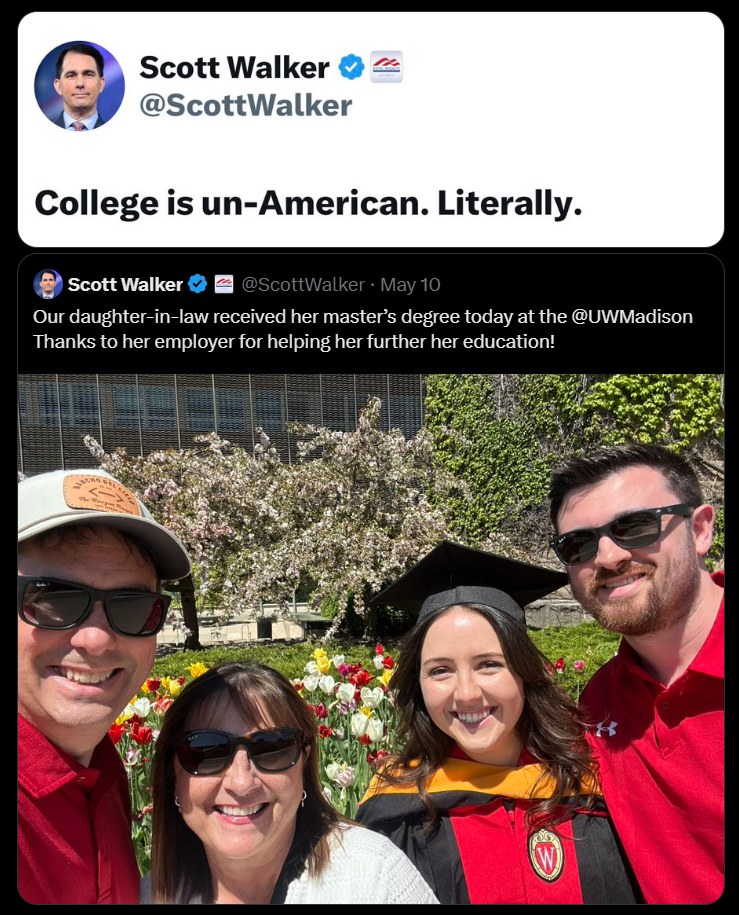
The overarching theme here is a seemingly paradoxical statement and accompanying image. Walker explicitly declares "College is un-American. Literally" and then immediately celebrates his daughter-in-law's Master's degree earned at a prominent university (UW-Madison). This is a key element of anti-anti-intellectualism: the seeming contradiction highlights how figures often benefit from intellectual pursuits (or their family members do) while simultaneously attempting to delegitimize higher education for others. It’s a performance of valuing individual achievement while contributing to a broader devaluing of intellectual effort. The tweet isn’t against learning, it’s against the system that facilitates learning (and the potential critiques it might generate).
---
Visual Description
The image shows a group of four people, presumably Scott Walker and his family, posing in front of blooming flowers. The daughter-in-law is wearing a cap and gown, clearly indicating a graduation ceremony. The others are casually dressed – caps, sunglasses, polo shirts – presenting a very “everyday American” appearance. The backdrop is idyllic and traditionally "American" (flowers, well-maintained greenery). This imagery reinforces the notion that they are relatable, down-to-earth people, despite their participation in an “un-American” activity. The composition implies a sense of wholesome family pride.
---
Foucauldian Genealogical Discourse Analysis
Michel Foucault’s work on power/knowledge is exceptionally relevant here. The statement "College is un-American" isn't a truth claim; it’s a discursive statement meant to establish a certain regime of truth. Walker is contributing to a discourse that positions intellectualism and elite education as foreign to true American values. This is a deliberate construction.
A genealogical analysis would trace the historical conditions that allow such a statement to gain traction. We’ve seen a growing trend, especially in certain political circles, to demonize higher education as a source of “indoctrination” or “elite” thinking detached from “real America.” Walker is tapping into (and reinforcing) this discourse. The idea that universities are inherently "un-American" positions them as sites of potentially subversive knowledge, requiring control or skepticism. It’s about regulating what is considered legitimate knowledge and who is considered legitimate knowledge-producers.
The contrast between the statement and the photo is a power play. By celebrating his family's success within that "un-American" system, he tries to disarm criticism and neutralize the potentially subversive power of higher education. It’s a demonstration that he can control the outcome, that his family can benefit while others are discouraged.
---
Critical Theory
From a Critical Theory perspective, particularly drawing on the Frankfurt School, this tweet illustrates the dangers of instrumental reason. The focus shifts away from the intrinsic value of education (critical thinking, expanding understanding) and towards its utility. The acknowledgment of the daughter-in-law’s degree is immediately followed by a thank you to her employer for “helping her further her education.” This frames education not as a pursuit of knowledge for its own sake, but as a means to an end – economic advancement and workforce participation.
The underlying message is that education is only valuable if it serves capitalist interests. The anti-intellectualism is not about rejecting learning, but about rejecting learning that challenges the existing power structures. This aligns with the Frankfurt School’s critique of the “culture industry,” where even seemingly progressive elements are co-opted to reinforce the status quo.
---
Marxist Conflict Theory
Through a Marxist lens, the statement reveals class conflict. Higher education is often seen as a mechanism for social mobility, allowing individuals to move beyond their class origins. Devaluing higher education serves to maintain the existing class structure. By portraying it as "un-American," Walker appeals to those who feel excluded from or resentful of the perceived benefits enjoyed by the educated elite.
The employer’s role in facilitating the education is highlighted, suggesting that individual success is achieved within the capitalist system, reinforcing its legitimacy. The tweet effectively deflects from systemic inequalities in access to education and blames the system itself rather than the unequal distribution of resources.
---
Postmodernism
The tweet embodies a postmodern skepticism toward grand narratives – in this case, the narrative of education as a universally positive force. Walker is actively deconstructing this narrative, suggesting that it’s not a neutral or objective good, but a culturally biased and potentially harmful ideology.
However, the deconstruction is ultimately used to reinforce a conservative agenda. The irony and contradiction inherent in the tweet serve to muddy the waters and create ambiguity. The truth is obscured. It’s a prime example of how postmodern rhetorical strategies can be co-opted for political purposes.
---
Queer Feminist Intersectional Analysis
While not immediately apparent, a queer feminist intersectional lens can illuminate some subtle dynamics. The image presents a very conventional family structure. The “American” ideal is being upheld. The critique of education (and those who engage in it) frequently targets fields like gender studies, critical race theory, and LGBTQ+ studies, often portraying them as divisive and “un-American.” The implicit message is that certain types of knowledge are unacceptable, often those that challenge dominant social norms.
The tweet silences alternative voices and reinforces a heteronormative, patriarchal view of what constitutes “true” American values. It contributes to a hostile environment for scholars and students engaged in critical inquiry.
In conclusion, this seemingly simple tweet is a complex performance that reveals a great deal about the current political landscape and the ongoing struggle over the meaning of education, American identity, and the role of intellectualism in society. It perfectly encapsulates the strategy of anti-anti-intellectualism by simultaneously celebrating a personal achievement and undermining the value of the institution that made it possible.
simple-description (llama3.2-vision_11b)
This meme is a satirical commentary on the perceived decline of intellectualism in American society. The image shows a photo of a family, likely from a graduation ceremony, with the caption "College is un-American" implying that the family's celebration of their daughter's education is somehow anti-American. The text "College is un-American. Literally" is a tongue-in-cheek commentary on the idea that the family's celebration of their daughter's education is somehow anti-American, implying that the family's support for their daughter's education is somehow un-American.
detailed-analysis (gemma3-27b-vision)
Okay, let's break down this image and its associated tweet through the lenses you requested. I'll include sections only where the relevant theories truly apply, and avoid forced fits.
Please note: This analysis is based solely on the image and tweet provided. A full understanding would require deeper context.
---
Visual Description
The image shows four people posing outdoors amidst lush greenery. It’s a bright, sunny day. All four are wearing sunglasses. The central figure, likely the daughter-in-law who just received her degree, is wearing a black gown with a red sash featuring a white "W" (presumably the University of Wisconsin-Madison emblem). Scott Walker, a former governor of Wisconsin, is prominent in the right of the image wearing a pink polo shirt and sunglasses. The other two figures appear to be men, one in a green baseball cap and the other in a blue shirt. All are smiling and posing for a celebratory photo. The scene feels staged, and intentionally presents a happy, 'normal' family portrait.
---
Foucauldian Genealogical Discourse Analysis
This tweet and image are ripe for a Foucauldian analysis because they contribute to a discourse around the value of education and what it means to be ‘American.’
- Power/Knowledge: Walker's statement "College is un-American. Literally." is a power play. It doesn’t offer argumentation or evidence. Rather, it declares a truth, positioning those who value higher education as somehow outside of (or contrary to) American values. This statement attempts to constitute what counts as "American" through the assertion of its opposition to education.
- Genealogy: Examining the "history" (genealogy) of the concept of “American-ness” reveals it’s been constructed and contested over time. Historically, access to education was limited, particularly for certain groups. By labeling college as "un-American", Walker draws on potentially latent anxieties about the perceived elitism of higher education, aligning himself with a narrative of ‘common sense’ or ‘authenticity’ for the “average American.” He invokes a past (or imagined past) where practical skills and labor were more highly valued, implying that college education somehow detracts from “true” American values.
- Disciplinary Power: This discourse participates in a broader attempt to discipline how Americans think about education. It attempts to categorize and regulate what counts as valuable knowledge and experience. It implicitly sets up a binary: a "real" American versus an "over-educated" one.
---
Critical Theory
Critical Theory sees this as a prime example of ideological work.
- Hegemony: Walker’s statement, though extreme, contributes to a larger cultural struggle about the purpose of education. By framing higher education as “un-American,” he subtly attempts to undermine its perceived legitimacy. This aligns with a broader conservative critique of “elite” institutions and a push for more vocational/skills-based education. It speaks to anxieties about social mobility, cultural change, and the perceived ‘liberal bias’ of universities.
- Critique of Instrumental Reason: While not explicit, this statement could be interpreted as a rejection of the ‘instrumental reason’ that often characterizes academic pursuits – the focus on abstract knowledge for its own sake. The implication might be that education prioritizes theory over practical skills, thereby detracting from the “real work” of being an American.
- Domination: The assertion could be a way of signaling dominance – reinforcing the idea that certain values (hard work, practicality) are inherently superior, and dismissing the value of intellectual pursuits.
---
Marxist Conflict Theory
This scenario can be analyzed through a Marxist lens as a manifestation of class conflict and ideological struggle.
- Class Interests: Walker’s statement could be seen as serving the interests of a particular class – those who prioritize practical skills and vocational training, potentially those who did not have access to higher education themselves. It reinforces the idea that education is ‘unnecessary’ or ‘even harmful’ for certain segments of the population.
- Ideology and False Consciousness: The claim that college is “un-American” functions as ideology – a set of beliefs that mask underlying power relations. It could contribute to a ‘false consciousness’ among certain groups, leading them to believe that education is not in their best interest. This supports the status quo by limiting social mobility and reinforcing existing inequalities.
- Cultural Capital: Higher education confers ‘cultural capital’—knowledge, habits, and tastes that can be used to gain social advantages. Walker’s statement can be seen as a rejection of this form of capital, potentially aiming to dismantle the structures that perpetuate class inequality through education.
---
Notes:
- Intersectional Analysis: While not strongly evident in the image/tweet, a Queer Feminist Intersectional analysis could explore how access to education is differentially available to those who hold marginalized identities (e.g., race, gender, sexual orientation), and how this claim intersects with those forms of marginalization.
- Postmodernism: A postmodern reading would see this as an example of the destabilization of grand narratives (like the value of education) and the proliferation of competing truths. It highlights the subjective nature of reality and the constructedness of all meaning. However, this interpretation feels less central to the core argument presented.
I hope this comprehensive analysis provides a thorough examination of the image and tweet through the requested theoretical lenses. Let me know if you'd like me to elaborate on any specific aspect or explore other interpretations.
simple-description (llama3.2-vision)
This meme is a screenshot of a tweet from a Twitter account called "Scott Walker" (a former US politician). The tweet reads: "College is un-American. Literally." It's a humorous and ironic statement, implying that the author thinks college is a bad thing, which is a contradictory and unexpected opinion from a politician. The tweet is likely meant to be satirical or sarcastic, poking fun at the idea that college is a necessary and beneficial part of American life.