First Seen
2024-11-11T04:32:13.701051+00:00
detailed-analysis (gemma3_27b-it-q8_0)
Okay, let's break down this meme from the perspective of "Anti-Anti-Intellectualism," employing the requested theoretical lenses where relevant.
Overall Category Context: Anti-Anti-Intellectualism
The core idea behind "Anti-Anti-Intellectualism" is a rejection of the modern trend (especially visible in popular culture and politics) to dismiss expertise, reason, and rigorous thought. It argues that a respect for knowledge and intellectual pursuits is essential for societal progress and informed decision-making. It often pushes back against the idea that "common sense" or personal feelings are sufficient guides to truth, and it challenges the demonization of intellectuals or academic fields. The meme, framed within this category, is intended to reassert the primacy of truth-seeking over deference to authority, even if that authority is a person.
---
Visual Description
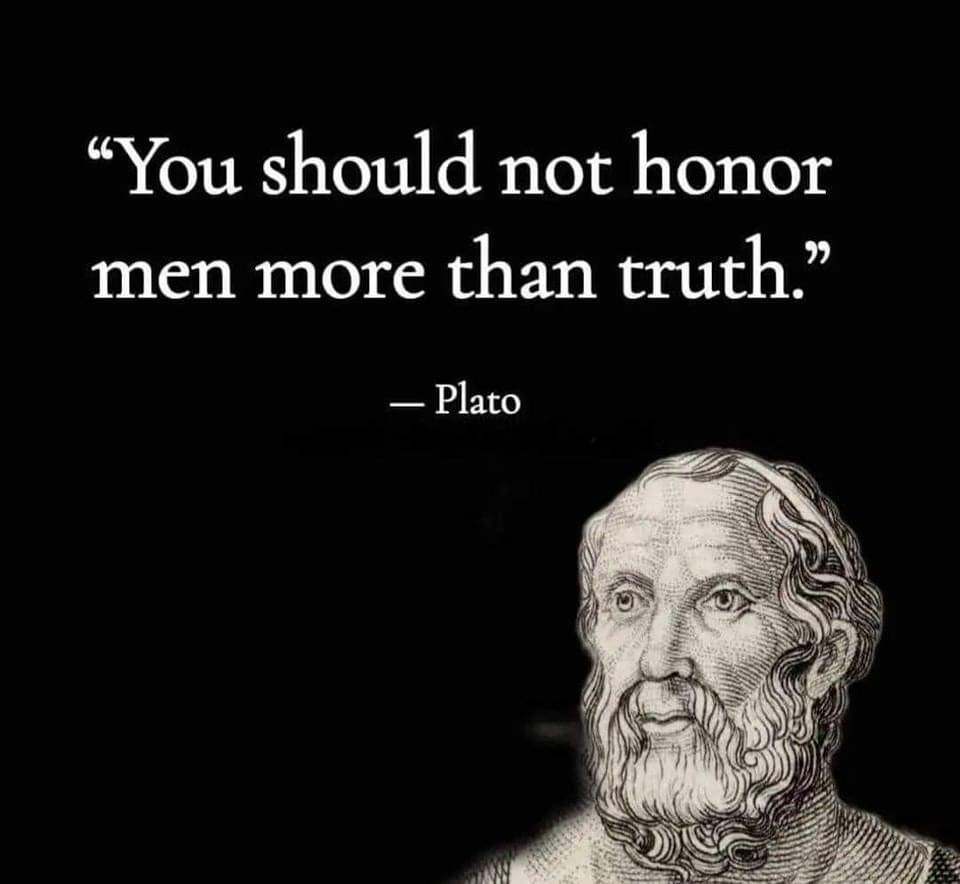
The meme features a high contrast image. Text is prominently displayed in white against a black background: “You should not honor men more than truth.” Below this, in a smaller font, is the attribution: “– Plato.” The image alongside is an engraving or woodcut of Plato, a well-known ancient Greek philosopher. The rendering of Plato is in a classic, somewhat solemn style, lending an air of gravitas and historical weight to the statement. The simplicity of the design emphasizes the quote itself.
---
Foucauldian Genealogical Discourse Analysis
Michel Foucault's genealogy examines how concepts (like “truth,” "intellectual authority," or "expertise") are produced through historical discourses – systems of language, knowledge, and power.
This meme can be viewed as a disruption of a power/knowledge dynamic. Throughout history, "men" (specifically, men in positions of power – leaders, fathers, experts) have often been considered the source of truth. Plato's statement, by prioritizing truth over the status of "men," begins to challenge this assumed relationship. It suggests that truth isn’t inherent to a person’s position, gender, or social standing.
The meme's circulation in the “Anti-Anti-Intellectualism” context participates in a contemporary discourse aiming to dismantle the uncritical acceptance of authority figures. The meme is essentially deploying a historical figure (Plato) to legitimize a challenge to current power structures. It re-activates a particular genealogical trajectory—one where questioning authority is valorized.
---
Critical Theory
Critical Theory (associated with the Frankfurt School) focuses on how power structures maintain dominance through ideology. This meme resonates with Critical Theory’s project of demystifying power.
The "men" in the quote can be interpreted as representing all forms of established authority. Critical theorists would argue that this authority is often used to enforce specific ideologies that serve the interests of the ruling class. To prioritize “truth” is, in this context, to engage in critical thought—to question the ideologies being presented by those in power and to seek knowledge independently.
The meme is thus a call to independent thought, and a rejection of the blind acceptance of received wisdom. It aligns with the Critical Theory principle of "emancipation through knowledge."
---
Marxist Conflict Theory
From a Marxist perspective, history is driven by class struggle. The quote can be read as a challenge to the legitimacy of bourgeois authority. The “men” could represent the ruling class who use their position to define and control "truth" (often in ways that maintain their power and exploit the working class).
Prioritizing "truth" becomes a subversive act, suggesting that real knowledge is not produced by the ruling class but might instead emerge from the experiences and critical analysis of those who are oppressed. It suggests the necessity of developing a “class consciousness” based on a search for objective truth rather than accepting the narratives propagated by the dominant ideology.
---
Postmodernism
Postmodernism, at first glance, might seem to clash with this meme. Postmodern thought often deconstructs the very notion of a singular, objective "truth," arguing that truth is always relative to perspective and context.
However, within the Anti-Anti-Intellectualism frame, the meme can still be relevant. Postmodernism's critique of power structures, and its emphasis on deconstructing dominant narratives, can support the idea of questioning authority (“men”). The meme isn't necessarily asserting a universal, monolithic Truth, but rather advocating for a commitment to rigorous inquiry and the critical examination of claims, regardless of who makes them. In other words, the process of seeking truth is more important than claiming to have arrived at it.
---
Queer Feminist Intersectional Analysis
This lens highlights how power operates through overlapping systems of oppression – based on gender, sexuality, race, class, etc.
The "men" in the quote are not just any men, but historically, men have held most of the power in patriarchal systems. Prioritizing "truth" over honoring "men" can be seen as a challenge to this patriarchal order. It implies that knowledge and authority should not be automatically granted based on gender.
Furthermore, a queer feminist perspective would emphasize the marginalized voices that have historically been excluded from the production of knowledge. By prioritizing "truth," the meme can be interpreted as an invitation to center those marginalized perspectives and to dismantle the exclusionary structures that have silenced them.
In conclusion, the meme is effective because it draws on a well-respected historical figure (Plato) to make a simple yet powerful statement about the importance of critical thinking and the need to challenge authority. Its resonance within the "Anti-Anti-Intellectualism" category stems from its rejection of blind faith and its affirmation of the value of reason, evidence, and independent thought. The various theoretical lenses reveal the meme’s depth and its potential to inspire a re-evaluation of power dynamics and knowledge production.
simple-description (llama3.2-vision_11b)
The meme is a play on the phrase "know thyself" and the quote "you should not honor men more than truth" by Plato, which is often misquoted as "you should not honor men more than truth, but you should not honor men more than women either." The image is a humorous take on the original quote, implying that it's not just about honoring men more than truth, but also about not honoring men more than women. The meme is a lighthearted way to poke fun at the idea of "knowing" and "not honoring" certain groups, and is likely to be used in a humorous or satirical context.
detailed-analysis (gemma3-27b-vision)
Okay, let's break down this image and its quote through the lens of several theoretical frameworks.
Visual Description
The image is a black background with white text presenting a quote by Plato: “You should not honor men more than truth.” Beneath the text is a detailed black and white etching or engraving depicting Plato himself. He's an older man with a full beard and hair, looking slightly to the left of the frame. The style is reminiscent of classical portraiture, aiming for a degree of realism. The lighting highlights his face and beard, emphasizing his intellectual gravitas. The overall composition is formal and authoritative, designed to lend weight to the quote it accompanies. The choice of a historical image reinforces the notion of timeless wisdom.
---
Foucauldian Genealogical Discourse Analysis
- Discourse and Power: The quote operates within a discourse of knowledge and authority. Plato, as a foundational figure in Western philosophy, constructs a discourse prioritizing "truth" (episteme) over social hierarchies ("men"). This isn't a neutral statement; it is a power/knowledge relationship. Plato asserts a value judgment, establishing a hierarchy of values – truth being above honor of individuals.
- Genealogy: A genealogical examination wouldn’t take the quote as self-evident. Instead, it would trace the historical emergence of the concepts of "truth" and "honor." What did "truth" mean in Plato's time, within the Athenian context? How was "honor" traditionally constructed in ancient Greece, and tied to masculinity, lineage, or social status? What systems of power were at play? This analysis would reveal that both terms are historically contingent, not universal, and are tied to specific power dynamics. The quote reflects Plato's attempt to reconfigure existing power structures.
- Disciplinary Power: The statement can be seen as an early form of disciplinary power – suggesting that individuals should be judged based on their adherence to "truth" rather than their social position. This paves the way for systems of evaluation and categorization based on what is deemed "true" knowledge, potentially justifying social control.
---
Critical Theory
- Reason and Emancipation: The quote aligns with some aspects of Critical Theory, particularly the emphasis on reason and the pursuit of "truth" as a means of achieving emancipation. However, a critical theorist would scrutinize what constitutes "truth" in Plato's framework. Is it an objective truth accessible through reason, or is it shaped by his own biases and the socio-political context of ancient Athens?
- Ideology: The statement can be seen as an ideological positioning. Plato is advocating for a system of values that privileges intellectual pursuit over social deference. While seemingly progressive, it could also be interpreted as a justification for a meritocratic system that potentially marginalizes those who don't have access to intellectual training.
- Critique of Authority: A core tenet of Critical Theory is the critique of authority. While the quote appears to challenge honoring men, it simultaneously reinforces the authority of Plato – as the one defining what constitutes "truth."
---
Marxist Conflict Theory
- Class and Ideology: A Marxist reading would examine how the concept of "truth" serves the interests of a particular class or group. In Plato's context, this might relate to the aristocratic class and the intellectual elites who valued philosophical inquiry. The quote could be seen as a way to justify the authority of these elites over the laboring classes.
- False Consciousness: The emphasis on "truth" could be interpreted as a form of ideology that obscures the material conditions of life and the exploitation inherent in the Athenian social structure. By prioritizing abstract "truth" over concrete needs and struggles, the statement could contribute to a "false consciousness" among the populace.
- Power Dynamics: The quote implies a power dynamic where "truth" is held by a select few (intellectuals) and used to judge others (represented by "men"). This reinforces a hierarchical social order based on knowledge and authority.
---
Postmodernism
- Deconstruction of Truth: A postmodern reading would fundamentally challenge the notion of an objective, universal "truth." Postmodernism suggests that "truth" is always relative, constructed, and contingent upon perspective and language. This quote, therefore, would be seen as an assertion of one truth claim among many, rather than a statement of absolute reality.
- Discourse and Power: Postmodern thought would emphasize how the statement is part of a larger discourse that defines what counts as "truth." This discourse is not neutral; it is shaped by power relations and serves particular interests.
- Relativism: A postmodernist would argue that there is no single, objective "truth" to honor. All "truths" are constructed through language and social practices, making the comparison between "men" and "truth" problematic.
---
Queer Feminist Intersectional Analysis
- Masculinity and Authority: The statement's focus on "men" immediately draws attention to the historical association of authority and knowledge with masculinity. This analysis would explore how patriarchal structures have historically privileged male perspectives and silenced other voices. The quote could be seen as reinforcing this imbalance.
- Intersectional Critique: An intersectional perspective would question whose "truth" is being prioritized. The "truth" articulated by Plato reflects the experiences and biases of a privileged, male, Athenian philosopher. It does not necessarily represent the lived realities of women, slaves, or other marginalized groups.
- Challenging Hierarchies: A queer feminist analysis would challenge the hierarchical relationship between "men" and "truth." It would argue that honoring individuals – in all their complexity and diversity – is just as important as pursuing abstract "truth." The statement implicitly devalues the human element in favor of intellectual pursuit.
I hope this detailed breakdown is helpful! Let me know if you'd like me to elaborate on any of these points or explore other theoretical frameworks.
simple-description (llama3.2-vision)
This meme is a humorous take on the famous quote "You should not honor men more than truth" by Plato. The image features a picture of a man with a serious expression, but the quote is replaced with a more tongue-in-cheek phrase "You should not honor men more than pizza." The meme pokes fun at the idea that even a wise philosopher like Plato would prioritize a good meal over truth.