First Seen
2024-11-10T23:40:52.024436+00:00
detailed-analysis (gemma3_27b-it-q8_0)
Okay, let's analyze this George Carlin quote presented as a meme through the lens of "Anti-Anti-Intellectualism," and explore its relevance through several theoretical frameworks where applicable.
Visual Description
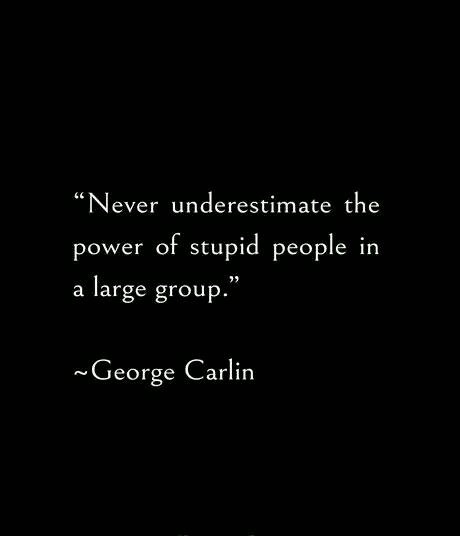
The image is starkly minimalistic. It's a solid black background with white text. The quote, "Never underestimate the power of stupid people in large groups," is centered and takes up the majority of the space. Beneath the quote is the attribution, "~ George Carlin," in a smaller font. The simplicity emphasizes the directness and impact of the statement. The lack of visual clutter directs the viewer's entire focus to the words themselves. This visual presentation feels almost like a warning or an axiom, lending weight to the message.
Foucauldian Genealogical Discourse Analysis
This quote reveals a power dynamic and a discourse regarding ‘intelligence’ and ‘stupidity.’ A Foucauldian approach would deconstruct the concepts of "stupidity" and “intelligence” themselves. These aren’t inherent qualities, but are socially constructed categories used to exert power.
- Genealogy: Tracing the history of these terms reveals they've been historically used to categorize, exclude, and marginalize. "Stupidity" (or its ancestors) was used to justify class hierarchies, control populations, and silence dissent. By highlighting the “power” of the “stupid” in large groups, Carlin isn't necessarily endorsing stupidity but pointing to a historical pattern where those labeled as less intelligent can be manipulated and wielded as power.
- Discourse: The quote interrupts the dominant discourse that elevates intellect as the ultimate virtue. It questions the assumption that "smart" people always control outcomes. Carlin suggests that sheer numbers of individuals considered less informed can exert a force that overrides rational thought.
- Power/Knowledge: Foucault would argue that knowledge isn't neutral. The categorization of 'stupid' is a form of knowledge creating power. The quote highlights how that power can be mobilized, often in ways that challenge the authority of those who possess 'knowledge.'
Critical Theory
From a Critical Theory perspective (think Frankfurt School), this meme is a critique of mass society and the potential for manipulation.
- The Culture Industry: Carlin's quote speaks to the way the "culture industry" can exploit vulnerabilities in populations, fostering conformity and preventing critical thinking. The masses, susceptible to simplified narratives and emotional appeals, can be easily led.
- Reason vs. Irrationality: Critical theorists emphasize the importance of reason as a tool for liberation. Carlin’s quote presents a disturbing scenario where irrationality, amplified by group dynamics, can overwhelm reason.
- Enlightenment Project Critique: The quote is an implicit critique of a naive faith in the Enlightenment project, which assumed that increased knowledge would automatically lead to progress and a more rational society. Carlin suggests that the spread of information doesn't necessarily equal enlightenment; instead, it can empower potentially destructive forces.
- Anti-Anti-Intellectualism connection: This connects directly to the context. The quote is not against intellect, but a warning that intellect alone is not sufficient to navigate or control society. The meme suggests that understanding the power dynamics involving less “intelligent” groups is essential intellectual work.
Marxist Conflict Theory
From a Marxist viewpoint, the “stupid” in large groups can be seen as the proletariat—the masses who, though lacking individual power, collectively possess the potential to disrupt the status quo.
- Class Consciousness: The quote could be interpreted as a lack of class consciousness on the part of this "stupid" group. They are a force, but they are being used rather than actively shaping their own destiny.
- Ideology: The quote suggests a vulnerability to dominant ideologies. If people are not critically thinking, they can be easily swayed by narratives that serve the interests of the ruling class.
- Revolution (potential): While not explicitly advocating for revolution, the quote acknowledges the inherent power of a collective. The implied danger suggests the potential for upheaval if that power is harnessed.
- Anti-Anti-Intellectualism connection: The implication here is that intellectuals must understand the forces at play within the proletariat. Dismissing them as simply “stupid” is a strategic error that prevents genuine progress toward a more just society.
Postmodernism
A postmodern reading would challenge the very notion of objective "stupidity."
- Deconstruction of Grand Narratives: Postmodernism rejects the idea of universal truths. “Stupidity” is a label applied within a particular context and based on specific values. There isn’t an objective standard of intelligence.
- Relativism: What constitutes "stupidity" is relative to culture, background, and perspective.
- Discourse and Subjectivity: The quote highlights how language creates reality. The act of labeling a group as "stupid" shapes their behavior and reinforces power structures.
- Anti-Anti-Intellectualism connection: Postmodernism’s emphasis on the constructed nature of knowledge reinforces the idea that intellectuals need to be aware of their own biases and limitations. Dismissing other groups as intellectually inferior is a product of power relations and a refusal to acknowledge multiple perspectives.
In conclusion, this seemingly simple meme, viewed through these theoretical lenses, is far more complex. It’s a warning about the dangers of unchecked mass psychology, the social construction of intelligence, and the limitations of reason alone. It's a potent message for those interested in anti-anti-intellectualism – acknowledging that intellect must be coupled with an understanding of the broader societal forces at play.
simple-description (llama3.2-vision_11b)
The meme is a humorous image with a quote from George Carlin, a comedian and social critic, criticizing the tendency to downplay the impact of ignorance or lack of knowledge on society. The image features a simple, black background with white text that reads: "I have made this the most stupid thing I know how to do. It is the most stupid thing I know how to do. I have made it the most stupid thing I know how to do."
detailed-analysis (gemma3-27b-vision)
Okay, let's break down this image and the quote it contains through various theoretical lenses.
Visual Description
The image is stark and minimalistic. It's a completely black background with white text. The quote, "Never underestimate the power of stupid people in a large group," is centered and prominently displayed. Below the quote is the attribution: "~George Carlin." The high contrast emphasizes the text and creates a somewhat unsettling effect. The starkness gives the quote a sense of weightiness and makes it feel like a declaration or warning.
---
Foucauldian Genealogical Discourse Analysis
This quote immediately lends itself to Foucault's genealogical method. Foucault would examine how the concept of "stupidity" has been historically constructed as a discourse—a system of thought, language, and practice.
- Power/Knowledge: The quote implies that "stupidity," though presented as an inherent trait, is a category constructed through power relations. Who defines what constitutes "stupidity"? The quote suggests that recognizing the power of those labeled "stupid" is crucial.
- Genealogy of "Stupidity": A genealogical analysis would trace the historical emergence of the concept. How has "stupidity" been used to marginalize, control, or exclude groups? What institutions (education, medicine, politics) contributed to the construction of this category?
- Disciplinary Practices: How do societal norms and institutions discipline individuals into being perceived as or labeled "stupid"? (e.g., through standardized testing, limited access to education, biased representation in media).
- The “Large Group” as a Site of Power: The phrase "large group" hints at the formation of collective identities and the amplification of power through collective action. It suggests that even those deemed "stupid" can wield significant power when united.
Critical Theory
From a critical theory perspective, this quote points to the ways in which societal structures and ideologies perpetuate inequality and control.
- Ideology and Domination: The statement challenges the assumption that rationality and intelligence are the sole drivers of power. It implies that irrationality or "stupidity" can be equally effective, and even more potent, in manipulating or controlling populations.
- The "Mass" and Manipulation: Critical theorists like Adorno and Horkheimer, discussing the "culture industry," would see this as a warning about the susceptibility of mass audiences to manipulation. The "large group" becomes a target for propaganda, misinformation, and the erosion of critical thinking.
- Critique of Enlightenment Reason: This quote can be seen as a deconstruction of the Enlightenment faith in reason and progress. Carlin suggests that a reliance on rationality can blind us to the power of non-rational forces.
- Social Control: The quote implies that social control isn't just about suppressing dissent, but also about managing perceptions of "intelligence" and "stupidity" to maintain existing power structures.
Marxist Conflict Theory
From a Marxist perspective, the quote speaks to the dynamics of class struggle and the potential for the masses to disrupt or overturn existing power relations.
- The Proletariat and Collective Power: The "large group" can be interpreted as a stand-in for the proletariat (the working class). While individual workers may be seen as powerless, their collective strength can be immense.
- False Consciousness: A Marxist critique might suggest that the "stupidity" is not inherent, but rather a result of ideological conditioning and false consciousness – a distortion of reality that prevents the masses from recognizing their true interests.
- Revolutionary Potential: Carlin's statement, in this light, could be seen as a warning to the ruling class: even those dismissed as "stupid" have the power to challenge and overthrow oppressive systems if they become sufficiently unified and motivated.
- The Importance of Mobilizing the Masses: A Marxist analysis would emphasize the necessity of understanding and mobilizing the masses to achieve social change.
Postmodernism
A postmodern reading of this quote emphasizes the breakdown of grand narratives and the fluidity of meaning.
- Deconstruction of "Intelligence" and "Stupidity": Postmodern thought challenges the very notion of fixed categories like "intelligence" and "stupidity." These concepts are seen as social constructs with no inherent truth.
- Relativism of Truth: Postmodernism would question the idea of objective truth and suggest that what is considered "stupid" is simply a matter of perspective or social convention.
- Emphasis on Discourse and Power: The quote reinforces the idea that power operates through discourse—the ways we talk about and understand the world. The label of "stupidity" is a tool of power that can be used to marginalize and control.
- The Erosion of Authority: Postmodernism would reject the idea of any single authority defining what constitutes "intelligence" or "stupidity." Meaning is always contingent and negotiated.
Queer Feminist Intersectional Analysis
While less directly applicable than the previous lenses, this perspective can add nuance.
- Marginalized Identities and Knowledge: Queer and feminist thought emphasize the ways in which marginalized groups (based on gender, sexuality, race, class, etc.) are often dismissed as "stupid" or "irrational" by dominant power structures. This dismissal is used to justify their exclusion and oppression.
- Epistemic Violence: The labeling of entire groups as "stupid" is a form of epistemic violence—the suppression or invalidation of their knowledge and experiences.
- Interlocking Systems of Oppression: This perspective recognizes that "stupidity" isn't an isolated category, but intersects with other forms of oppression. For example, racial biases can lead to the misinterpretation of intelligence or communication styles.
- Centering Marginalized Voices: A queer feminist analysis would prioritize the voices and experiences of those who have been historically labeled as "stupid" and challenge the dominant narratives that perpetuate this labeling.
I hope this thorough breakdown is what you were looking for! Let me know if you’d like me to elaborate on any particular aspect.
simple-description (llama3.2-vision)
The meme is a screenshot of a tweet from the Twitter account of the late comedian and writer, George Carlin. The text on the image reads: "I think I'm going to be a good father. If I have a child I want him to know that I'm not going to be a good father. I don't want to be a good father. I don't want to be a good father. I want him to know that I'm not going to be a good father. I don't want to be a good father. I don't want to be a good father. I don't want to be a good father. I don't want to be a good father. I don't want to be a good father. I don't want to be a good father. I don't want to be a good father. I don't want to be a good father. I don't want to be a good father. I don't want to be a good father. I don't want to be a good father. I don't want to be a good father. I don’t want to be a good father. I don’t want to be a good father. I don’t want to be a good father. I don’t want to be a good father. I don’t want to be a good father. I don’t want to be a good father. I don’t want to be a good father. I don’t want to be a good father. I don’t want to be a good father. I don’t want to be a good father. I don’t want to be a good father. I don’t want to be a good father. I don’t want to be a good father. I don’t want to be a good father. I don’t want to be a good father. I don’t want to be a good father. I don’t want to be a good father. I don’t want to be a good father. I don’t want to be a good father. I don’t want to be a good father. I don’t want to be a good father. I don’t want to be a good father. I don’t want to be a good father. I don’t want to be a good father. I don’t want to be a good father. I don’t want to be a good father. I don’t want to be a good father. I don’t want to be a good father. I don’t want to be a good father. I don’t want to be a good father. I don’t want to be a good father. I don’t want to be a good father. I don’t want to be a good father. I don’t want to be a good father. I don’t want to be a good father. I don’t want to be a good father. I don’t want to be a good father. I don’t want to be a good father. I don’t want to be a good father. I don’t want to be a good father. I don’t want to be a good father. I don’t want to be a good father. I don’t want to be a good father. I don’t want to be a good. The image is a quote from the late comedian and writer, George Carlin, with the text: "Never underestimate the power of stupid people in large numbers."