First Seen
2026-01-27T08:31:41.145948+00:00
simple-description (qwen3.5_2b-q8_0)
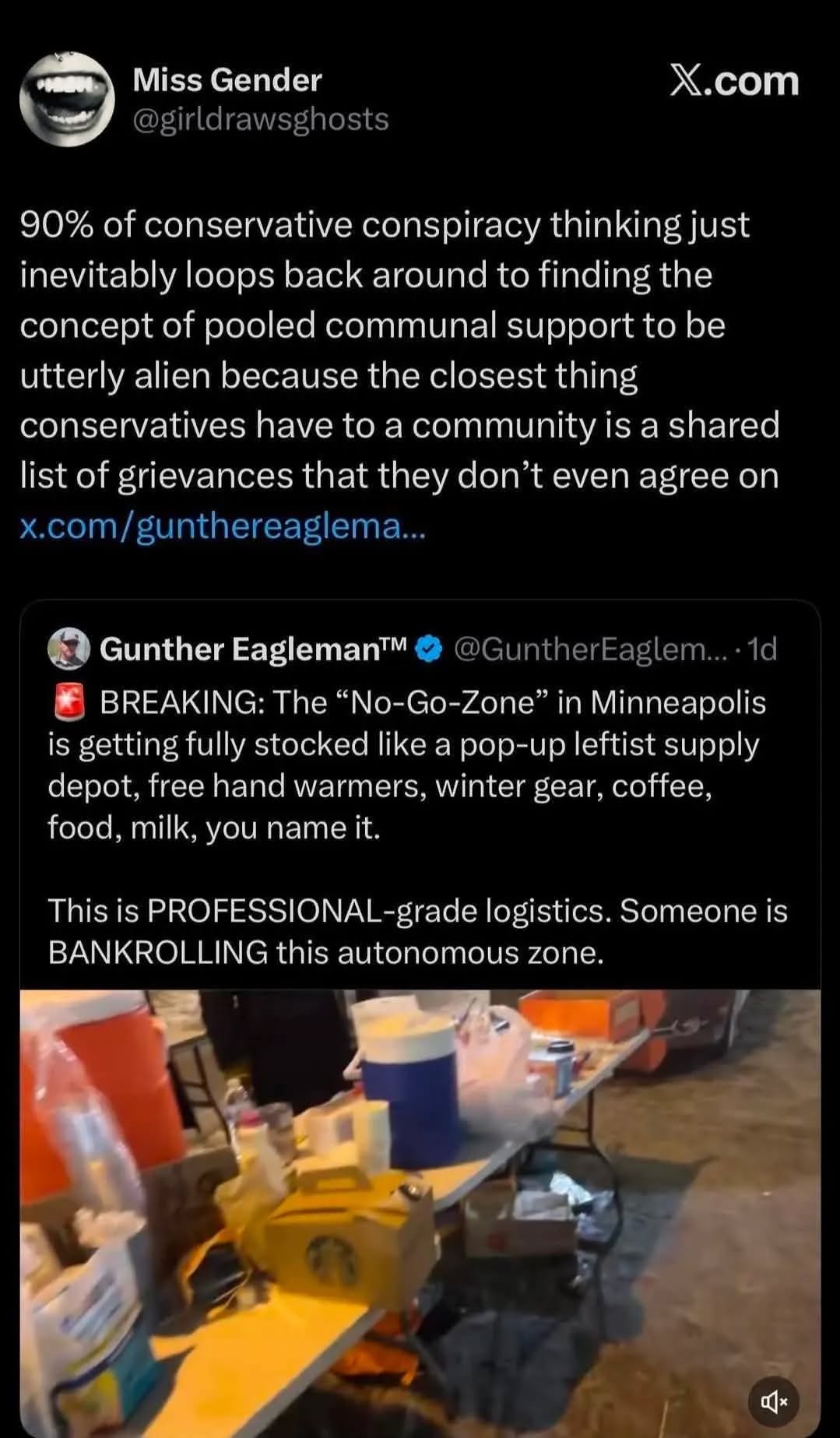
This meme points out the irony of conservative rhetoric by referencing Leninist "pooled communal support" as something conservatives view as alien despite the fact that they are currently funding a government supply run for low-income populations. It highlights the contrast between a group calling themselves "anti-communist" or using anti-Leninist logic while simultaneously stockpiling essentials like warmers, food, and milk in a zone dubbed a "No-Go-Zone."
detailed-analysis (gemma3_27b-it-q8_0)
Okay, let's break down this meme through the lens of "Anti-Anti-Communism," using the requested theoretical frameworks where appropriate. It's a complex meme steeped in online leftist subculture, so this will be a detailed analysis.
Overall Framing: Anti-Anti-Communism
This meme operates within the "Anti-Anti-Communism" sphere. This doesn't necessarily mean it advocates for communism in a straightforward way. Rather, it's a reaction against the often hyperbolic, unnuanced, and fear-mongering rhetoric used against leftist ideologies, particularly communism and socialism. The humor derives from highlighting the absurdity of anti-communist arguments, often by juxtaposing them with material reality, and by pointing out hypocrisy. It's a playful, ironic engagement that seeks to de-fang the narratives of red scares and demonization. The meme aims to show that practical, communal aid and organization are actually happening, and are far less terrifying than conservative imaginations portray.
1. Visual Description
The image depicts a well-stocked "supply depot" – a table laden with necessities like food, milk, coffee, hand warmers, and winter gear. A person is serving a customer (presumably) at the table. The aesthetic is intentionally somewhat DIY, suggesting an organically created, grassroots support system. The framing and lighting create a sense of cozy functionality. The scene's appearance and wording ("No-Go-Zone") evoke a deliberately exaggerated dystopian scenario – ironically contrasted with the mundane goods being offered.
2. Foucauldian Genealogical Discourse Analysis
Foucault’s genealogical method examines the historical construction of power relations through discourse. Here, the meme operates by deconstructing the discourse of “No-Go Zones”.
- The Discourse: Conservative media frequently utilizes the concept of "No-Go Zones" to describe areas where they claim law and order have broken down, often implying a loss of control to radical groups. This discourse is inherently linked to anxieties about immigration, cultural change, and perceived threats to national identity. The term is meant to evoke fear and demonize certain communities.
- Genealogical Deconstruction: The meme actively subverts this discourse. By using the term “No-Go-Zone” to describe a place offering practical aid, it reclaims the language and deflates its power. The abundance of goods (milk, coffee, winter gear) directly contradicts the narrative of chaos and abandonment. It reveals how the concept of “No-Go-Zone” is a construct, a rhetorical tool used to create an imagined reality rather than reflect objective conditions.
- Power/Knowledge: The meme implies that the power to define reality lies not solely with conservative media, but also with those directly involved in creating and sustaining these mutual aid networks. The act of providing resources is a counter-narrative to the manufactured fear.
3. Marxist Conflict Theory
The meme implicitly touches on themes central to Marxist conflict theory:
- Class Struggle: The "No-Go-Zone" is framed as a grassroots response to systemic failures—failures to provide basic needs like food, warmth, and healthcare. This implicitly points to the inherent contradictions within capitalism that necessitate such forms of mutual aid. The needs being met indicate a failure of capital to provide.
- Base and Superstructure: The base (the material conditions of life – the need for food, shelter, warmth) are being addressed directly through the superstructure (the social organization and infrastructure – the supply depot). The meme suggests that when the base is ignored or underserved by the existing system, alternatives emerge.
- Alienation: The meme’s initial statement ("90% of conservative thinking...") hints at the alienation inherent in capitalist society. Conservatives, according to this line of thought, are so detached from genuine community and mutual support that they can only conceptualize it as “alien” or threatening.
4. Postmodernism
Postmodernism emphasizes the deconstruction of grand narratives and the subjective nature of truth.
- Rejection of Meta-Narratives: The meme rejects the conservative “grand narrative” of a collapsing society overrun by radical elements. It offers a counter-narrative—a localized, practical response to real needs.
- Irony and Parody: The entire meme is layered with irony and parody. The exaggerated language ("BREAKING," "autonomous zone," "PROFESSIONAL-grade logistics") and the juxtaposition of a "dystopian" setting with mundane supplies create a humorous effect that undermines the seriousness of the conservative narrative.
- Simulacra and Simulation: The concept of the “No-Go-Zone” itself can be seen as a simulacrum – a copy without an original. The conservative depiction of these zones is a manufactured reality that has little to do with the lived experiences of the people within them.
5. Critical Theory
The meme can be viewed as an application of Critical Theory’s goal to expose power structures and ideological biases.
- Critique of Ideology: The meme challenges the ideology of individual self-reliance and demonizes collectivism. It exposes the inherent contradictions in a system that promotes individualism while failing to provide for the basic needs of its citizens.
- Emancipatory Potential: By highlighting the success of the mutual aid network, the meme suggests a potential for emancipation—a way to create a more just and equitable society outside the confines of existing power structures. The meme suggests that there is an alternative to the system, and that is communal support.
In conclusion, this meme is a sophisticated piece of online political communication. It uses humor, irony, and a blend of theoretical frameworks to critique conservative narratives and promote a vision of mutual aid as a viable, even desirable, alternative. It’s a prime example of how “Anti-Anti-Communism” operates as a cultural and political force, challenging dominant ideologies and sparking dialogue in the digital sphere.
simple-description (llama3.2-vision_11b)
The meme is a satirical commentary on the anti-anti-communist movement. It features a screenshot of a Twitter thread from a user named "Miss Gender" who is mocking the idea of an "anti-anti-communist" movement. The thread is filled with absurd and humorous statements, such as "90% of conspiracy theories are actually anti-anti-Communist" and "the best way to get a job is to be a anti-anti-Communist."