First Seen
2026-03-28T19:46:12+00:00
simple-description (qwen3.5_2b-q8_0)
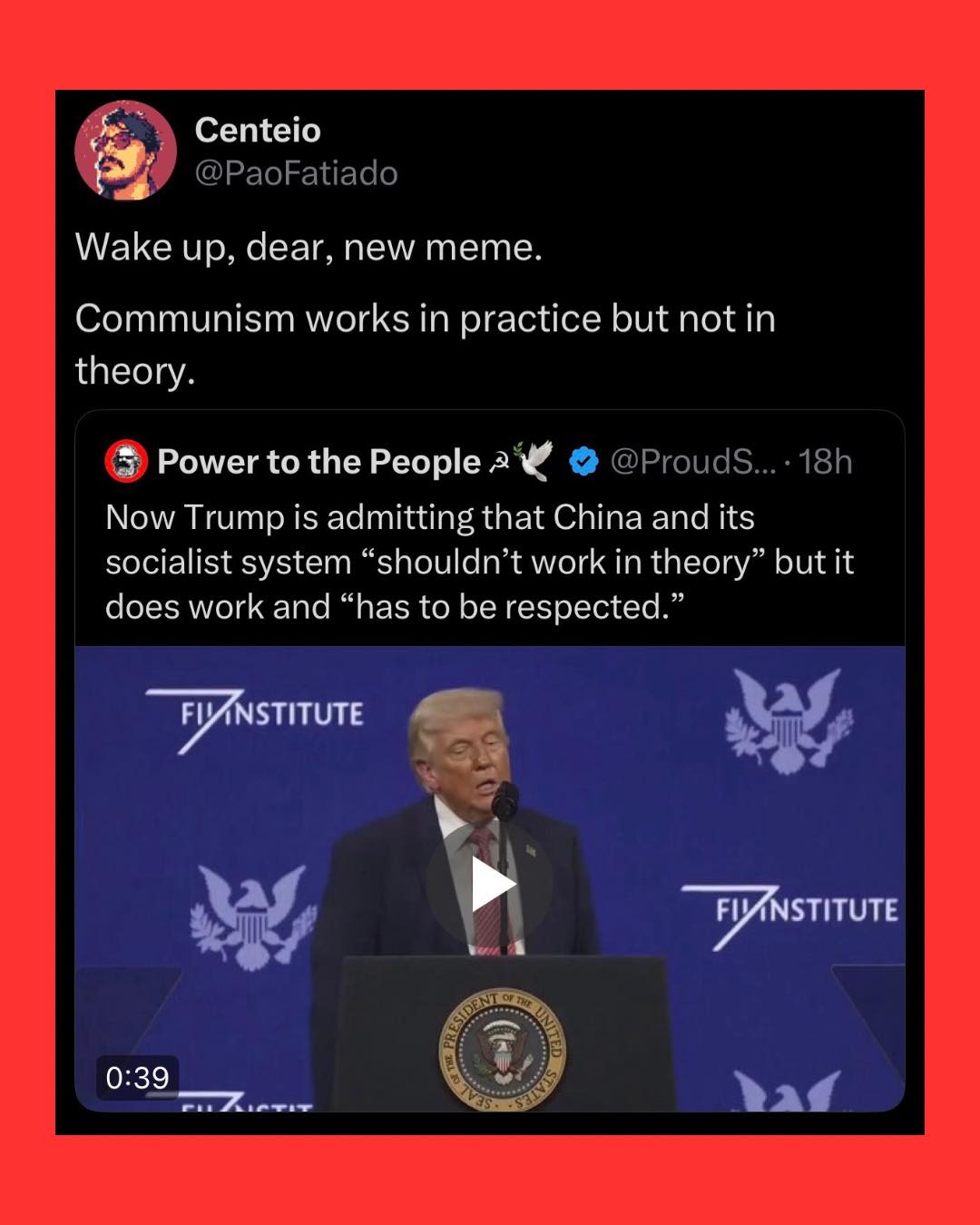
This anti-American joke targets political hypocrisy by referencing a claim that communism "works in practice but not in theory." It uses footage of Donald Trump speaking at an event to illustrate this point, where he is purportedly admitting that China and its socialist system theoretically fail ("shouldn't work in theory") yet actually do succeed and deserve respect.
detailed-analysis (gemma3_27b-it-q8_0)
Okay, let's break down this meme from an "Anti-America" perspective, utilizing the requested theoretical frameworks where applicable. Given the explicit framing in the tweet ("Wake up, dear, new meme. Communism works in practice but not in theory."), we can assume a critical stance towards American exceptionalism and potentially a pro-socialist/communist leaning.
Important Note: This analysis assumes the "Anti-America" category emphasizes critique of US power structures, historical injustices, and inherent contradictions within the nation-state, rather than simply blanket negativity. The meme likely functions as a means of disrupting dominant narratives.
---
Visual Description
The image is a screenshot of a video, seemingly featuring former US President Donald Trump speaking at a podium. The backdrop is branded with "FI INSTITUTE," and a stylized eagle logo appears repeatedly. The time stamp "0:39" is visible at the bottom, indicating the image is taken from a longer clip. Trump is mid-sentence, his expression appearing slightly quizzical or contemplative. The overall composition is formal, highlighting the authority of the speaker and the institution represented. The meme's format – a screenshot of a political figure speaking – lends itself to easily shareable content that can be used for commentary or criticism.
Foucauldian Genealogical Discourse Analysis
From a Foucauldian perspective, the meme functions as a disruption of the dominant discourse surrounding communism, and by extension, US foreign policy. For decades, US discourse has framed communism as inherently flawed, ideologically bankrupt, and destined to fail. The meme’s claim – “Communism works in practice but not in theory” – undermines this narrative.
- Genealogy: The meme deconstructs the history of how “communism” has been defined. The historical articulation of communism was frequently opposed to "American values" or "democracy" and constructed as a threat. By pointing out the "practical" success of a communist/socialist system (specifically referencing China), the meme reveals this history as contingent, not natural or inevitable.
- Power/Knowledge: The meme implicitly questions the "knowledge" produced by US institutions about communism. The fact that Trump (a representative of US power) is reportedly acknowledging a functional aspect of a socialist system demonstrates the instability of that knowledge.
- Discursive Formation: This meme aims to shift the discursive formation around communism. It suggests that the theoretical problems with communism are less important than its demonstrable successes. This could open up space for a reevaluation of socialist ideologies in the US context.
Critical Theory
The meme taps into core tenets of Critical Theory, particularly the critique of ideology and the examination of power structures.
- Ideology Critique: The meme challenges the dominant ideology in the US, which traditionally equates capitalism with freedom and prosperity and demonizes alternative economic systems. The statement suggests that ideology has blinded Americans to the successes of other systems.
- Instrumental Reason: The claim implicitly critiques the instrumental reason that underpins capitalist logic. Capitalism prioritizes efficiency and profit, but this meme subtly implies that it has not delivered on its promises of universal well-being.
- The Culture Industry: The meme’s rapid spread on social media can be seen as a counter-movement to the “culture industry” – the production and dissemination of standardized cultural goods that reinforce dominant ideologies. The meme, as a piece of subversive content, attempts to disrupt this process.
Marxist Conflict Theory
This meme is potent from a Marxist perspective.
- Class Struggle: The "success" of China (as implied in the meme) is inherently tied to the overcoming of class exploitation, at least in the framework of Marxist thought. By acknowledging China's functionality, Trump is, according to the meme, implicitly recognizing the potential for alternatives to capitalist class structures.
- Historical Materialism: The meme challenges the linear progression narrative of history often promoted by capitalist ideology. Historical materialism posits that economic systems drive historical development. The meme suggests that the "failure" of communism isn't a result of inherent flaws, but a consequence of power dynamics and external interference from capitalist states.
- False Consciousness: The meme implies that many Americans are suffering from "false consciousness" – a state of unawareness regarding the true nature of their economic and political reality. They have been conditioned to believe that capitalism is the only viable system, and therefore cannot see the potential of alternatives.
Postmodernism
While the meme isn’t explicitly postmodern, aspects align with postmodern thought:
- Deconstruction: The phrase itself, “works in practice but not in theory,” operates as a deconstructive statement. It challenges the traditional binary of theory and practice. It suggests that theory isn't necessarily the foundation for practice, and practice can generate its own validity, independent of theoretical frameworks.
- Rejection of Grand Narratives: The meme challenges the grand narrative of American exceptionalism and the supposed superiority of capitalist democracy. It hints at the possibility that different systems, with different values, can achieve success.
- Relativism: By suggesting that communism can work, the meme implies that there is no single, universally correct economic or political system.
In conclusion:
From an "Anti-America" perspective, this meme is a subversive critique of US power, ideology, and foreign policy. It leverages a potentially shocking statement (Trump acknowledging a socialist system’s success) to dismantle dominant narratives, expose contradictions within the US system, and open up space for alternative political thought. Its theoretical foundations draw heavily from Critical Theory, Marxism, and elements of Foucauldian thought and Postmodernism. The meme's power lies in its simplicity and its ability to provoke questioning and critical engagement.
Disclaimer: This analysis is based on the provided context and the assumption that the "Anti-America" category focuses on systemic critique. Interpretations may vary depending on specific ideological stances.
simple-description (llama3.2-vision_11b)
This meme is a screenshot of a tweet from user @PaoFatiado, featuring a photo of Donald Trump at a podium. The tweet reads: "Wake up, dear, new meme. Communism works in practice, but not in theory." The image is set against a red background and has a black border, with the text and image itself being white. The tweet is a commentary on the idea that communism, despite its theoretical flaws, can still be effective in practice. The image of Trump at the podium is likely intended to be ironic or satirical, as Trump is not typically associated with communist or socialist ideologies. Overall, the meme is a humorous commentary on the contrast between theoretical and practical applications of communism.