First Seen
2026-03-15T23:18:19.462612+00:00
simple-description (qwen3.5_2b-q8_0)
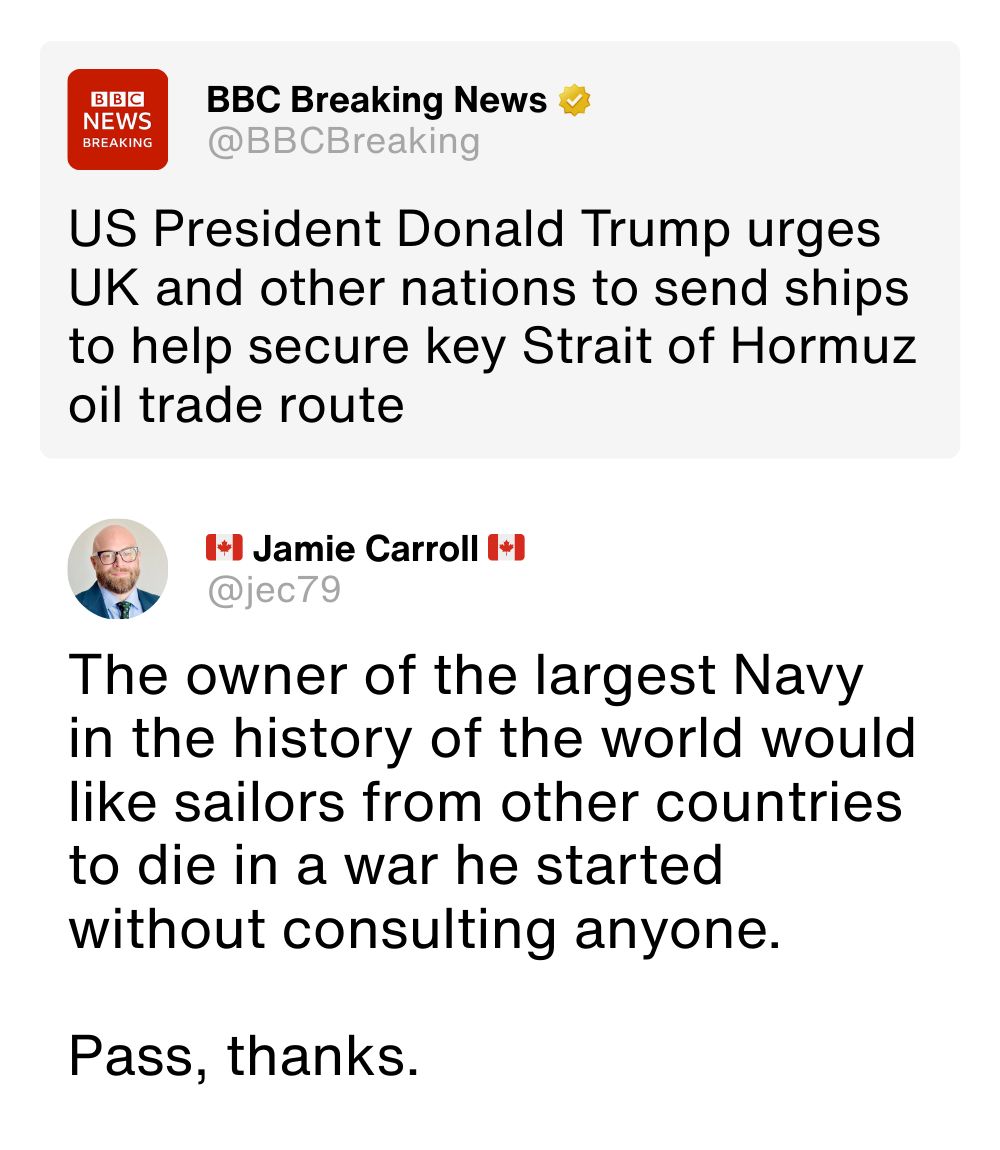
This meme satirizes American military interventionism by flipping a standard security pledge on its head. It begins with a real news headline from BBC asking other nations to send ships for oil safety, implying that cooperation and trade routes are important goals. The text then instantly refutes this by claiming the "owner of the largest Navy" would rather have sailors die in a war he started without consulting anyone. The final line, "Pass, thanks," mocks American arrogance and refusal to acknowledge these aggressive military postures.
detailed-analysis (gemma3_27b-it-q8_0)
Okay, let's break down this meme through the lens of the "Anti-America" category, incorporating relevant theoretical frameworks where applicable.
Overall Interpretation (from an Anti-American Perspective):
This meme fundamentally critiques US exceptionalism, unilateralism, and perceived hypocrisy. It frames a request for international support (to secure the Strait of Hormuz, a crucial oil route) as a demand for other nations to potentially sacrifice their personnel in a conflict initiated by the US, without any democratic consultation or shared decision-making. The tone is deeply sarcastic, highlighting a perceived willingness of the US to exploit global resources and potentially endanger others for its own benefit. It taps into long-standing criticisms of American imperialism and its historical pattern of interventionism.
1. Visual Description
The meme is composed of two Twitter screenshots. The top one is a post from BBC News reporting that Donald Trump (then US President) requested assistance from the UK and other nations to secure the Strait of Hormuz. The second is a reply from Jamie Carroll, stating a deliberately blunt and sardonic response. Carroll's tweet is the core of the meme's message. The inclusion of the Canadian flag next to his name likely indicates his national origin, further underlining the "outsider" perspective on US actions.
2. Foucauldian Genealogical Discourse Analysis
From a Foucaultian perspective, the meme deconstructs the discourse of security that underpins US foreign policy. The “security” of the Strait of Hormuz isn’t presented as a universal, neutral goal, but as a power/knowledge construct shaped by US interests.
- Genealogy: We can trace the genealogy of this “security” discourse back through decades of US involvement in the Middle East, resource control, and military interventions. It's linked to a historical narrative of American leadership and responsibility for global stability – a narrative this meme directly challenges.
- Power/Knowledge: The tweet exposes the power dynamic inherent in the BBC News report. The US, as a dominant power, defines the threat and dictates the “solution” (requiring others to contribute). The other nations’ responses are not represented in the initial reporting, highlighting their lack of agency within this discourse.
- Disciplinary Power: By framing the situation as a "request" for help, the US exerts a subtle form of disciplinary power. While not explicitly coercive, it relies on a network of alliances and expectations, compelling other nations to consider complying. The meme reveals this disciplinary process.
3. Marxist Conflict Theory
The meme clearly resonates with Marxist conflict theory. The core issue at stake – control of the Strait of Hormuz – is fundamentally about controlling a key resource (oil) and, therefore, economic power.
- Class Struggle (Expanded): While traditionally focused on internal class divisions, we can extend the concept to include international class struggle or, more accurately, the struggle between nations representing capitalist interests. The US, as a major capitalist power, is seeking to protect its access to vital resources.
- Imperialism: The meme implicitly critiques US imperialism. The demand for assistance is framed as a form of economic exploitation – the US seeks to outsource the risk and cost of securing its economic interests to other nations.
- The role of the state: The state (US) is acting in the interest of capital, protecting the ability of US-based corporations to extract profit from oil resources. The meme exposes how the state's actions are driven by economic imperatives rather than genuine concern for global security.
4. Postmodernism
A postmodern reading would focus on the deconstruction of grand narratives, like the "US as a benevolent global protector."
- Rejection of Metanarratives: The meme rejects the idea that the US has a legitimate claim to global leadership or that its actions are motivated by altruism.
- Skepticism of Truth: The meme’s sarcastic tone reflects a skepticism about the “truth” of official pronouncements from the US government. It implies that there’s a hidden agenda beneath the stated goal of securing the Strait of Hormuz.
- Irony and Parody: The tweet uses irony to expose the absurdity of the US request. It parodies the language of security and international cooperation, suggesting that it’s merely a facade for self-interest.
5. Why other analyses don’t fully apply
- Queer Feminist Intersectional Analysis: While possible to layer this in (thinking about how militarism and resource conflicts disproportionately impact marginalized communities), it's not central to the meme’s core argument. The primary focus is on the relationship between nations and the dynamics of power, not specifically on gender, sexuality, or intersectional identities.
In conclusion: From the "Anti-America" category, this meme is a sharp critique of US foreign policy, exposing its perceived hypocrisy, self-interest, and willingness to risk the lives of others for its own economic gain. It relies on sarcasm, irony, and a rejection of dominant narratives to convey its message. The theoretical frameworks outlined above help to unpack the deeper layers of meaning and highlight the meme's resonance within a broader context of anti-imperialist and anti-US sentiment.
simple-description (llama3.2-vision_11b)
The meme is a satirical commentary on the United States' foreign policy, specifically its involvement in the Strait of Hormuz oil trade route. The top part of the image features a BBC News Breaking News tweet from President Donald Trump, urging the UK and other nations to send ships to help secure the key oil trade route. Below this, a response from user @jec79 is shown, criticizing the President's statement by comparing him to the owner of the largest Navy in history, who would have wanted to die in a war he started without consulting anyone. The response is accompanied by a Canadian flag emoji, indicating that the user is Canadian and likely critical of the US's actions. The meme is meant to be humorous and critical of the US's foreign policy, with the user's response serving as a satirical commentary on the President's statement.