First Seen
2025-09-05T01:35:30.388455+00:00
simple-description (qwen3.5_2b-q8_0)
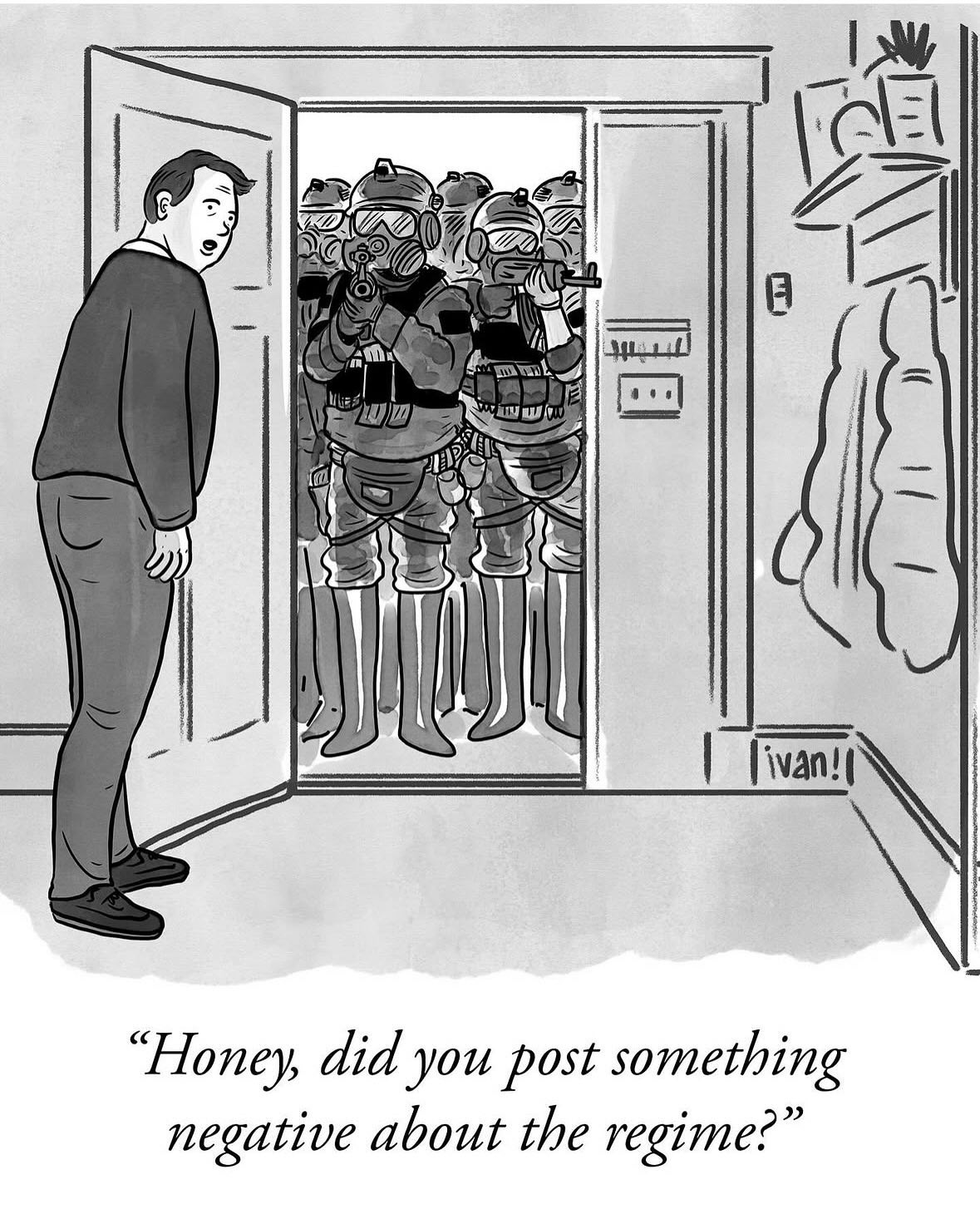
This meme satirizes the current trend of American political discourse where citizens now claim dislike for their own country. The text asks someone to share negative thoughts about their government, effectively inviting critics to label it an oppressive regime. A soldier enters to block him out because this person just asked people to post something bad about America.
detailed-analysis (gemma3_27b-it-q8_0)
Okay, let's break down this meme from a specifically "Anti-America" perspective, using the requested theoretical frameworks where relevant. It’s important to state upfront that applying these theoretical lenses is about understanding the implied critique within the meme, rather than necessarily endorsing its conclusions.
Image Description
The cartoon depicts a man opening a doorway to reveal a heavily armed, militarized police (likely SWAT) team filling the entire space. The man appears startled and frightened, and is asking, “Honey, did you post something negative about the regime?” The setting is domestic - the doorway suggesting a home, adding to the sense of the violation of personal space. There’s a small poster on the wall in the entryway with “Ivan!!” in large letters, possibly referencing an antagonist or cultural reference. The overall style is a stark black and white, adding to the grimness. The implication is clear: expressing dissent, even online, can lead to a highly aggressive, even terrifying, response.
Foucauldian Genealogical Discourse Analysis
This meme is highly resonant with Foucault’s ideas about power, knowledge, and discourse.
- Disciplinary Power: The armed SWAT team represents the exercise of disciplinary power. Foucault argued that power isn’t simply repressive (a top-down force); it's productive. It produces docile bodies—individuals who internalize norms and self-regulate. The very threat of this kind of response (the team arriving at someone’s door) serves to regulate speech and behavior. It aims to instill a constant awareness of the limits of acceptable discourse.
- Panopticism: While not a direct panoptic scene (no central tower observing), the meme invokes the feeling of panoptic surveillance. The possibility that any online expression could be monitored and trigger this response creates a self-monitoring effect. Individuals modify their behavior, fearing potential repercussions even if they aren’t actively being watched.
- Genealogy of the Police: Foucault traced the historical development of the police, showing how they transitioned from simply enforcing the law to actively managing populations and controlling behavior. This meme represents a heightened, almost dystopian, version of that trend—where the police are not protectors but enforcers of ideological conformity.
- Regime of Truth: The question "Did you post something negative about the regime?" highlights the existence of a ‘regime of truth’ – the ways in which power structures define what is considered true, legitimate, and acceptable knowledge. Dissenting opinions are not merely errors, but threats to the established order.
Critical Theory
From a Critical Theory standpoint (drawing on the Frankfurt School), this meme exposes the ways in which the ostensibly democratic “regime” utilizes its power to suppress critical thought and maintain the status quo.
- Instrumental Rationality: The SWAT team represents a purely instrumental rationality – using force as a means to an end (silencing dissent) without regard for ethical or moral considerations. The goal isn’t justice or safety, but the preservation of power.
- Culture Industry: The meme can be seen as a critique of the “culture industry” and the increasing homogenization of thought. By silencing dissenting voices, the regime seeks to control the narrative and prevent alternative perspectives from emerging.
- False Consciousness: The meme implies a disconnect between the proclaimed ideals of the regime (freedom of speech, democracy) and its actual practice (intimidating and suppressing dissent). This contributes to a condition of “false consciousness,” where individuals are unaware of the true nature of their oppression.
Marxist Conflict Theory
In a Marxist framework, the meme highlights the inherent conflict between the ruling class and the oppressed.
- State as an Instrument of Class Rule: The SWAT team represents the state apparatus, which Marxists view as an instrument of class rule, used to protect the interests of the ruling class. The response to dissenting speech is not about maintaining order, but about suppressing potential challenges to the existing power structure.
- Ideological Control: The meme suggests that the regime uses force to enforce its ideology and prevent the emergence of counter-ideologies. By silencing dissent, it prevents the working class from developing a critical consciousness and organizing resistance.
- Alienation: The domestic setting emphasizes the intrusion of the state into the private lives of individuals, contributing to a sense of alienation and powerlessness.
Postmodernism
A postmodern reading would focus on the breakdown of grand narratives and the instability of truth.
- The Death of Metanarratives: The meme suggests that the traditional narrative of a benevolent, democratic state is crumbling. The reality revealed—a heavily armed response to online speech—contradicts the proclaimed values of freedom and justice.
- Simulacra and Simulation: The “regime” itself could be seen as a simulacrum – a copy without an original, a constructed reality that has lost touch with any underlying truth. The response of the SWAT team is a performance of power, designed to create a sense of fear and obedience.
- Deconstruction of Power: The meme deconstructs the image of state authority, revealing its underlying brutality and repressive potential.
In summary:
From an “Anti-America” viewpoint, this meme functions as a potent critique of the American state, portraying it as a repressive force that suppresses dissent and maintains control through fear and intimidation. The theoretical frameworks above illuminate the various ways in which the meme reveals the underlying power dynamics, ideological control, and historical context that shape this reality. The image implies that even expressing mild criticism of the system carries significant risk, suggesting a deeply authoritarian undercurrent within the seemingly democratic society.
Disclaimer: This analysis is based on the prompt's request for an interpretation from an "Anti-America" perspective. It does not necessarily reflect my own views, and is presented solely for the purpose of fulfilling the prompt's requirements.
simple-description (llama3.2-vision_11b)
The meme is a humorous illustration of a situation where someone is being confronted by a group of soldiers or police officers, likely in a foreign or hostile country. The text "Honey, did you post something negative about the regime?" is a sarcastic and ironic comment, implying that the person's online activities have attracted the attention of the authorities, and they are being questioned about their online behavior. The meme pokes fun at the idea that someone's online posts can be a threat to the authorities, and the person's response is a witty and humorous way to deflect the situation.