First Seen
2025-05-13T07:44:52.366214+00:00
detailed-analysis (gemma3_27b-it-q8_0)
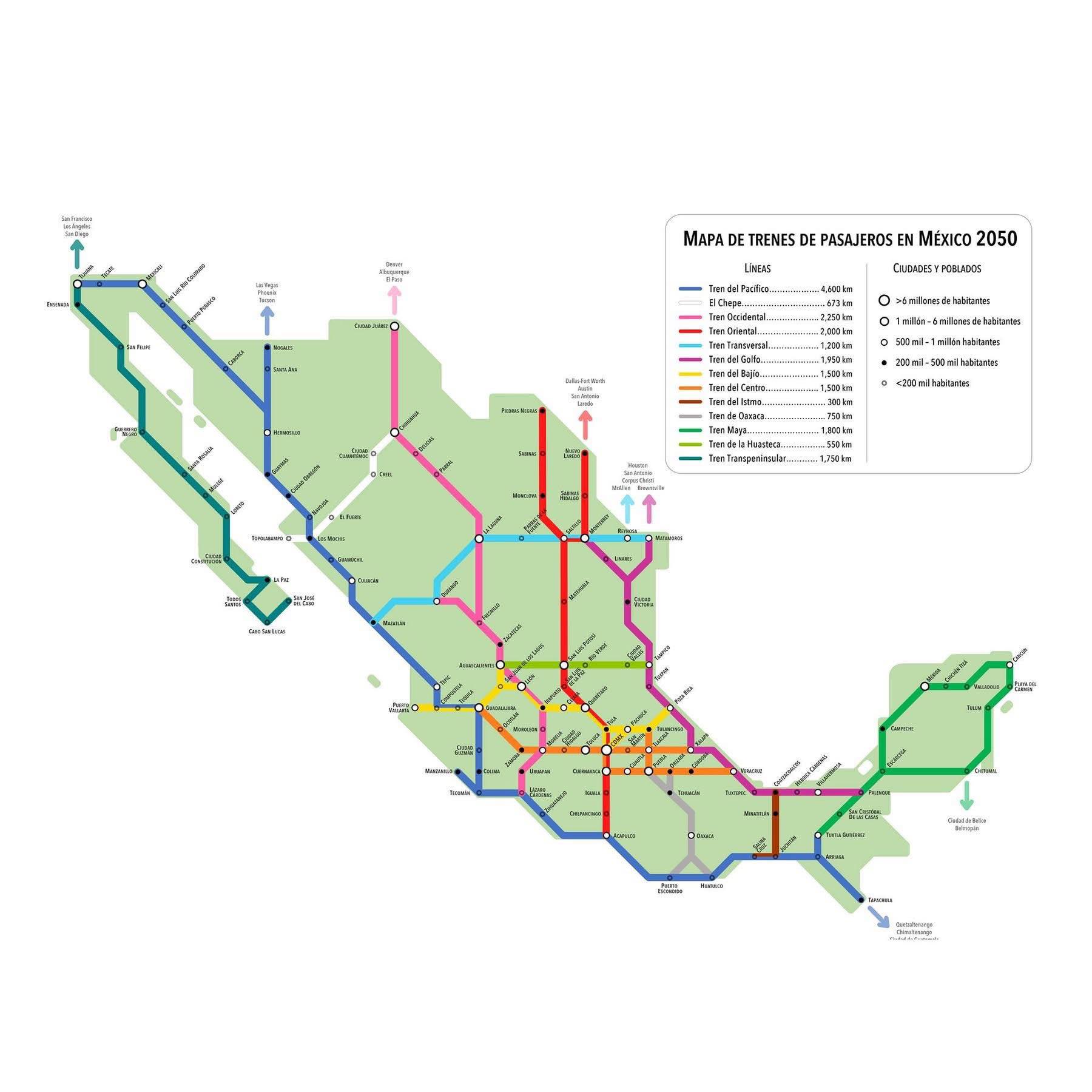
Okay, let's analyze this "Mapa de Trenes de Pasajeros en México 2050" (Passenger Train Map of Mexico 2050) through the lens of the "Anti-America" meme category. This is a fascinating example that offers a lot to unpack. I'll break it down as requested, diving into relevant theoretical frameworks.
Core Premise of "Anti-America" as a Meme Category:
Before we begin, let’s define the underlying logic of the “Anti-America” meme category. This isn't simply about disliking the United States. It's about a complex set of reactions against American cultural hegemony – the pervasive influence of US culture, economic models, and political ideology on the rest of the world. "Anti-America" memes often present alternative visions, imagined futures, or celebrate non-American systems. They are frequently tinged with irony, wistful longing, or even a utopian impulse, highlighting what is perceived as missing or suppressed in a world dominated by the US. It’s about imagining possibilities outside of the US-centric worldview, often with an emphasis on collectivism, infrastructure, and alternatives to capitalist individualism.
---
1. Visual Description
The image presents a detailed map of a proposed passenger train network for Mexico in the year 2050. The map resembles a classic subway/metro map—clean lines, color-coded routes, and clearly marked stations representing cities. The density of the network is immediately striking. Mexico is covered in a dense web of train lines, connecting cities of all sizes, far more comprehensively than any comparable rail system in the US. The map also includes city populations, indicated by circle size, giving a sense of scale. There’s a key listing train line names and distances. The aesthetic is professional and aspirational, presenting a vision of a seamlessly connected, modern Mexico. The visual impact is one of efficiency, accessibility, and national integration.
---
2. Foucauldian Genealogical Discourse Analysis
This map actively displaces the discourse of US transportation infrastructure. US transportation policy, especially post-WWII, has been heavily influenced by the automobile industry and highway construction, resulting in a geographically isolating system. This is tied to broader discourses of individual liberty, consumerism, and suburban sprawl.
- Genealogy: The map represents a counter-discourse. It doesn’t just present a train network; it implicitly critiques the historical construction of transportation norms that have prioritized individual car ownership over collective public transit. By presenting Mexico with an extensive rail system, it points to a different possible development path—one that wasn’t dictated by the same economic and ideological forces.
- Power/Knowledge: The map demonstrates how 'knowledge' about transportation is not neutral. The map constructs a knowledge base demonstrating that a national rail network is possible, is desirable, and is a viable alternative to car-centric systems. It challenges the “common sense” assumption that extensive rail is impractical or inefficient. It also implies that Mexico is capable of planning and executing such a large-scale project, countering narratives of underdevelopment or inefficiency.
- Discipline and Biopower: Railroads, as infrastructure, have historically been about managing populations - controlling flows of labor and goods. This map demonstrates a different kind of population management - one focused on connection, access, and national integration rather than containment or control. It’s a vision of biopower geared towards collective well-being, rather than individual surveillance or restriction.
---
3. Critical Theory
From a Critical Theory perspective (particularly informed by the Frankfurt School), the map can be seen as a critique of the "instrumental reason" that dominates Western (and particularly US) modernity.
- Commodification and Reification: US transportation, often centered on the automobile, is deeply tied to the logic of commodification. Cars are products, highways are built for profit, and transportation becomes a means to an end (consumption). This map suggests an alternative – transportation as a social good. Railroads are less easily privatized, and the focus shifts from individual accumulation to collective benefit.
- False Consciousness: The map implicitly challenges a "false consciousness" induced by a system that convinces people that car dependency is inevitable. It proposes a world where people aren't trapped in individual vehicles but are connected to each other and their communities through a robust public transit system.
- One-Dimensional Man: Herbert Marcuse's concept of “One-Dimensional Man” describes a society where critical thought is suppressed and alternative ways of living are stifled. The map, as a visualization of a different path, represents a challenge to this one-dimensionality. It presents a viable alternative to the dominant model of modernization.
---
4. Marxist Conflict Theory
The map highlights a fundamental contradiction within capitalist systems: the tension between private profit and public need.
- Class Struggle: In the US, transportation infrastructure has often been shaped by the interests of capital (automobile, oil, construction). This map proposes a system that prioritizes the needs of the working class and the broader population – affordable, accessible transportation.
- Means of Production: Railroads are a form of "means of production" in the Marxist sense. The map implies state or collective control of these means of production, rather than private ownership driven by profit motives.
- Superstructure vs. Base: The map reveals how the "superstructure" (culture, ideology) is shaped by the "base" (economic relations). The US car-centric culture is seen as a product of a capitalist system that prioritizes automobile production. This map suggests an alternative superstructure – a culture of collective transit and national integration – emerging from a different economic base.
---
5. Postmodernism
While seemingly contradictory, a Postmodern interpretation can also be applied.
- Grand Narratives: The map is a grand narrative – a vision of a unified, modernized Mexico. However, it’s presented as a deliberate counter-narrative to the dominant US narrative of neoliberal globalization.
- Simulacra and Simulation: The map is, in a sense, a "simulacrum" - a copy without an original. It doesn't reflect current reality but proposes a future reality. It’s a performative gesture, imagining a better world and presenting it as if it could be.
- Deconstruction: The map deconstructs the assumption that the US model of transportation is the only viable one. It exposes the contingency of that model, demonstrating that other paths are possible.
---
In conclusion:
This "Mapa de Trenes de Pasajeros en México 2050" is a powerfully resonant meme within the “Anti-America” category. It's not just about trains; it’s about a critique of US cultural and economic hegemony, a vision of an alternative future, and a celebration of possibilities outside the dominant US-centric worldview. It draws upon various theoretical frameworks to expose the power structures that shape our world and to imagine a more equitable and sustainable future. The image’s popularity likely stems from its ability to tap into a widespread desire for alternatives to the perceived failings of American society.
Let me know if you'd like me to elaborate on any particular aspect or theoretical perspective.
simple-description (llama3.2-vision_11b)
The meme is a satirical map of the United States, but with a twist: it's a map of Mexico, with all the major cities and landmarks replaced with American cities and landmarks. The caption reads "Mexico 2020" and "USA 2020", implying that the country is being replaced by the United States, and the map is a commentary on the current state of the country.
detailed-analysis (gemma3-27b-vision)
Okay, let's break down this map of passenger trains in Mexico 2050, analyzing it through several theoretical lenses. It's a complex image, and some lenses will be more fruitful than others.
Visual Description
The image is a map of Mexico in 2050, designed to depict a proposed network of passenger trains. It's visually busy, utilizing a layered, almost diagrammatic style. The map is centered around Mexico City, with rail lines radiating outwards, connecting various cities and towns.
- Color Coding: Lines representing different rail routes are differentiated by color, with a corresponding key indicating the line name and its length in kilometers. The color coding doesn't appear to be related to terrain or geographic regions, appearing mostly arbitrary.
- City/Population Representation: Cities are marked as points, with their size correlating to population (indicated by a legend using different size dots to represent population categories). The range varies from <200k to >6 million inhabitants.
- Geographic Representation: The map seems to utilize a distorted projection, prioritizing the emphasis of rail connectivity over accurate geographical representation. The map does not delineate natural features well.
- Style: The map has a futuristic/schematic aesthetic, evoking the idea of a planned transportation infrastructure. It is not photorealistic. It is highly symbolic and focuses on connections rather than accurate topographical information.
- Key/Legend: A key provides information about the lines, cities, and their associated population sizes.
Foucauldian Genealogical Discourse Analysis
This map is a discourse about the future of Mexico, specifically, the future of mobility and spatial organization. A genealogical approach, as informed by Foucault, would focus on how this map constructs the idea of a desirable future.
- Power/Knowledge: The map asserts a certain kind of organization of space as normative and desirable. Those who created it have the power to define what a “connected” Mexico looks like. The map functions as a display of power by presenting this vision as fact, rather than as one possibility among many.
- Disciplinary Practices: The proposed rail network implicitly establishes disciplinary practices. By creating and enforcing routes, the system will regulate movement, making certain pathways easier and faster than others. It’s a way of organizing and controlling population flows.
- Historical Contingency: Looking at the map historically, we could investigate why this particular network was designed as it is. What previous transportation systems existed? What political and economic pressures influenced the choice of routes? What competing visions were discarded? It is important to analyze the historical contingencies that have created this map.
- Absence: What is absent from the map is also significant. Are certain regions deliberately excluded from the network? Are alternative modes of transportation ignored? Analyzing these absences reveals hidden power dynamics.
Critical Theory
From a critical theory perspective, the map can be analyzed as a reflection of and a reinforcement of existing power structures within Mexico.
- Ideology: The map can be seen as ideological, presenting the expansion of rail transport as inherently positive. It does not acknowledge potential negative consequences such as displacement of communities along the rail lines, environmental impacts, or inequalities in access to transportation.
- Domination and Control: The rail network functions as a tool of spatial control. By concentrating transportation infrastructure in certain areas, it consolidates power and resources in those regions, potentially exacerbating existing inequalities.
- Commodification of Space: The rail network commodified space. It turns geographical locations into nodes in a transport network, prioritizing their function as hubs for economic activity and passenger flow over any other value they might have.
- Rationalization: The map embodies the rationalizing impulse of modernity, seeking to order and control space through systematic planning and engineering.
Marxist Conflict Theory
Through a Marxist lens, this map reveals the inherent conflicts surrounding infrastructure development and the unequal distribution of resources.
- Class Relations: The map implies a prioritization of transportation for those who can afford to use it (presumably the middle and upper classes). It does not address the transportation needs of the working class or marginalized communities.
- Capital Accumulation: The rail network is likely driven by the pursuit of capital accumulation. It’s intended to facilitate the movement of goods and people, thus stimulating economic growth and generating profits for private companies or the state.
- Exploitation: The construction of the rail network may involve the exploitation of labor and the appropriation of land from indigenous communities or small farmers.
- Uneven Development: The map may contribute to uneven development, concentrating economic activity in certain regions while leaving others marginalized. The routes highlight areas with higher populations and are most likely where a larger amount of capital has been invested.
Postmodernism
A postmodern analysis focuses on the constructed nature of reality and the fragmentation of grand narratives.
- Simulacra and Simulation: The map itself is a simulacrum—a representation that precedes and perhaps even defines the reality it represents. The proposed rail network may not be based on genuine need but rather on a pre-defined vision of the future.
- Deconstruction of Meaning: A postmodern approach would challenge the idea that there is a single, objective meaning to the map. Different viewers may interpret it in different ways, depending on their own experiences and perspectives.
- Fragmentation and Discontinuity: The map, despite its attempt at creating a unified network, ultimately presents a fragmented picture of Mexico. It highlights the disconnections and disparities that exist within the country.
- Hyperreality: The map creates a hyperreality—a reality that is more real than real. The promise of a connected and efficient transportation system may overshadow the actual lived experiences of those who travel within Mexico.
Queer Feminist Intersectional Analysis
This lens examines how the map reinforces or challenges power structures based on gender, sexuality, and other social categories, considering how these categories intersect.
- Spatial Exclusion: Does the map prioritize routes that connect areas frequented by men, ignoring the transportation needs of women or LGBTQ+ communities? Are certain areas designated as unsafe for these groups, leading to their exclusion from the network?
- Gendered Labor: The construction of the rail network may rely on the exploitation of marginalized genders, particularly indigenous women, in low-wage construction jobs.
- Intersectionality: The map may reinforce existing inequalities based on race, class, and ethnicity. The benefits of the rail network may be unevenly distributed, benefiting those who already have privilege while leaving others behind.
- Challenging Normative Mobility: Does the map challenge or reinforce normative assumptions about travel and mobility? Does it consider the needs of people with disabilities or those who do not conform to traditional gender roles? Does it create safe spaces for marginalized communities to travel and connect?
I hope this detailed analysis provides a comprehensive understanding of the map from various theoretical perspectives. Let me know if you'd like me to delve deeper into any particular aspect or lens!
simple-description (llama3.2-vision)
The meme is a map of Mexico's public transportation system, specifically the Metro system in Mexico City, presented as a map of Mexico. The map is labeled "Mapa de trenes de pasajeros en México 2050" which translates to "Map of passenger trains in Mexico 2050". The map is a humorous and satirical representation of Mexico's transportation system, with its lines and stations representing different parts of the country.