First Seen
2025-03-17T02:45:56.601474+00:00
detailed-analysis (gemma3_27b-it-q8_0)
Okay, let's analyze this meme within the "Anti-America" category, using the requested theoretical frameworks. It’s important to note that applying these frameworks is often interpretive, and nuance is key.
Overall Interpretation: The meme, within the anti-America context, expresses a belief that the core problems plaguing the US stem from its inherent internal contradictions and hypocrisies – namely, the targeting of “ordinary” or “progressive” symbols (Teslas) as terrorism while historical and systemic violence perpetrated by groups like the KKK are downplayed or even excused. The core argument is that the nation is deeply flawed and unlikely to improve due to these double standards.
---
1. Visual Description
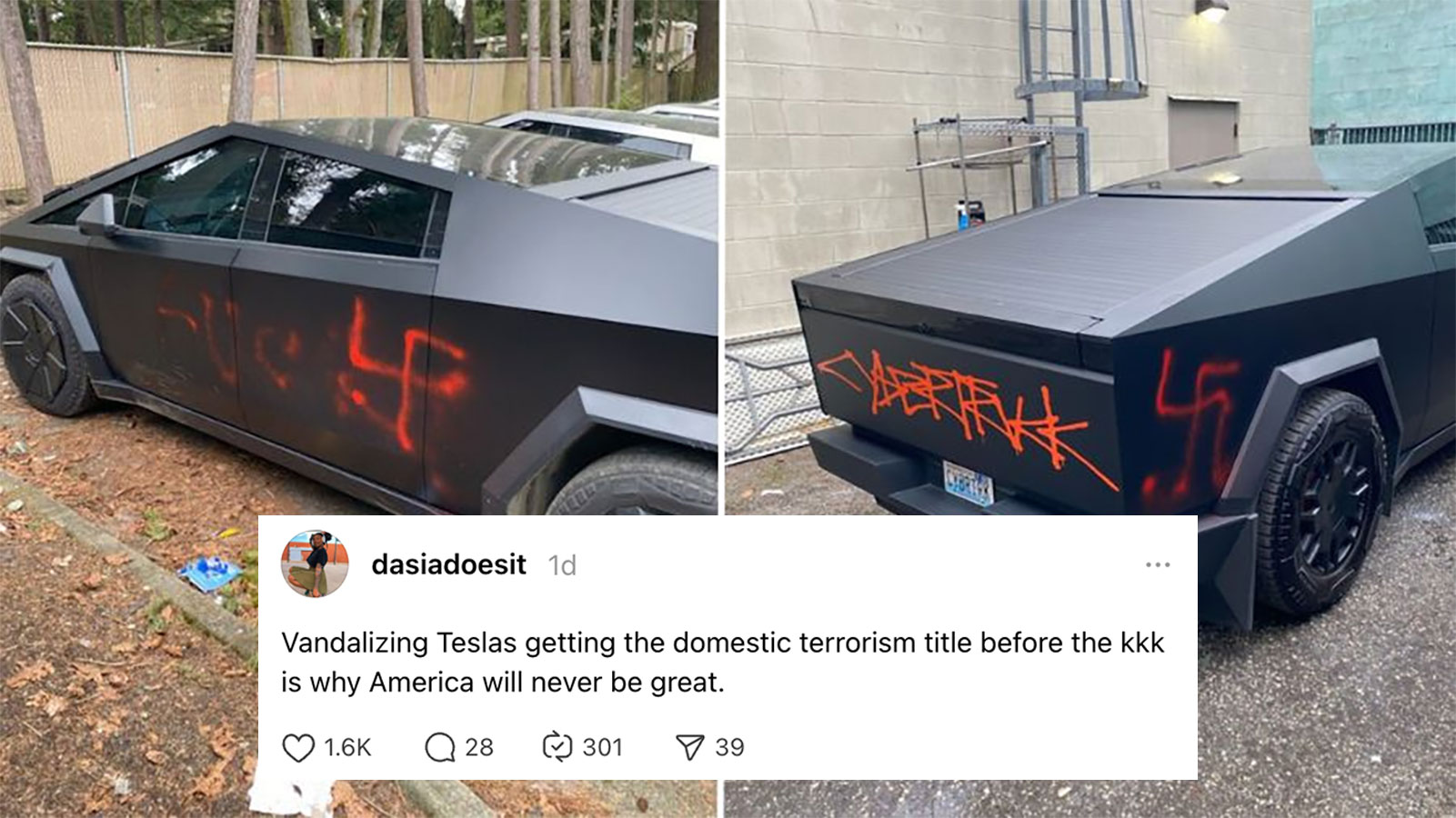
The image depicts a Tesla Cybertruck vandalized with red spray paint. The visible graffiti includes the number "45" (presumably referencing Donald Trump) and what appears to be other markings, potentially symbols or short phrases. The Tesla is a visually striking vehicle, designed to be futuristic and disruptive. Its sleek, angular form stands in contrast to the chaotic, aggressive act of vandalism. The backdrop appears to be a suburban or semi-urban setting, suggesting this occurred within a fairly normalized environment. The juxtaposition is crucial: a symbol of technological innovation and, for some, a progressive future, defaced with political markings.
2. Foucauldian Genealogical Discourse Analysis
From a Foucaultian perspective, this meme disrupts the discourse around "terrorism." Traditionally, "terrorism" is a label applied to external threats or fringe extremist groups. The meme suggests a re-calibration of that discourse. It argues that the act of vandalizing Teslas – often seen as vehicles owned by relatively affluent, progressive individuals – is being constructed as "domestic terrorism" at a rate faster than the acknowledgement of historical, systemic terrorism practiced by groups like the KKK.
- Genealogy of "Terrorism": Foucault would ask: how has the meaning of "terrorism" been shaped historically? Who has the power to define it? This meme implies that the definition is shifting, being manipulated for political purposes.
- Power/Knowledge: The meme points to a power dynamic where certain forms of dissent are criminalized and labeled as "terrorism" while established forms of systemic violence are normalized. This demonstrates how "knowledge" (in this case, the understanding of what constitutes terrorism) is intertwined with power.
- Discursive Formation: The meme aims to challenge the current discursive formation around terrorism by bringing the focus to the unequal application of the label.
3. Critical Theory
Critical Theory, stemming from the Frankfurt School, would focus on the ways in which this meme reveals systemic power structures and ideological contradictions within American society.
- Critique of Instrumental Reason: The Tesla, as a symbol of technological progress, could be seen as representing a faith in instrumental reason – the idea that problems can be solved through technological fixes. The vandalism disrupts this faith, suggesting that technological advancement alone cannot address deeper social and political issues.
- Culture Industry: The meme implicitly critiques the "culture industry" (the mass production of culture). The Tesla is part of this culture industry, a product designed to be desirable and status-symbolic. Defacing it is a rejection of this system of manufactured desire.
- Ideology: The meme challenges the dominant ideology that America is a beacon of freedom and justice. It points to a contradiction – that the nation simultaneously condemns relatively minor acts of protest while tolerating historical and ongoing systemic violence.
4. Marxist Conflict Theory
From a Marxist viewpoint, this meme reflects class struggle and the inherent contradictions within a capitalist system.
- Class Conflict: The Tesla is a luxury item, often associated with a wealthier demographic. Vandalizing it could be seen as an expression of resentment towards the perceived privileges of the upper class. The comparison to the KKK might be a way of pointing out how systemic oppression (tied to class, race, etc.) continues to be ignored while petty crimes against property receive outsized attention.
- False Consciousness: The meme suggests that the focus on vandalizing Teslas as terrorism is a distraction – a way to maintain the status quo by focusing attention on superficial issues rather than addressing deeper systemic problems.
- Ideological State Apparatus: The media and the legal system, in this view, act as ideological state apparatuses, reinforcing the dominant ideology and suppressing dissent. The meme argues that they are biased in their application of the “terrorism” label.
5. Postmodernism
A postmodern interpretation would emphasize the deconstruction of grand narratives and the instability of meaning.
- Deconstruction of “Terrorism”: The meme deconstructs the notion of "terrorism" by challenging its fixed definition. It suggests that the term is fluid, subjective, and politically motivated.
- Rejection of Meta-Narratives: The meme rejects the grand narrative of American exceptionalism. It asserts that the nation is fundamentally flawed and incapable of achieving greatness due to its internal contradictions.
- Fragmentation and Simulacra: The image itself could be seen as a fragmented signifier, lacking a clear, stable meaning. The act of vandalism becomes a symbol of resistance against a hyperreal world where appearances often outweigh substance.
---
Important Considerations:
- Specificity of "Anti-America": The strength of these interpretations relies heavily on understanding the nuance within the "Anti-America" category. It’s not merely about disliking the US; it's often about critiquing its historical and ongoing injustices.
- Meme Context: The meme's impact is also shaped by the specific platform it's shared on (Twitter in this case) and the broader online conversations surrounding it.
I hope this detailed analysis is helpful! Let me know if you'd like me to elaborate on any of these points.
simple-description (llama3.2-vision_11b)
The meme is a photo of a Tesla with swastikas and a racial slur spray-painted on it, accompanied by a caption from a Twitter user that says "vandalizing Teslas with Nazi symbols is a great way to show the world how much you hate America."
detailed-analysis (gemma3-27b-vision)
Okay, let's break down this image and accompanying social media post through the lenses you've requested. Given the content, certain sections will be more substantial than others.
Visual Description
The image shows a black Tesla Cybertruck with graffiti spray-painted on its side and rear. The graffiti appears to consist of a combination of symbols and letters, including the number "57" and a symbol resembling a broken circle with lines. The vehicle is parked outdoors, possibly in a parking lot near a building with chain link fencing visible in the background. The image is in color and appears to have been taken with a smartphone. The image is split into two panes and is a screenshot of a social media post. The post includes a username, a comment, and the number of reactions to the post.
Foucauldian Genealogical Discourse Analysis
The act of vandalizing Teslas, as highlighted in the post, can be analyzed through a Foucauldian lens by examining the discourse surrounding it. Michel Foucault’s genealogical method focuses on uncovering the power dynamics embedded within seemingly neutral actions and statements. Here’s how it applies:
- Discourse of "Domestic Terrorism": The post directly links vandalism to the label of "domestic terrorism." A Foucauldian analysis would investigate how this label emerged, who wields it, and what power it grants them. It isn't an objective truth, but a construct shaped by historical forces and used to define (and control) certain behaviors.
- The Power/Knowledge Nexus: The assignment of "domestic terrorism" isn't about objective harm; it's about establishing power. By labeling an act as terrorism, the state (or those wielding the label) gains justification for surveillance, repression, and control. This act can be seen as a power play.
- The Genealogy of "Vandalism": What constitutes vandalism? Is it solely about property damage? Or is it a form of protest, a challenge to the status quo? Examining the historical development of the concept of vandalism reveals how it's been used to suppress dissent. The graffiti itself can be viewed as a counter-discourse, an attempt to disrupt the dominant narratives.
Critical Theory
This image lends itself well to analysis through the Frankfurt School's Critical Theory.
- Culture Industry & Commodity Fetishism: The Tesla Cybertruck represents a key component of late-stage capitalist culture. It is a heavily marketed product, imbued with symbolic meaning. The vandalism is a direct attack on a symbol of wealth, innovation, and technological progress. It challenges the fetishization of commodities.
- Domination & Resistance: Critical Theory examines how power structures maintain domination. The vandalism could be seen as a form of resistance against perceived injustices, systemic inequalities, or the dominance of a particular ideology (e.g., techno-capitalism). It challenges the social order.
- Ideology Critique: The post's claim that this vandalism will prevent America from being "great" reveals an underlying ideological assumption about what constitutes "greatness." Critical Theory would unpack this assumption, questioning whose interests are served by this definition.
Marxist Conflict Theory
From a Marxist perspective, this image encapsulates class conflict.
- Class Warfare: Teslas, being luxury vehicles, are symbols of wealth and privilege. Vandalizing them can be interpreted as an attack on the ruling class and the symbols of their power. This act of vandalism represents a direct expression of resentment towards the affluent.
- Capitalist Exploitation: The production and consumption of Teslas are rooted in a system of capitalist exploitation. The vandalism could be seen as a rejection of this system, a protest against the inequalities it creates.
- Alienation: The commenter's pessimism about America could be seen as stemming from feelings of alienation—a sense of disconnection from society and a lack of control over one's own life, a common theme in Marxist thought.
Postmodernism
Postmodern analysis would focus on deconstructing the meaning and signs within the image and post.
- Simulacra & Simulation: The Tesla, and its image, are already heavily mediated and represent a simulation of "future" technology and "modern" living. The vandalism layers another layer of simulation on top of that, further obscuring any "real" meaning.
- Deconstruction of "Greatness": The comment about America’s “greatness” deconstructs the idea of a singular, objective notion of national success. It highlights how such concepts are socially constructed and open to interpretation.
- Rejection of Grand Narratives: The commenter's pessimism suggests a rejection of “grand narratives,” such as the idea of inevitable progress or the American Dream. This skepticism is characteristic of postmodern thought.
Queer Feminist Intersectional Analysis
This lens is the least immediately applicable, but some connections can be made.
- Challenging Power Structures: While the vandalism itself doesn't directly relate to queer or feminist issues, the act of defiance and resistance can be framed as challenging patriarchal and heteronormative power structures. The commenter's assertion could be seen as a frustration with systemic oppression, including those based on gender and sexuality.
- Marginalized Voices: The vandalism might be motivated by a desire to amplify the voices of marginalized groups who feel excluded from mainstream society.
- Symbolic Disruption: Graffiti, as a form of public art, can be a way to reclaim public space and disrupt dominant narratives. This can be particularly empowering for marginalized communities.
Important Note: These are interpretations. The actual motivations and meanings behind the vandalism and the post are complex and likely multifaceted. The above analyses offer different lenses through which to understand the image and its context.
simple-description (llama3.2-vision)
This meme is a humorous take on the infamous Tesla Cybertruck vandalism incident. The image shows the Cybertruck with swastika and Nazi symbols spray-painted on it, with the caption "Vandalizing Teslas getting the domestic terrorism title before the KKK is why America will never be great."