First Seen
2024-11-14T17:15:12.071263+00:00
detailed-analysis (gemma3_27b-it-q8_0)
Here's a breakdown of the meme through the lens of "Anti-America" scholarship, incorporating the requested theoretical frameworks where relevant.
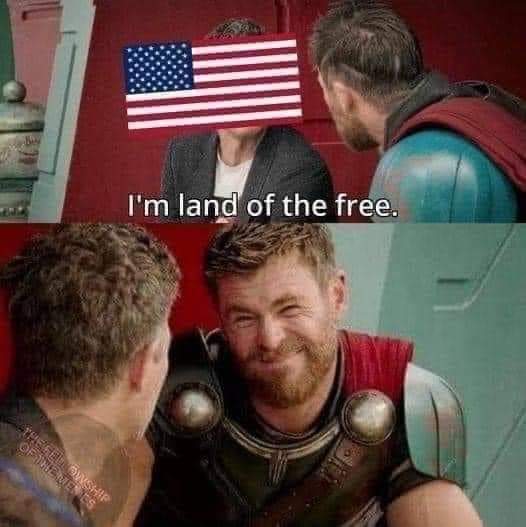
Overall Framing: This meme fundamentally critiques the foundational American myth of freedom and casts it as a knowing, cynical lie. The juxtaposition of a seemingly earnest statement ("I'm land of the free") with a blatant display of insincerity (Thor's wink) suggests a disconnect between the rhetoric and the reality of the United States. The context within the "Anti-America" category suggests a deep skepticism towards American exceptionalism and a critical stance towards its historical and contemporary practices.
---
Visual Description:
The meme uses a two-panel format based on a scene from a Thor movie.
- Top Panel: Shows two figures, one obscured, with the American flag superimposed on the first figure, presumably representing the US. Text reads, "I'm land of the free". The figures' body language is serious and formal.
- Bottom Panel: Shows Thor, played by Chris Hemsworth, with a distinctly mischievous wink, looking directly at the viewer. He is in his Asgardian battle attire. The wink is the key visual element.
The visual contrast is stark. The formal, somewhat stiff presentation of the top panel contrasts sharply with Thor's casual, knowing expression. This deliberately creates a sense of irony and disbelief.
---
Foucauldian Genealogical Discourse Analysis
Michel Foucault's work on power/knowledge is incredibly relevant. The meme isn't simply denying that the US is the "land of the free," but rather it's questioning how that claim became a powerful discourse – a way of understanding and ordering the world.
- Genealogy of "Freedom": A Foucauldian approach would ask: What historical forces, power dynamics, and systems of knowledge constructed the very concept of “freedom” as it is understood in the American context? How has this concept been used to legitimize certain actions (like colonialism, slavery, imperialism, etc.) while silencing dissenting voices? The meme implicitly suggests that this genealogy reveals a darker, contradictory history.
- Discursive Formation: The statement "I'm land of the free" isn't just a factual assertion; it's part of a larger discursive formation that shapes how Americans (and the world) think about the US. The wink challenges this formation, undermining its authority by exposing it as a performance.
- Power/Knowledge: The meme exposes the link between power and knowledge. The ability to define “freedom” and then present it as a self-evident truth is a form of power. By questioning that definition, the meme subtly disrupts that power dynamic.
---
Critical Theory
Drawing on the Frankfurt School, this meme embodies a critique of ideology.
- False Consciousness: The meme critiques the idea that most Americans operate under "false consciousness"—a state of being unaware of the true nature of the socio-political and economic systems that govern their lives. The statement "I'm land of the free" is presented as part of this ideology, a comforting narrative that obscures the realities of inequality, oppression, and exploitation.
- The Culture Industry: The use of a popular culture figure (Thor) to deliver this critique can be seen as a form of intervention within the “culture industry.” It repurposes a mainstream image to challenge mainstream narratives.
- Enlightenment Critique: Critical Theory builds on a critique of the Enlightenment’s rationalistic promises. The meme suggests that the ideals of liberty and equality, hallmarks of the Enlightenment tradition, have been corrupted and betrayed in the American context.
---
Marxist Conflict Theory
From a Marxist perspective, the meme highlights the inherent contradictions within capitalist societies like the US.
- Class Struggle: The "land of the free" rhetoric often masks the realities of economic inequality and class struggle. While certain freedoms may exist legally, access to those freedoms is heavily conditioned by class. The meme suggests that the promise of freedom is a smokescreen for maintaining the existing power structures.
- Ideological Apparatus: The state (and its associated institutions) function as an "ideological apparatus," producing and disseminating ideologies that legitimize the capitalist system. "I'm land of the free" is a key component of this ideology. The wink exposes the inherent falsity of that ideology.
- Material Conditions: A Marxist analysis would emphasize that material conditions—economic exploitation, poverty, lack of access to healthcare/education—undermine the idea of true freedom. The meme implicitly points to these contradictions.
---
Postmodernism
A postmodern reading would focus on the deconstruction of grand narratives and the rejection of essential truths.
- Rejection of Metanarratives: The meme actively undermines the "American Dream" and the narrative of American exceptionalism—both are "metanarratives" that claim to offer universal explanations of history and society.
- Irony & Pastiche: The use of a superhero image in this context is a form of pastiche—a playful mixing of high and low culture. The irony is central; it highlights the absurdity of believing in simplistic, totalizing narratives.
- Subjectivity & Relativism: The meme doesn’t claim to offer a new "truth" about America. Instead, it suggests that "freedom" is a subjective concept, and its meaning is contingent on perspective and power relations.
---
Queer Feminist Intersectional Analysis
This framework brings in the experiences of marginalized groups and the interconnectedness of oppression.
- Intersectionality of Oppression: For many marginalized groups (people of color, LGBTQ+ individuals, women, disabled people, etc.), the promise of "freedom" in America has always been conditional and incomplete. The meme acknowledges this disparity by subtly suggesting that the narrative of freedom excludes or actively harms these communities.
- Critique of Liberal Identity Politics: The meme is not a call for greater inclusion within the existing system. It's a critique of the system itself. It challenges the idea that simply extending formal rights (e.g., same-sex marriage, racial equality laws) is enough to achieve true liberation.
- Deconstruction of Norms: A queer feminist approach would also analyze how the very concept of "freedom" is often defined in normative terms—based on the experiences and privileges of dominant groups (e.g., white, heterosexual, cisgender men). The wink implicitly mocks those norms.
In conclusion: This meme, from an Anti-American perspective, is a potent expression of cynicism towards American ideals. It's a deconstruction of a powerful myth, drawing on a range of critical and theoretical tools to expose the contradictions and power dynamics that underpin the American project. The wink is the key – it’s a visual signal of a shared understanding of the hypocrisy at the heart of the nation's self-image.
simple-description (llama3.2-vision_11b)
This meme is a play on the phrase "I'm free" from the song "I'm Free" by The Who, but with a patriotic twist. The image shows a person with their face obscured by the American flag, implying that they're embracing their American identity. The text "I'm land of the free" is a clever pun on the phrase "I'm free" that pokes fun at the idea of patriotism and national identity.
detailed-analysis (gemma3-27b-vision)
Okay, let's break down this meme through various critical lenses.
Visual Description
The meme is a two-panel image employing a popular "distracted boyfriend" format.
- Top Panel: Shows a person (presumably representing the United States, indicated by a blurred image of an American flag over their head) walking with another person (unseen, but implied as a form of oppression/harm) while looking longingly at someone else (presumably a population, possibly international or a population within the United States). The text reads, “I’m land of the free.”
- Bottom Panel: Shows the same situation, but focuses on the distracted person (Thor), looking with visible skepticism and a slightly cynical expression. It is a meme format suggesting hypocrisy or conflicting priorities.
Foucauldian Genealogical Discourse Analysis
This meme can be viewed through a Foucauldian lens as a disruption of the discourse surrounding American exceptionalism. Foucault would be interested in how the idea of "land of the free" is not an inherent truth but a constructed narrative, a discourse that has been built up through history to exercise power and legitimize certain actions.
The meme genealogically traces the history of this discourse. It exposes the inherent contradiction: the claim of freedom coexisting with realities of oppression. The “distracted boyfriend” format implies that the nation says one thing ("I’m land of the free") but its actions and priorities point elsewhere—toward harmful practices/oppression. The meme, through its irony, deconstructs the power inherent in the phrase, suggesting it’s a performance, a way of maintaining control rather than a reflection of reality. The skepticism in the second panel is a critique, a refusal to accept the discourse at face value.
Critical Theory
From a broader Critical Theory perspective, the meme exemplifies the critique of ideology. Ideology, in this context, is the system of beliefs and values that perpetuate the status quo, often masking power imbalances. The meme deconstructs the dominant ideology of American freedom by highlighting the discrepancy between this ideal and actual practices. It points to the ways in which power operates through the construction of narratives that serve certain interests (those in power) while obscuring others.
The meme functions as a negative dialectic: it exposes the contradictions within the existing social order by contrasting the proclaimed ideal of freedom with the lived experiences of those who are not free. It doesn’t offer a solution, but it diagnoses a problem, revealing the ways in which the “land of the free” narrative is a form of symbolic violence that masks injustice.
Marxist Conflict Theory
From a Marxist standpoint, the meme can be seen as a representation of class and global power dynamics. "Land of the free" is often presented as a universal benefit, but from a Marxist perspective, it is important to ask who is free and at whose expense? The meme implicitly suggests that the freedom of some (those in positions of power) may come at the expense of others (the oppressed).
The image can be interpreted as a representation of imperialist tendencies. The US, often perceived as a powerful entity, is “distracted” from the problems it creates through its policies and interventions. The meme thus exposes the inherent contradiction in the claim to freedom when coupled with systemic exploitation and oppression. The skepticism expressed by Thor suggests a recognition of this exploitation.
Postmodernism
From a postmodern perspective, the meme embodies a rejection of grand narratives and universal truths. The claim “I’m land of the free” can be seen as a meta-narrative – an overarching story that attempts to explain and justify a whole way of life.
The meme, through its irony and skepticism, deconstructs this meta-narrative. It suggests that there is no single, objective truth about freedom; it is a socially constructed concept subject to multiple interpretations and contradictions. The use of a meme format itself is a postmodern gesture: a playful and self-aware appropriation of existing cultural references to create new meaning.
Queer Feminist Intersectional Analysis
While not explicitly focused on queer or feminist concerns, the meme's exposure of hypocrisy is particularly relevant to these frameworks. Intersectionality recognizes that oppression is multi-layered and interconnected. The claim to “land of the free” is often used to justify policies that disproportionately harm marginalized groups (people of color, LGBTQ+ individuals, women, etc.).
From a queer/feminist perspective, the meme highlights the gap between the idealized narrative of freedom and the lived experiences of those who are systematically denied that freedom based on their identities. The meme implicitly challenges the idea that freedom is universally accessible, demonstrating that it is often conditional and selectively applied. It would be an ideal entry point to discuss the different aspects of oppression and who it impacts.
Let me know if you'd like me to elaborate on any of these analyses or explore another critical lens!
simple-description (llama3.2-vision)
The meme is a humorous image of a character from the Marvel Cinematic Universe (Thor) with his eyes closed, implying he's not paying attention. The text "I'm not paying attention" is overlaid on the image. The character's friend, Thor, is standing behind him, and the friend is holding a sign with the American flag, but with the stars replaced by a skull. The text "I'm not paying attention" is likely a sarcastic comment on the friend's sign.