First Seen
2024-03-27T22:40:22.482224+00:00
simple-description (llama3.2-vision_11b)
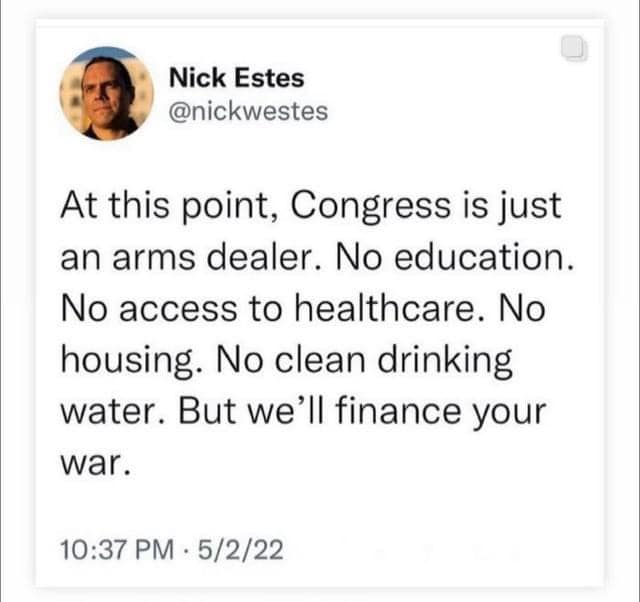
This meme is a satirical commentary on the perceived lack of action from the US government in addressing the country's social and economic issues. The image is likely a photo of a person looking frustrated or disappointed, with the text "When the US government is more concerned with the Ukraine war than the US war on poverty" or a similar quote. The meme pokes fun at the idea that the US government is more focused on international conflicts than addressing domestic issues, implying that the country's priorities are out of whack.
detailed-analysis (gemma3-27b-vision)
Okay, here's an analysis of the provided Twitter post, broken down into sections addressing the requested theoretical frameworks. I'll indicate when a framework doesn't particularly apply, as well.
Visual Description
The image shows a screenshot of a Twitter post by "Nick Estes (@nickwestes)." The post contains text directly addressed in the analysis below. The timestamp indicates the post was made at 10:37 PM on May 2, 2022. The image is fairly minimal, a text post on the social media platform.
Foucauldian Genealogical Discourse Analysis
This post is ripe for a Foucauldian analysis. The claim that "Congress is just an arms dealer" isn't a literal statement of what Congress is, but rather a discursive construction of power.
- Power/Knowledge: The post highlights the relationship between power and knowledge. The list of what Congress doesn't provide (education, healthcare, housing, clean water) establishes a lack, a deprivation. This lack is then juxtaposed with the provision of war financing. The discourse positions Congress not as a provider of basic necessities, but as a mechanism that actively enables violence and profit from it. It implies that these are intrinsically linked. Knowledge about these priorities (or lack thereof) produces the power dynamic.
- Genealogy: A genealogical investigation would trace the historical development of this power dynamic. How have policies been shaped to prioritize military spending over social programs? What discourses have historically justified this prioritization (e.g., national security, economic growth)? How has the arms industry become so intertwined with political power? The post implies a historical trajectory that has led to this state of affairs.
- Discourse & Truth: The post doesn't claim objective "truth," but rather presents a particular interpretation of Congress's role. By framing Congress as an "arms dealer," it challenges the dominant narrative of a body meant to serve the people. It questions the very notion of legitimate governance.
Critical Theory
This post engages strongly with the core tenets of Critical Theory, specifically concerning the critique of power structures.
- Domination & Emancipation: The post points to a system of domination where basic needs are denied to the population while resources are funnelled into warfare. The implicit aim is to raise awareness and potentially inspire emancipation – a breaking free from this perceived cycle of exploitation.
- Ideology Critique: The post implicitly critiques the dominant ideology that justifies military spending. The juxtaposition of denied necessities with financed war exposes the contradictions within this ideology. It implies that the prioritization of war is not natural or inevitable but a deliberate choice that benefits a specific group at the expense of others.
- Reason as Instrument of Domination: The post suggests that the "reason" (rationality) underpinning Congressional decisions is not aimed at improving societal wellbeing but at furthering a specific agenda (profit, power). It implies a critique of instrumental reason – a form of rationality focused solely on efficiency and achieving goals, regardless of ethical considerations.
Marxist Conflict Theory
This post is inherently rooted in Marxist conflict theory.
- Class Struggle: The post implies a fundamental class struggle. The denial of basic necessities (education, healthcare, housing, water) disproportionately affects the working class and marginalized communities, while the financing of war benefits the capitalist class (arms manufacturers, those profiting from conflict).
- Exploitation: The post suggests exploitation: the resources that could be used to address social problems are instead diverted to an industry that profits from destruction. This reinforces the notion of capital accumulation through mechanisms of violence.
- Material Basis of Power: The post emphasizes the material basis of power – the control of resources (money, weapons) that allows Congress to exert its influence. The claim that Congress will "finance your war" is a clear demonstration of this power.
Postmodernism
While not the primary lens through which to analyze this post, Postmodernism can offer some insights.
- Deconstruction of Grand Narratives: The post challenges the “grand narrative” of a benevolent government that prioritizes the wellbeing of its citizens. It undermines the idea that Congress functions in a rational or ethical manner.
- Relativity of Truth: While the post expresses a strong opinion, it can be seen as highlighting the constructed nature of "truth" regarding political motives. There isn't a single, objective "truth" about Congress’s intentions, but rather interpretations shaped by power dynamics.
- Fragmentation and Discontinuity: The list of denied necessities (education, healthcare, housing, water) creates a sense of fragmentation and discontinuity, contrasting with the singular, powerful act of financing war.
Queer Feminist Intersectional Analysis
This framework is less directly applicable, but some connections can be made.
- Intersectionality: The denial of basic needs (education, healthcare, housing, water) will disproportionately impact marginalized groups, particularly those facing multiple forms of oppression (race, gender, class, sexual orientation, etc.). Queer and feminist perspectives would emphasize these intersecting vulnerabilities.
- Power Dynamics & Violence: The financing of war is inherently linked to violence, and feminist theory has long analyzed the connections between patriarchy, power, and violence. The post implicitly critiques the ways in which military spending perpetuates systems of domination.
- Resource Allocation & Care: Feminist and queer theories of care emphasize the importance of providing resources for wellbeing and fostering community. The post highlights the deliberate lack of these resources, exposing a system that prioritizes destruction over care.
I hope this comprehensive breakdown is helpful! Let me know if you'd like any of these analyses expanded or clarified.
simple-description (llama3.2-vision)
The meme is a screenshot of a Twitter post from user @nickestes (not @nickwestes). The post is a sarcastic response to a hypothetical conversation about the US government's priorities. The text reads: "At this point, Congress is just an arms dealer. No education. No healthcare. No housing. No clean water. But we'll finance your war."
tesseract-ocr
Nick Estes @nickwestes At this point, Congress is just an arms dealer. No education. No access to healthcare. No housing. No clean drinking water. But we’ll finance your war. 10:37 PM - 5/2/22