First Seen
2023-07-18T18:31:44+00:00
simple-description (llama3.2-vision_11b)
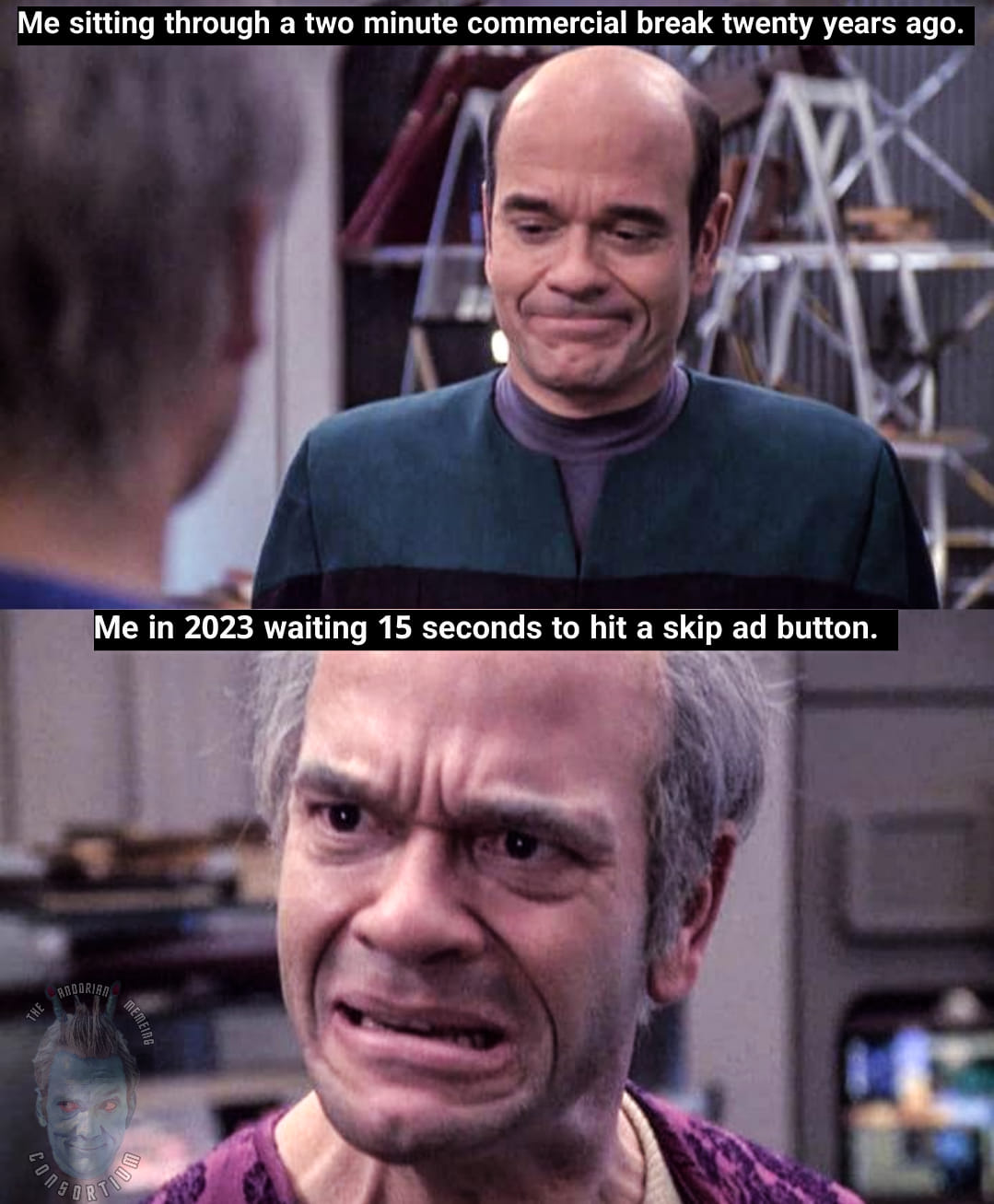
The meme is a humorous commentary on the frustration of being constantly bombarded with ads. It features a before-and-after image of a person, with the top caption "Me watching a 2-minute ad" and the bottom caption "Me in 2023 watching a 2-minute ad". The meme is poking fun at how our tolerance for ads has decreased over time, and how we're now more likely to get annoyed and click away quickly.
detailed-analysis (gemma3-27b-vision)
Okay, let's break down this meme through various critical lenses.
Visual Description
The meme is a two-panel comparative image. Both panels feature Patrick Stewart as Captain Jean-Luc Picard from Star Trek: The Next Generation.
- Top Panel: Picard is seated, presumably in his Captain's chair on the Enterprise, looking serene and almost bemused. The lighting is dramatic, emphasizing his expression. The text above reads "Me sitting through a two minute commercial break twenty years ago."
- Bottom Panel: A closer, heavily zoomed-in shot of Picard, now appearing visibly distressed—eyes squeezed shut, face contorted in frustration. The text reads "Me in 2023 waiting 15 seconds to hit a skip ad button."
The stark contrast in Picard's expression and framing is the central comedic element. The meme visually embodies the frustration with the increasing prevalence and inaccessibility of ad-skipping in contemporary digital media.
Foucauldian Genealogical Discourse Analysis
Foucault's work can help us understand how the experience of advertising—and resistance to it—has shifted over time, constructing new subject positions.
- Power/Knowledge: Twenty years ago, commercial breaks were a given – an accepted part of the media landscape. We passively accepted the power of advertisers to interrupt our programming. The discourse around advertising was largely about products and their desirability. Now, the shift is toward control – specifically, the desire to control when and how we are exposed to ads. This shift itself is a manifestation of power – the user attempting to reclaim agency over their viewing experience.
- Genealogy of Control: The meme highlights a change in the technology of control. Previously, passive reception was the norm. Now, the (often thwarted) expectation of ad-skipping introduces a new level of engagement—and frustration. The genealogy (historical development) of this control can be traced from limited commercial breaks to streaming services with pre-roll and mid-roll ads, then to increasing delays on skip buttons, shaping our expectations and our annoyance.
- Disciplinary Power: The meme subtly reveals how ad-skipping buttons are designed to exert a form of disciplinary power. The delay in being able to skip creates a moment of forced exposure, even if it’s just a few seconds. This acts as a micro-punishment, reinforcing the power of advertisers.
Critical Theory
The meme speaks to broader themes within Critical Theory relating to the culture industry and the commodification of attention.
- Commodification of Attention: The meme highlights how advertising has moved beyond simply selling products to selling our attention. The extended ad formats and frustrating skip delays are not about maximizing sales as much as maximizing the time we spend exposed to advertisements. Our attention becomes a commodity in itself.
- False Consciousness: The image suggests a form of awakening from "false consciousness." Twenty years ago, we were largely conditioned to accept advertising as a necessary evil. Now, we are increasingly aware of its manipulative potential and actively resist it, even in small ways like clicking on a skip button.
- The Erosion of Experience: The meme can be seen as a critique of how advertising has fragmented and commodified our viewing experiences. The "seamless" flow of entertainment has been interrupted by constant intrusions, leading to a sense of frustration and alienation.
Marxist Conflict Theory
From a Marxist perspective, the meme reveals the inherent conflict between capital (advertisers) and the audience (consumers).
- Means of Production & Control: Advertisers, as the owners of the “means of production” (the advertising industry), seek to maximize profit by controlling our attention. The meme illustrates a struggle over this control. The increasingly frustrating ad-skipping mechanisms are a tactic used by capital to maintain its dominance.
- Alienation: The meme encapsulates a sense of alienation from the media experience. Previously, entertainment was seen as a source of leisure and enjoyment. Now, it's constantly interrupted by forces that seek to exploit our attention, creating a sense of disconnect.
- Class Struggle: Though subtle, it hints at a micro-level class struggle: advertisers representing a powerful economic class seeking to exert control over the attention (and thus, consumption) of the masses.
Postmodernism
From a postmodern perspective, the meme deconstructs the idea of a "natural" viewing experience.
- Simulation & Hyperreality: The constant bombardment of advertisements creates a hyperreal environment where it becomes increasingly difficult to distinguish between "authentic" content and commercial messaging. The meme acknowledges this fragmentation and loss of authenticity.
- Irony & Parody: The use of Captain Picard, a figure associated with a utopian vision of the future, is inherently ironic. It highlights the contrast between the promise of technology and the reality of being constantly bombarded with advertisements.
- Deconstruction of Narrative: Traditional narrative structures are disrupted by constant commercial breaks. The meme subtly acknowledges this disruption and the fragmentation of experience that results.
In conclusion: The meme is deceptively simple, but it touches on a range of complex social and cultural issues. It highlights the changing relationship between viewers, advertisers, and the media, and it encapsulates a sense of frustration and resistance in the face of increasing commercialization.
simple-description (llama3.2-vision)
This meme is a humorous commentary on the passage of time and the changing nature of advertising. It features two images from the TV show Star Trek: The Next Generation, with the top image showing a character looking calm and relaxed, while the bottom image shows the same character looking angry and frustrated. The text at the top reads "Me sitting through a two-minute commercial break twenty years ago," and the text at the bottom reads "Me in 2023 waiting 15 seconds to hit a skip ad button."
tesseract-ocr
Me sitting through a two minute commercial break twenty years ago. ew s adh el . fl - - i > <> Te PTN ) s i x Me in 2023 waiting 15 seconds to hit a skip ad LTTE a ah 4 \i = f / o é . Bi { , _ ee , = Le * . a st bs a a - oa 74 7 / ‘ yw ~~