First Seen
2026-01-19T05:31:13.056927+00:00
simple-description (qwen3.5_2b-q8_0)
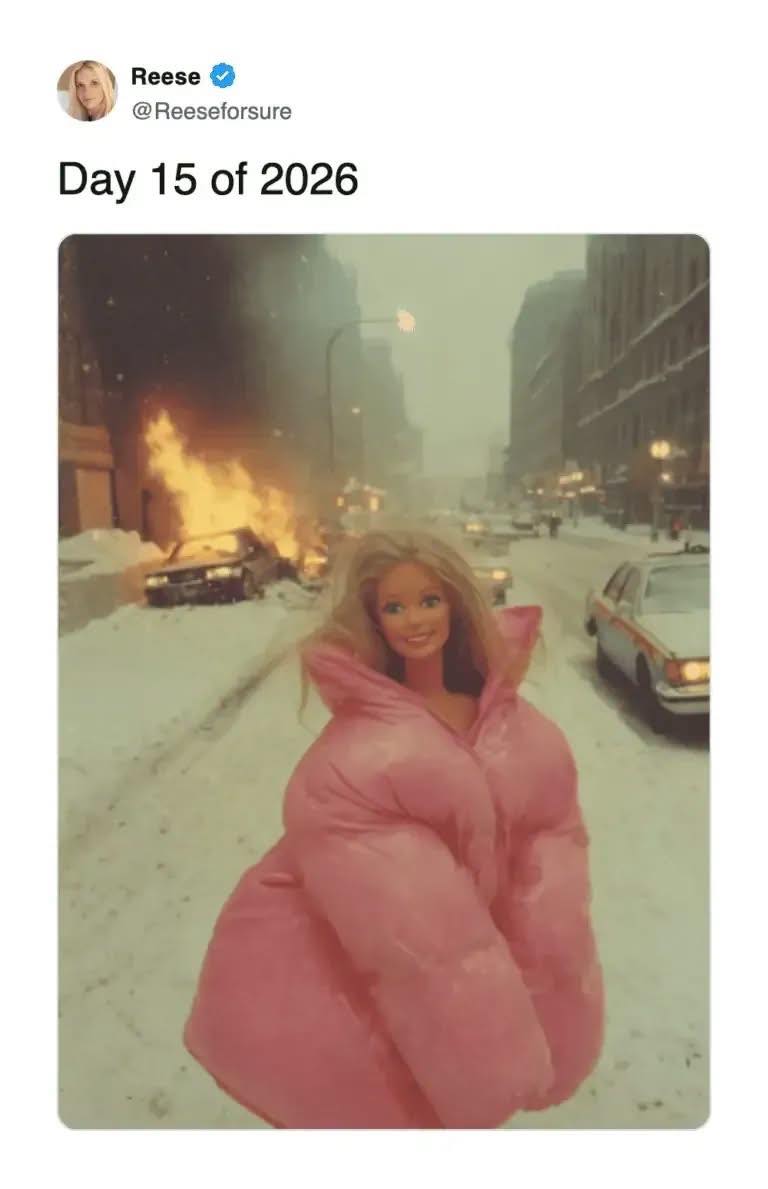
Annualism is internet slang suggesting that major events like financial recessions are cyclical and will inevitably repeat in about one year. This meme uses that concept to mock a potential future economic collapse by applying this cycle logic to a specific timeline, implying that whatever chaos the economy brought in 2008 (at Day 15 of 2026) will inevitably return very soon. The image text @Reeseforsure sets the specific date for this inevitable loop, framing the financial panic of the past as an event that is destined to happen again soon.
detailed-analysis (gemma3_27b-it-q8_0)
Okay, let's break down this meme – a picture of a heavily photoshopped, inflated, almost grotesquely oversized Barbie doll-like figure in a massive pink puffer coat standing in a snowy city street with the caption "Day 15 of 2026" – through the lens of "Annualism" as a central category, and then the requested theoretical frameworks where applicable.
Understanding Annualism & Its Relevance
Annualism, broadly, examines the rhythmic and cyclical nature of experience, time, and cultural phenomena. It's less about strict repetition and more about recurring patterns, resonances, and the ways things feel like they're returning, even when they aren’t exactly the same. This meme functions powerfully because it taps into an anticipatory dread of repeating cycles, specifically around fashion, beauty standards, and societal anxieties. The "Day 15 of 2026" framing immediately positions this image as part of a continuing narrative, suggesting this isn't a singular event, but a developing condition. It suggests a cyclical return to something previously experienced, but intensified. The image itself feels… uncanny. It's recognizably Barbie-esque, but distorted, making it feel both familiar and unsettling.
Visual Description
The image depicts a digitally altered woman who strongly resembles Barbie. She is encased in an extremely oversized, shiny, pink puffer coat. Her face has been digitally smoothed and given a fixed, plastic-doll expression. She stands in a snowy urban environment, likely a city street, with cars and buildings visible in the background. The lighting is muted, lending to a slightly surreal atmosphere. The scale and proportion of the figure within the environment are distorted—she’s too large, too plastic. The photo appears slightly retro, adding to the sense of a re-emerging pattern.
Foucauldian Genealogical Discourse Analysis
This meme resonates deeply with Foucault's ideas around discourse and power. The Barbie figure isn’t merely an image; it's a product of a discourse around femininity, beauty, and the body. The extreme exaggeration of the body, the plastic smoothness, and the fixed expression illustrate how these discourses produce subjects.
- Genealogy: Tracing the history of beauty standards reveals a cyclical trend of exaggerated forms—from Victorian corsets to the 1950s "hourglass" to the hyper-slim 90s. This image suggests a further intensification, a grotesque return to hyper-femininity. The "Day 15" framing implies this is a deliberate, ongoing construction of femininity, not a natural evolution.
- Power/Knowledge: The image demonstrates how power operates through knowledge. The discourse around beauty isn't neutral; it’s backed by industries (fashion, cosmetics, media) that benefit from reinforcing specific ideals. The meme subtly critiques this power dynamic, exposing the absurdity of the relentless pressure to conform to impossible standards. The over-the-top nature of the image makes the underlying power structures visible.
- Normalization: The "Day 15" implies a gradual normalization of this extreme aesthetic. This is the most unsettling aspect – the suggestion that this distorted image will become commonplace.
Critical Theory
From a Critical Theory perspective, the meme deconstructs the myth of natural beauty and exposes the constructed nature of identity. It highlights the ways in which cultural norms are imposed on individuals and the damaging effects of these norms.
- Commodification of the Body: Barbie herself is a commodity, and this meme takes that to an extreme. The body is presented as a surface, something to be sculpted and enhanced to meet artificial standards.
- Alienation: The figure's plastic, detached expression and exaggerated form evoke a sense of alienation. She is disconnected from genuine human experience, existing purely as an object of consumption.
- Ideology: The image challenges the ideological underpinnings of beauty standards. By making the absurdity so obvious, it forces viewers to question the norms they have internalized.
Postmodernism
The meme is thoroughly postmodern.
- Hyperreality: The image isn't representing reality; it's a simulation of a simulation. Barbie is already a constructed figure, and this image takes that construction to a new level, creating a hyperreal version that is more "real" than real.
- Pastiche/Irony: The meme blends elements of nostalgia (Barbie, retro snow scenes) with a sense of exaggerated artificiality. There's a strong current of irony, suggesting that this is a parody of the future, but also a potential truth.
- Fragmentation/Deconstruction: The distortion of the figure and the fragmented sense of time (“Day 15”) contribute to a feeling of fragmentation and deconstruction of traditional notions of beauty and identity.
Queer Feminist Intersectional Analysis
This meme can be interpreted through an intersectional queer feminist lens, although subtly.
- Critique of Gender Performance: The figure's exaggerated femininity is a hyper-performance of gender. It highlights the ways in which gender is constructed and the pressure on women to conform to restrictive ideals. The figure's immobility in the oversized coat can be seen as symbolic of the constraints placed upon women by patriarchal norms.
- Body Policing: The meme indirectly criticizes body policing. The expectation to achieve a specific body type, even if that body type is digitally altered and unattainable, is inherently oppressive.
- Intersectional Aspects: The meme doesn't explicitly address race, class, or other identity markers, but it's important to note that the standards of beauty promoted by Barbie historically have been predominantly white and middle-class. This meme's critique, while broad, implicitly challenges those underlying power dynamics.
Back to Annualism - The Cycle and the Dread
Ultimately, the power of this meme comes from its suggestion that this is not new. The image isn’t just about the future; it’s about the cyclical nature of cultural trends and the anxieties surrounding them. It's an anticipatory dread, a sense that we are returning to a distorted version of the past. The “Day 15” framing emphasizes the ongoing, relentless nature of this cycle. The meme is a warning, a satire, and a commentary on our complicity in perpetuating these patterns. It’s a visual representation of the annual, relentless return of anxieties around body image, consumerism, and the constructed nature of identity.
Let me know if you'd like me to elaborate on any of these points or explore other theoretical angles!
simple-description (llama3.2-vision_11b)
This meme is a humorous commentary on the absurdity of a popular trend or event that will supposedly occur in 2026. The image shows a Barbie doll wearing a puffy pink coat, standing in the middle of a snowy street, with a burning car in the background. The text "Day 15 of 2026" is likely a reference to a popular social media challenge or trend that has been going on for 15 days, and the image is a humorous take on that.