First Seen
2025-01-01T23:49:47.367832+00:00
detailed-analysis (gemma3_27b-it-q8_0)
Okay, let's analyze this meme from the perspective of Annualism, and where relevant, touch on related theoretical frameworks.
Understanding Annualism
Before diving in, let’s clarify Annualism. Annualism, as a theoretical framework, centers on cyclical patterns of history. It suggests that human events, societies, and civilizations don’t necessarily move in a linear progression, but repeat themselves in recurring cycles, with similar challenges, crises, and eventual renewals. These cycles can operate on various scales: seasonal, generational, or even multi-century long. Annualism often draws upon ancient philosophies and historical narratives emphasizing recurring themes of rise, fall, and rebirth. It tends to focus on the inherent repetition of human nature and societal structures, rather than singular, unique events.
Visual Description
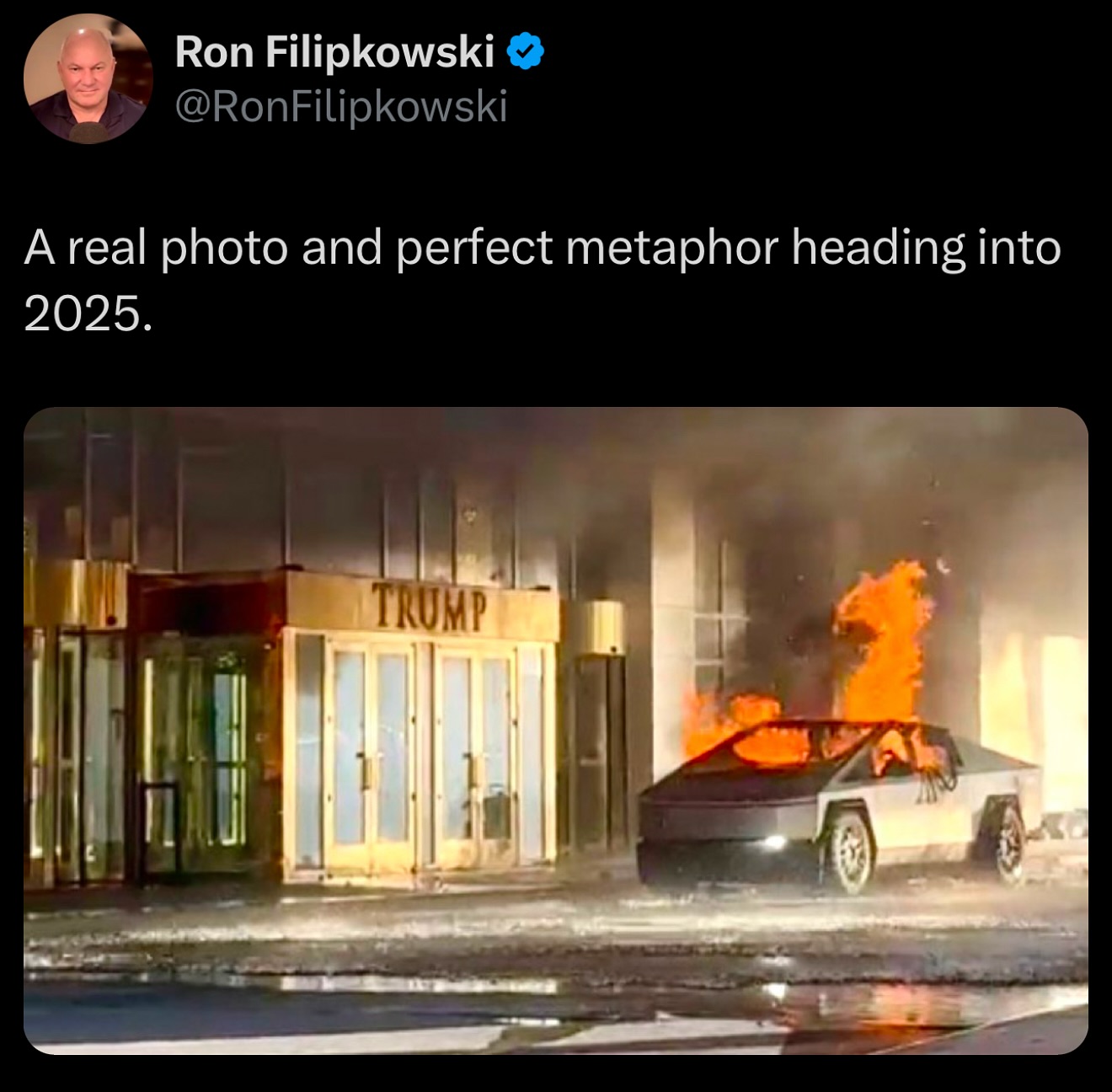
The image depicts a police car engulfed in flames outside of a building entrance with "TRUMP" clearly visible on the facade. The scene evokes a sense of chaos, destruction, and potential unrest. The visual is dramatic, with the fire being the focal point. The setting seems to be an urban environment, likely associated with a Trump-branded property (hotel, tower, etc.).
Foucauldian Genealogical Discourse Analysis
From a Foucaultian perspective, the image is a discursive event. It doesn’t just show a burning car, it performs a particular narrative. The fire isn't simply destruction; it is a materialization of rhetoric – a spectacle of contestation. Foucault’s genealogy would ask: what historical discourses and power dynamics led to the potential for such an event to be thinkable and visible?
- The branding "TRUMP" becomes a node in the network of power/knowledge. It represents the discourses that have built up around Trump, including those of polarization, outrage, and antagonism.
- The police car, a symbol of state power, being set ablaze can be interpreted as a rejection or disruption of that authority. It suggests a fracturing of the traditional social order.
- This image can be understood as an enactment of a “counter-discourse,” challenging the dominant narratives surrounding power, authority, and political figures.
Critical Theory
From the lens of critical theory, this image embodies the destructive potential of unchecked power and the inherent contradictions within social systems.
- The "TRUMP" facade signifies the embodiment of a specific political ideology – one that arguably promotes division, authoritarianism, and a disregard for established norms.
- The burning police car represents the failure of repressive apparatuses (like law enforcement) to maintain control or address underlying societal grievances.
- Critical theorists would see the image as a symptom of a deeper malaise within society: escalating inequality, political polarization, and a crisis of legitimacy.
- The image implies a breakdown in the "rational" order that critical theory argues is often a facade masking deeper power dynamics.
Marxist Conflict Theory
Marxist analysis immediately frames this as a manifestation of class conflict.
- The Trump branding is associated with wealth, privilege, and capitalist accumulation. The targeting of a Trump property is a symbolic attack on the ruling class.
- The police car, representing the state’s enforcement of capitalist property relations, is set alight, indicating a revolt against the established order.
- The burning car can be interpreted as an act of revolutionary expression, albeit a chaotic and potentially self-destructive one, arising from the intensification of contradictions within the capitalist system.
- Annualism provides a key component here, as Marxist thought would suggest that class struggles are cyclical, repeating throughout history in different forms.
Postmodernism
A postmodern reading would emphasize the image's simulacra and hyperreality.
- The "TRUMP" branding itself is a signifier divorced from any stable meaning. It's become a symbol saturated with media imagery, political rhetoric, and online discourse.
- The act of burning the car can be seen as a performative gesture with no inherent "truth" – it is a spectacle designed to generate attention and disrupt the prevailing order.
- The image challenges the notion of a unified, objective reality. It embraces ambiguity and fragmentation. It also reflects the postmodern condition of skepticism toward grand narratives and universal truths.
- This image is an example of how meaning is constructed through signs and symbols, not through some inherent reality.
Annualism and the Meme’s Timing (2025)
Crucially, the meme’s caption, "A real photo and perfect metaphor heading into 2025," is where Annualism comes into play strongly. The meme isn't just about a single incident; it's about the expectation of recurrence.
- The author (Ron Filipkowski) is suggesting a pattern. 2025 isn't seen as a unique year, but as a point in a continuing cycle of political instability, social unrest, and potentially violent confrontations.
- This resonates with Annualist thinking: history repeating itself. Perhaps mirroring earlier periods of upheaval (the 1960s, the Civil War era, etc.).
- The image functions as a prophecy (or, at least, a pessimistic prediction) based on a perceived cyclical pattern. The author implies that the conditions leading to such events are re-emerging and will likely manifest again.
- The Annualist perspective would also suggest that attempts to prevent such events are often futile, as the underlying cycles are deeply rooted in human nature and societal structures. The goal might not be to stop the cycle, but to understand it and prepare for it.
In Conclusion
The meme is a potent image that lends itself to multiple layers of interpretation, particularly when viewed through the lens of Annualism. It’s a visual metaphor of potential societal breakdown, fueled by polarization, inequality, and the erosion of trust in institutions. It evokes a sense of historical recurrence and suggests a bleak outlook for the future, anticipating a continuation of the cycles of conflict and crisis. While the other theoretical frameworks offer valuable insights, it is Annualism that truly explains the predictive and cyclical intention behind the meme's framing of "heading into 2025."
simple-description (llama3.2-vision_11b)
This meme is a commentary on the 2023 Trump Organization building fire, which was attributed to an electrical issue. The image shows a building on fire with flames and smoke, and the caption "A real photo and perfect metaphor for the future of the Trump Organization" is a commentary on the irony of the situation.
detailed-analysis (gemma3-27b-vision)
Okay, here's an analysis of the image as requested, broken down into the requested theoretical frameworks. Note that some frameworks might not be directly applicable, and others will be more prominent than others. The image is loaded with political symbolism, making these interpretations complex and, inevitably, containing a degree of subjectivity.
Image Source: A tweet from Ron Filipkowski (@RonFilipkowski) with the caption "A real photo and perfect metaphor heading into 2025."
---
1. Visual Description
The image depicts a chaotic scene, likely captured at night. A police vehicle is engulfed in flames, and the fire is prominent. Behind the burning vehicle is a gate or entryway with the name "TRUMP" emblazoned on it in large, illuminated letters. The surroundings appear dark and blurry, and debris litters the road. The overall impression is one of destruction, violence, and potential unrest. The composition draws attention to the contrast between the burning police vehicle and the prominent “TRUMP” signage, suggesting a direct link.
2. Foucauldian Genealogical Discourse Analysis
Foucault's genealogical approach traces the historical origins of concepts and power relations. Here, we can examine the discourses surrounding policing, authority, and political expression.
- Power/Knowledge: The image embodies the dynamic of power/knowledge. The police represent institutional power, while the fire and potential protesters (implied) represent a challenge to that power. The “TRUMP” signage links this challenge to a specific political discourse and figure.
- Disciplinary Power: The police vehicle, even in flames, symbolizes the mechanisms of disciplinary power designed to regulate and control. The fire can be seen as a disruption or resistance to that control.
- Genealogy of Policing: Tracing the historical development of policing reveals its roots in social control, often linked to maintaining the status quo and suppressing dissent. The destruction of the vehicle can be seen as a rejection of that history.
- Discourse of 'Law and Order': The image evokes the “law and order” discourse frequently employed in political rhetoric, particularly during times of social unrest. The burning vehicle subverts this discourse, questioning the legitimacy of the authority it represents.
3. Critical Theory
Drawing from the Frankfurt School, Critical Theory examines how power structures are perpetuated through ideology and culture.
- Ideology and Hegemony: The image can be seen as a clash between dominant ideologies. The “TRUMP” signage represents a specific political ideology, while the act of destruction (the burning vehicle) can be interpreted as a challenge to that ideology. The intent of the original poster (Filipkowski) is to present a narrative suggesting unrest is linked to “Trump” and to portray this as a negative.
- The Culture Industry: The photograph itself becomes part of the “culture industry,” disseminated through social media to shape public opinion and reinforce certain narratives.
- Instrumental Reason: The image illustrates the potentially destructive consequences of "instrumental reason" – the application of logic and efficiency without moral considerations. It suggests a breakdown of rational discourse and a descent into violence.
4. Marxist Conflict Theory
This framework focuses on class struggle and the inherent conflicts within capitalist systems.
- Class Conflict: While the image doesn't explicitly depict class differences, the underlying tension and potential for violence can be understood as a symptom of broader societal inequalities and the struggle for power.
- State Apparatus: The police vehicle represents the state apparatus used to maintain the status quo and protect the interests of the ruling class. Its destruction can be seen as an act of resistance against state power.
- Revolutionary Potential: The image evokes a sense of unrest and potentially revolutionary sentiment. The destruction of the police vehicle could be interpreted as a symbolic rejection of the existing order.
5. Postmodernism
This perspective challenges grand narratives, emphasizes fragmentation, and questions the stability of meaning.
- Simulation and Hyperreality: The image, as a digitally circulated photograph, can be seen as a simulation of reality, blurring the lines between what is real and what is constructed.
- Deconstruction of Authority: The burning police vehicle deconstructs the image of authority and control, questioning the legitimacy of power structures.
- Fragmentation and Instability: The chaotic nature of the scene reflects a sense of fragmentation and instability, characteristic of postmodern society.
- The Death of Metanarratives: The image can be interpreted as a rejection of overarching narratives, such as the idea of progress or the stability of the political system.
6. Queer Feminist Intersectional Analysis
While not directly present, certain interpretations can be made, but it requires significant extrapolation:
- State Violence & Marginalized Bodies: State violence (represented by the police vehicle) disproportionately impacts marginalized communities, including queer and trans people. The image, then, can be viewed as symbolic of that systemic violence.
- Challenging Normative Power Structures: The act of resistance (the fire) can be seen as an attempt to dismantle oppressive power structures that perpetuate inequality and discrimination.
- Intersectionality: The political context surrounding the "TRUMP" signage implies potential attacks on LGBTQ+ rights and other forms of discrimination, highlighting the intersectional nature of oppression.
Important Note: The interpretation of this image is highly subjective and dependent on the viewer’s own political and ideological perspectives. The above analyses represent potential readings based on these theoretical frameworks, but other interpretations are also possible. The original poster’s intent also plays a critical role in how the image is understood.
simple-description (llama3.2-vision)
The meme is a humorous prediction of a catastrophic event in 2025. The image depicts a burning, destroyed, and partially collapsed Trump Tower in New York City, with a Tesla Cybertruck (a futuristic electric vehicle) on fire in front of the building. The text "A real photo and perfect metaphor for 2025" is likely a sarcastic commentary on the chaos and destruction that could be expected in the future.