First Seen
2025-01-02T22:03:58.175454+00:00
detailed-analysis (gemma3_27b-it-q8_0)
Okay, let's break down this meme – “RIP 2024 (2024-2024)” – through the lens of "Annualism" as its category context, and then exploring relevant theoretical frameworks where they apply.
Understanding the Context: Annualism
Annualism, as a conceptual framing, places significant weight on the perceived distinct characteristics and 'energy' of individual years. It's a cyclical worldview where each year is not merely a chronological unit, but a unique, self-contained entity with its own personality, destiny, or overall vibe. This often ties into the idea that years can "die" or have a defined ending point. It's connected to trends of "year wrap-ups," collective anxieties about what a new year will bring, and the general human tendency to narrativize time.
---
Visual Description
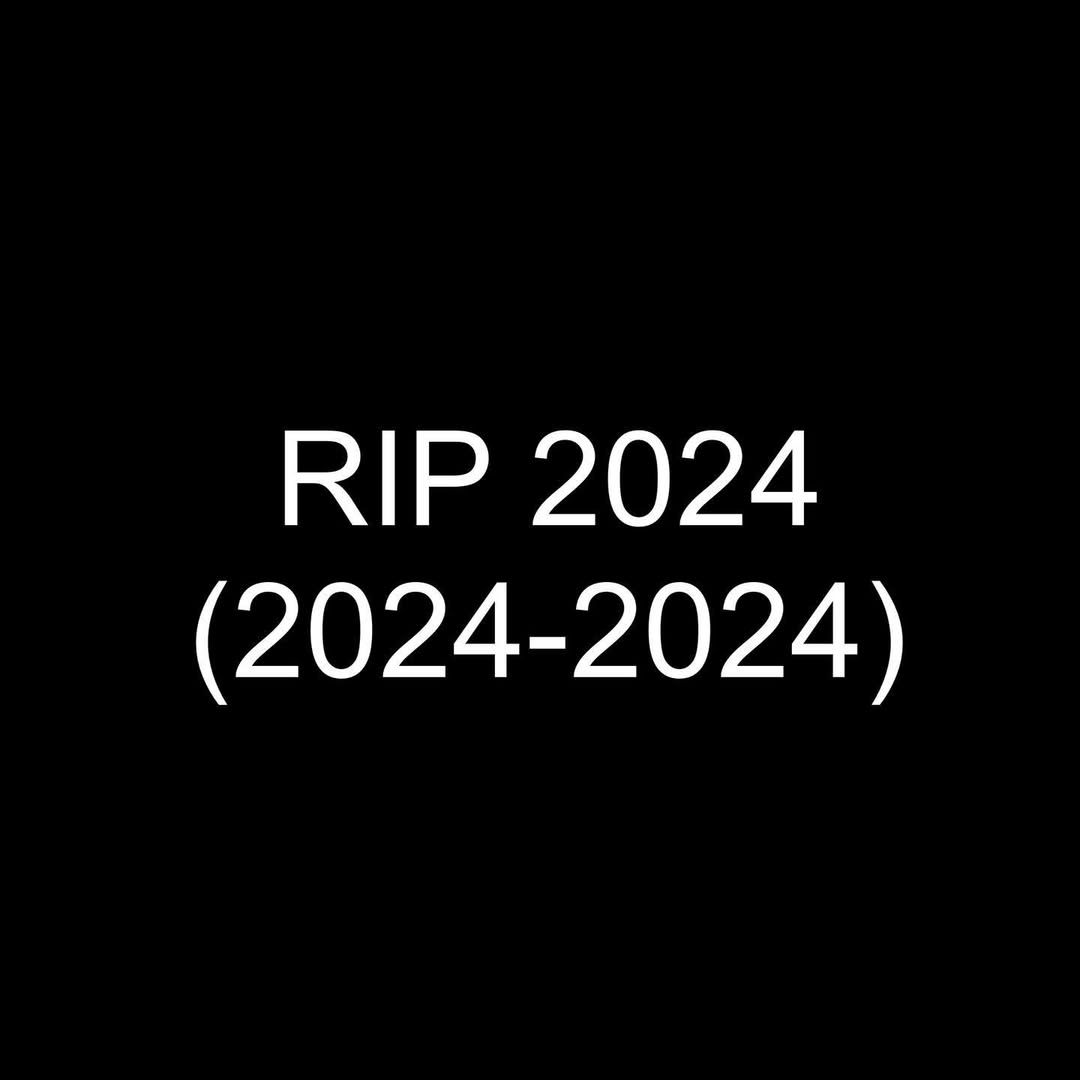
The meme is strikingly minimalist. White text on a stark black background. The “RIP 2024” is prominent. Beneath it, in parenthesis, is the date range "2024-2024." This succinctness underscores a sense of abrupt finality. The lack of visual embellishment contributes to a deadpan humor; it’s the starkness of a mourning announcement applied to something utterly temporal. The equal dates emphasize an extreme shortness of life.
---
Foucauldian Genealogical Discourse Analysis
This meme subtly reveals power dynamics inherent in how we talk about time. Foucault's genealogy would ask: How did we arrive at the idea of years as entities worth mourning?
- Discursive Formation: The meme participates in a discourse of annual assessment and prognosis. We expect to evaluate and predict years. This expectation isn’t inherent to time itself, but a product of cultural and social construction.
- Power/Knowledge: The “RIP” format, usually reserved for the deceased, is a power move. It imbues the year with an almost human status, capable of life and death. Those who participate in this discourse (by sharing, creating, understanding the meme) reinforce that power/knowledge relationship.
- Archaeology of Knowledge: Historically, ways of marking time have been varied (lunar cycles, reigns of monarchs, etc.). The modern, linear, year-based system is relatively recent. The meme is a brief, ironic commentary on the authority of this system.
---
Critical Theory
The meme touches on several elements of Critical Theory, particularly concerning societal anxieties and the commodification of time.
- The Culture Industry: The meme's very existence is enabled by the “culture industry.” It circulates on social media platforms that are part of that industry, fueled by the need to generate content and engage in collective experiences. The annual ritual of assessment and pronouncements of a year's quality is partly driven by the desire to create content (like this meme) and participate in online communities.
- False Consciousness: While seemingly humorous, the meme can be seen as a symptom of a kind of collective resignation. It’s a pre-emptive mourning for a year that hasn’t even fully unfolded. This is a type of manufactured discontent.
- Commodification of Time: The relentless focus on “making the most of” each year, on “year-end reviews,” turns time itself into a commodity to be optimized and consumed. “RIP 2024” is a cynical acknowledgement of this process.
---
Postmodernism
This meme is highly postmodern in its playful self-awareness and irony.
- Hyperreality: The meme doesn't reflect a genuine loss. It creates a sense of loss through simulation. The act of “mourning” a year is a simulation of mourning a person.
- Deconstruction: The meme deconstructs the very idea of a year as a meaningful unit. By applying a traditionally serious concept ("RIP") to a fundamentally arbitrary temporal division, it reveals the constructed nature of that division.
- Playfulness and Pastiche: The use of the "RIP" format in this context is a playful pastiche—a blending of styles and contexts that undermines traditional meaning. It’s taking a solemn trope and applying it to something mundane.
- Rejection of Grand Narratives: There is no “big story” of 2024 yet. The "RIP" is a premature, absurdist rejection of any attempt to construct a coherent narrative about the year.
---
Marxist Conflict Theory
While less directly applicable, we can see subtle connections.
- Alienation: The meme could reflect a feeling of alienation from time itself. The capitalist mode of production demands constant efficiency and "making the most" of every moment. This can create a sense of temporal pressure and anxiety, leading to a cynical disengagement reflected in the meme.
- Ideology: The notion that years are inherently “good” or “bad” can be seen as ideological—a way of framing social conditions without addressing underlying structural problems. “RIP 2024” implies that the year itself is to blame for its failures, rather than the systems that shape it.
---
Queer Feminist Intersectional Analysis
This framework could highlight the varying experiences and precarity associated with time. The feeling of time moving quickly, or feeling "behind," is often heightened for marginalized groups navigating systemic oppression. The premature mourning implied in the meme could be seen as a reflection of the burnout and exhaustion felt by those constantly fighting for survival and liberation. A queer, feminist reading could ask: who is permitted to mourn, and for what? Whose time is valued, and whose is discarded?
In conclusion, the "RIP 2024" meme, viewed through the lens of Annualism and its intersection with critical theory, is a darkly humorous commentary on our relationship with time, the pressures of modern life, and the constructed nature of our cultural narratives. It encapsulates the fleeting nature of time and our shared need to find meaning within it, even if that meaning is ironic and self-deprecating.
simple-description (llama3.2-vision_11b)
The meme is a humorous way to express the idea that something is going to be completely gone by the end of 2024. It's a lighthearted way to poke fun at the idea that something will be obsolete or no longer relevant by the end of the year. The text "RIP 2024" is a play on the traditional "rest in peace" phrase, but with a humorous twist to imply that 2024 itself is being "buried" or made obsolete.
detailed-analysis (gemma3-27b-vision)
Here's an analysis of the image based on the requested theoretical frameworks. Given the simplicity of the image, some sections will be more substantial than others.
Visual Description
The image is stark. It features white text on a completely black background. The text consists of "RIP 2024" in a large, bold font, followed by "(2024-2024)" in a slightly smaller font, placed directly below. The direct date range seems to suggest that the 'thing' being mourned existed only for a moment. The contrast is high, making the text immediately prominent. The simplicity of the visual elements contributes to a sense of immediate, somber gravity.
Foucauldian Genealogical Discourse Analysis
This image is a concise example of a "discourse of mourning," specifically a premature or anticipatory mourning. Foucault’s genealogical approach focuses on the historical and social construction of knowledge and power relations. Here, the utterance "RIP 2024" isn't a natural expression of grief but a performance of a certain discourse.
- Power/Knowledge: The declaration is a statement claiming a loss, asserting a particular understanding of time and what constitutes something worthy of mourning. What does it imply about the conditions of the time that lead to its preemptive memorialization?
- Discursive Formation: The format (“RIP [Year]”) is a standardized discursive practice, a ritualized way of acknowledging ending. Its use here raises questions: What is being mourned before it has ended? Is it a symbolic death, a concept, a regime, a future? The format itself shapes our understanding of loss.
- Archaeology of Knowledge: Examining the history of "RIP" as a phrase reveals its relatively modern origins in commemorative practices. Tracing this history shows how mourning rituals are themselves constructed and evolve over time.
- The date range (2024-2024) suggests an extremely short duration, a fleeting existence. It seems as if something has begun and finished within the same year.
Critical Theory
From a critical theory perspective, this image functions as a critique or a form of commentary on the current socio-political landscape.
- Ideology: The "RIP 2024" could be interpreted as a coded message pointing to the perceived "death" of something considered valuable or hopeful. It's an expression of disillusionment, a lament for the loss of a possible future.
- Domination & Emancipation: It suggests that some force or system is causing a pre-emptive or accelerated sense of loss. The image functions as a protest or warning, attempting to mobilize attention and potentially resistance against whatever is perceived to be causing this perceived death.
- Negativity & Critique: The very nature of the "RIP" declaration is negative. Critical theory emphasizes the importance of negativity as a catalyst for change. The image is not celebrating anything, but rather denouncing a perceived loss.
- The brevity of the date range is striking and emphasizes the sense of futility and the fleeting nature of existence.
Marxist Conflict Theory
This image can be examined through the lens of class struggle and the material conditions of life.
- Alienation: The "death" being mourned could represent the death of hope for a better future under the existing capitalist system. It suggests a sense of powerlessness and alienation from the structures that govern our lives.
- Ideological State Apparatuses: The image could be a response to the manipulation of information and the creation of false consciousness. The "RIP" might refer to the death of critical thinking or the erosion of democratic values.
- Crisis of Capitalism: The image might be symbolic of a perceived crisis within the capitalist system, expressing fears about economic collapse or the further concentration of wealth and power. The year 2024 could represent a specific point of anticipated rupture.
Postmodernism
From a postmodern perspective, the image embodies several key themes.
- Simulacra & Simulation: The "RIP 2024" could be a simulation of grief, a hollow gesture detached from genuine emotion. It may not be mourning an actual loss, but a representation of loss, a cultural trope.
- Deconstruction of Meaning: The image challenges the traditional meaning of "RIP." By applying it to a year that hasn't passed, it disrupts our expectations and forces us to question the very nature of loss and mourning.
- Fragmentation & Instability: The image reflects a sense of fragmentation and instability in contemporary culture, where traditional values and beliefs are being eroded.
- The Year 2024: It could be referencing a cultural event or trend which is symbolic of a fleeting moment in time.
Queer Feminist Intersectional Analysis
While the image doesn't explicitly center queer or feminist themes, these frameworks can provide additional layers of interpretation.
- Precarity & Violence: The "RIP" could symbolize the constant precarity faced by marginalized communities, particularly queer and trans people, who are disproportionately affected by violence and discrimination.
- Erasure & Visibility: The act of mourning can be a form of resistance against erasure. The image could be a way to acknowledge and lament the loss of queer and trans lives, histories, and futures.
- Intersectional Loss: The "death" being mourned could represent the loss of intersectional struggles for liberation, highlighting the interconnectedness of various forms of oppression.
- Temporary Nature: The brevity of the date range can suggest that the 'thing' being mourned had a fleeting existence. Often, marginalized communities have fleeting moments of progress, which are then undermined or erased by systemic forces.
Important Note: These interpretations are speculative and depend heavily on context. Without further information about the image's origin or intent, these analyses remain open to multiple readings.
simple-description (llama3.2-vision)
This meme is a play on the typical "RIP" (Rest in Peace) format, but with a humorous twist. The text "RIP 2024 (2024-2024)" is a joke about the impossibility of a year dying, as it's a date range that's already over. The meme is likely meant to be humorous and ironic, poking fun at the idea of a year having a "death" date.