First Seen
2023-05-10T21:03:32+00:00
simple-description (llama3.2-vision_11b)
The meme is a play on the phrase "I'd rather go blind" from the song "I'd Rather Go Blind" by Etta James, but with a twist. The original phrase is a metaphor for a person's desire to be with someone else, but in this meme, the phrase is used to express a desire to go into a spiral, which is a metaphor for a person's desire to be in a state of confusion or chaos. The meme is captioned "I'd rather go into a spiral".
detailed-analysis (gemma3-27b-vision)
Here's an analysis of the provided Twitter post, broken down by the requested theoretical frameworks.
Visual Description
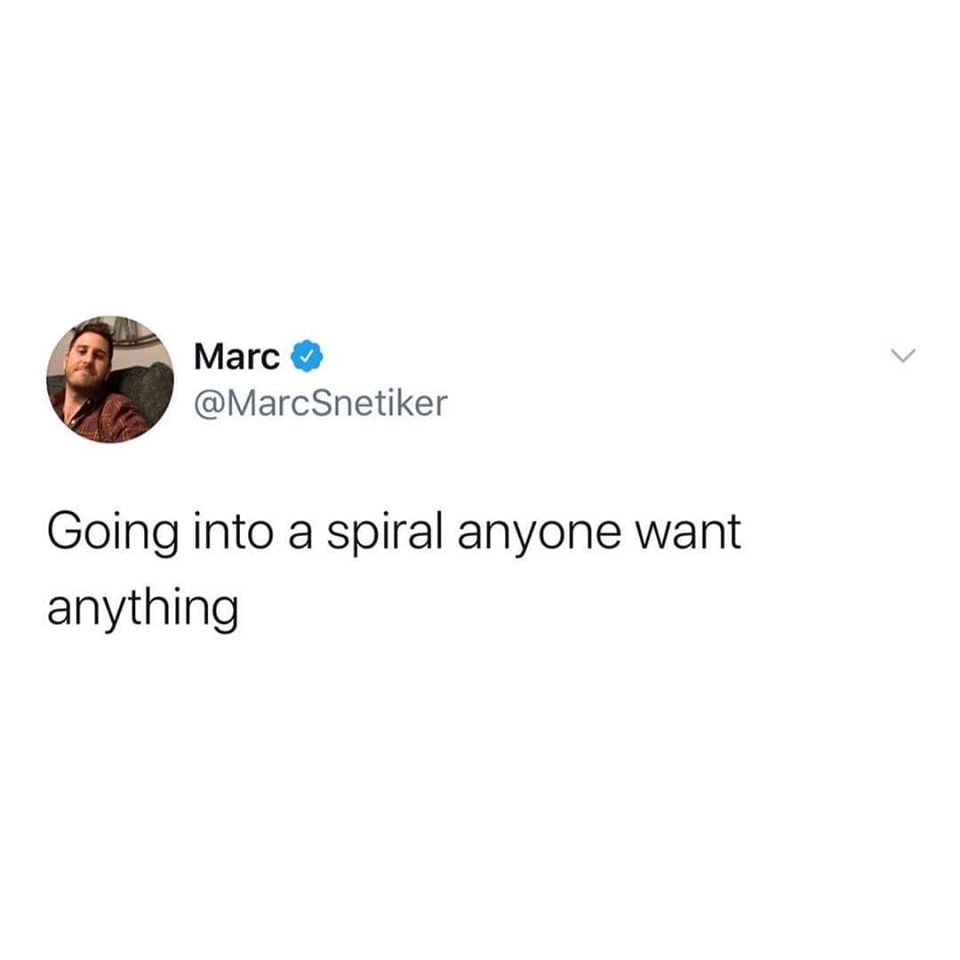
The image is a screenshot of a Twitter post. It features a profile picture of a man (Marc Snetiker, verified) alongside his username (@MarcSnetiker). Beneath this, there’s a short text post reading: “Going into a spiral anyone want anything.” The background is a simple, light gray or white. The overall aesthetic is minimalist and contemporary, typical of social media posts.
---
Foucauldian Genealogical Discourse Analysis
The phrase "going into a spiral" is interesting. From a Foucauldian perspective, we can analyze the discourse surrounding "spirals" and "mental health." The term "spiral" itself functions as a discourse, often employed to describe a perceived descent into a negative emotional or psychological state.
- Power/Knowledge: The invocation of a “spiral” subtly acknowledges the power of diagnostic categories and the medicalization of emotional states. By acknowledging a potential "spiral," the poster participates in a discourse that positions certain subjective experiences (like anxiety, depression, or overwhelm) as pathological or requiring intervention. The "spiral" becomes a way of understanding (and controlling) individuals.
- Genealogy: A genealogical tracing of the "spiral" as a metaphor would reveal how its contemporary usage is tied to certain historical developments in psychiatry and psychology (the rise of cognitive behavioral therapy, the categorization of "negative thought patterns").
- The Offer: The phrase "anyone want anything" is a request that potentially exposes a vulnerability. It also operates as a subtle assertion of power – the poster offers their state of distress, framing it as something others could potentially consume or interact with. The vulnerability may be a way to generate care or attention.
---
Critical Theory
From a critical theory perspective, the tweet points to the pervasive sense of alienation and precarity in late-stage capitalism.
- Subjectivity and Commodification: The speaker seemingly offers up their distress ("going into a spiral") to others, framing it as something potentially consumable. This highlights a disturbing trend in contemporary culture where even vulnerability and emotional experience are susceptible to commodification and performance for social media.
- Social Atomization: The plea "anyone want anything" suggests a sense of loneliness and disconnection. The individual is reaching out, attempting to establish a connection but doing so through the often-superficial medium of social media. This underscores the alienation fostered by capitalist social structures.
- The Illusions of Connection: The tweet implies a search for something that is missing and highlights that even on social media, genuine connection is difficult to attain.
---
Postmodernism
The tweet embodies several themes consistent with postmodern thought:
- Fragmentation and Instability: "Going into a spiral" suggests a lack of grounding and an unraveling of coherent selfhood. This resonates with the postmodern emphasis on the instability of identity and the rejection of grand narratives.
- Irony and Self-Awareness: The seemingly casual, almost flippant tone of the post suggests a level of irony. The speaker acknowledges their emotional state but presents it in a way that distances them from it. This is a common characteristic of postmodern expression.
- Simulation and Hyperreality: The use of social media as the platform for this confession contributes to a sense of simulation. The emotional state is being performed for an audience, becoming part of the curated self-presentation that characterizes online life.
---
Queer Feminist Intersectional Analysis
While not immediately obvious, a queer feminist intersectional reading could focus on the ways in which vulnerability and emotional distress are often coded as "feminine" and are thus subject to social stigma and silencing.
- The Policing of Emotions: The act of openly admitting vulnerability ("going into a spiral") can be seen as a transgression of normative expectations, particularly for those who are not traditionally afforded the space to express such feelings (e.g., men, individuals from marginalized communities).
- Intersectionality & Stigma: The tweet's meaning could be different depending on the identity of the speaker. For example, a queer person sharing this post may experience additional stigma or risk associated with admitting vulnerability, given the historical pathologization of queer emotions.
- Seeking Connection as Resistance: The act of reaching out, even in a fragmented or indirect way, can be seen as a form of resistance against systems that seek to isolate and control individuals. It represents a reclaiming of emotional expression and a desire for authentic connection.
Important Note: These analyses are interpretations based on theoretical frameworks. The meaning of the tweet is ultimately open to subjective interpretation.
simple-description (llama3.2-vision)
The meme features a tweet from Marc Snetiker, which reads: "Going into a spiral anyone want anything." The tweet is accompanied by a photo of Marc Snetiker. The image is presented on a white background, with the text and photo arranged in a simple and clean layout. The overall design is straightforward and easy to read, making it clear and concise.
tesseract-ocr
Pp Marc @ A; @MarcSnetiker Going into a spiral anyone want anything