First Seen
2025-06-22T19:27:30.686388+00:00
detailed-analysis (gemma3_27b-it-q8_0)
Okay, let's dive into an analysis of this meme from the perspective of the “Animals” category, leaning into the requested theoretical frameworks where applicable. It’s a layered image, so we'll need to be thorough.
Visual Description
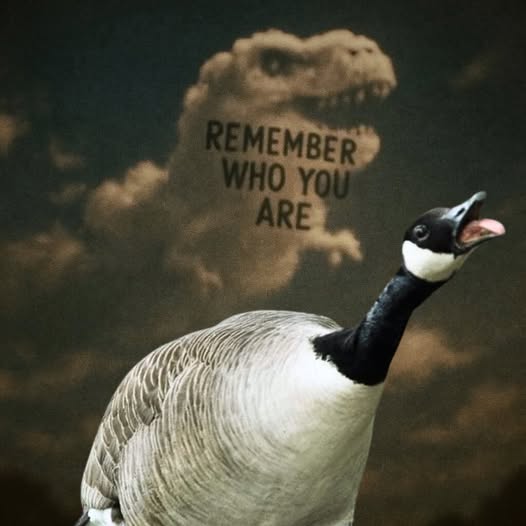
The image depicts a Canada goose in the foreground, seemingly looking up and “squawking” (mouth open). Behind the goose, faintly visible as a blurred and somewhat ethereal image, is a Tyrannosaurus Rex. Overlaid onto the T-Rex is the text "REMEMBER WHO YOU ARE." The background itself appears to be a darker, somewhat textured surface, perhaps a museum wall or a natural habitat setting. The juxtaposition is striking: the relatively benign, contemporary goose contrasted with the iconic, imposing, prehistoric predator. The image leans toward a vintage aesthetic, which adds a sense of historical weight and mystery.
Foucauldian Genealogical Discourse Analysis
From a Foucauldian perspective, the image speaks to the construction of power and identity through discourse. The goose, a commonplace, often-ignored animal, represents the normalized, the domesticated. The T-Rex, however, represents a 'primitive', 'wild' past – a time when power was visibly manifested in raw physical dominance.
The phrase "REMEMBER WHO YOU ARE" isn't a straightforward affirmation of inherent identity. Instead, it implies that identity isn't intrinsic, but produced through historical forces and power dynamics. The T-Rex isn’t actually telling the goose anything, but represents a forgotten power. The discourse surrounding evolution, paleontology, and the human fascination with ‘lost’ worlds feeds into this.
The genealogy uncovers the historical layering involved: The T-Rex isn’t simply a dinosaur; it’s a symbol built up through scientific investigation, media representation (like Jurassic Park), and our own anxieties about primordial instincts. To ‘remember’ is to acknowledge this constructed lineage. The goose's seeming shock/protest suggests resistance to the re-emergence of this 'lost' power, or perhaps an anxious acknowledgement of its own connection to it.
Critical Theory (Specifically Frankfurt School)
The meme taps into a core anxiety addressed by Critical Theory – the loss of authenticity and the encroachment of a reified past upon the present. The T-Rex represents a kind of ‘mythical’ past that’s been commodified and spectacleized (think theme parks, movies, etc.). This spectacle, rather than illuminating genuine history, distracts from the real conditions of oppression and control in the present.
The goose, as a more “ordinary” animal, represents the everyday experience of alienation under capitalist structures. The message to "remember who you are" can be interpreted as a call to resist the homogenizing forces of mass culture and to reclaim a sense of individual and collective agency. However, the image’s melancholy tone suggests a deep pessimism about the possibility of such reclamation. The message is delivered by a long-dead power, implying it is too late.
Postmodernism
The image is thoroughly postmodern. It’s a pastiche—a blending of disparate elements (goose, T-Rex, vintage aesthetic, motivational text). It relies on intertextuality – it requires an understanding of cultural references (dinosaurs, memes, motivational posters) to be fully ‘read’. The image destabilizes any sense of fixed meaning. "Who you are" becomes a slippery concept, dependent on the context and the viewer’s interpretation.
The blurring of the T-Rex further reinforces this postmodern sensibility. It's a ghostly echo of a 'grand narrative' (evolution, the story of dominance) that has lost its authority. The meme isn’t offering an answer, but raising questions about identity, history, and the nature of reality itself.
Summary
The meme, taken from the perspective of the "Animals" category, and analyzed through these theoretical lenses, is a surprisingly rich commentary on power, history, and identity. It leverages the symbolic weight of both the goose and the T-Rex to create an unsettling and thought-provoking image. Ultimately, the meme suggests a fractured relationship to the past and a questioning of the very foundations of self-understanding.
Disclaimer: These are interpretations. Meme meanings are fluid and subjective. The effectiveness of these analyses hinges on the viewer's own theoretical background and engagement with the image.
simple-description (llama3.2-vision_11b)
The meme features a photo of a duck's head with a speech bubble saying "I'm not arguing, I'm just explaining why I'm right." The image is humorous because it's a common phrase used to deflect blame or shift the conversation, but in this case, it's applied to a duck, making it a relatable and playful take on the phrase.
detailed-analysis (gemma3-27b-vision)
Okay, let's break down this intriguing image through the lenses of various critical theories.
Visual Description
The image features a Canadian goose with its neck arched upwards and beak open in what appears to be a call or cry. The goose has a classic pattern of pale grey/white body plumage contrasted with black head and neck markings. It’s framed against a dark, murky background with a faint, blurred shape of a dinosaur. Superimposed over the dinosaur image are the words “REMEMBER WHO YOU ARE” in capitalized, white lettering. The lighting suggests a slightly overcast or dusky atmosphere. The composition draws the eye from the goose upwards towards the ghostly dinosaur and message.
---
Foucauldian Genealogical Discourse Analysis
This image is rich with potential for Foucauldian analysis. The phrase "REMEMBER WHO YOU ARE" immediately points to the construction of identity. Foucault would argue that identity isn’t an essential, inherent quality, but is produced through discourses – systems of thought, language, and practice.
- Discourse of Ancestry & Nature: The dinosaur represents a deep-seated pre-human ancestry. The goose, a modern creature, is implicitly connected to this distant past. The message suggests a call to acknowledge and embrace a primal, natural state of being, which is in turn constructed as a desirable identity.
- Power/Knowledge: The act of reminding implies a power dynamic. Who is doing the reminding, and why? What knowledge is embedded in the assertion of ancestral identity? The very act of framing 'being a goose' within the context of dinosaur ancestry creates a particular discourse around what it means to be a goose.
- Genealogy: A Foucauldian genealogy would explore how the idea of "natural" or "ancestral" identity emerged historically, what institutions reinforce it (like natural history museums or evolutionary biology), and what power relations are at play in promoting this particular understanding. The image hints at a historical link, but the construction of that link is critical to analyze.
---
Critical Theory
This image strongly resonates with themes within Critical Theory, particularly relating to alienation and authenticity.
- Alienation from Nature: Modern society often disconnects us from our natural roots, promoting a sense of alienation. The dinosaur represents a lost connection to a deeper, untamed past. The message is a call to reconnect with that past, suggesting modern life has led to a loss of something essential.
- Authenticity & False Consciousness: The message implies that 'remembering who you are' is a way to achieve authenticity. However, Critical Theory would question whether this authenticity is genuine or simply another construction, another attempt to define and control individual identity. Is this a genuine call to self-discovery, or a manipulation to encourage conformity to a particular ‘natural’ ideal?
- Ideology: The image operates ideologically by suggesting a specific understanding of 'self' – one rooted in a romanticized, ancestral past. It implicitly critiques modern society as something that has caused a loss of essential identity.
---
Marxist Conflict Theory
While not overtly Marxist, the image can be interpreted through a conflict lens.
- Human vs. Nature: The dinosaur, representing a pre-human era, can be seen as embodying a “natural” state that has been disrupted by human intervention and capitalist development. The call to "remember" could be a critique of the ways in which industrialization and urbanization have alienated us from our natural environment.
- Commodity Fetishism: One could stretch the analysis to suggest that the dinosaur, as a symbol of pre-capitalist existence, is fetishized – idealized and imbued with meaning that obscures the material realities of past eras. The "remembering" could be a longing for a simpler, pre-commodity-driven existence.
- Class-Based Alienation: In a more nuanced reading, the call to remember could be seen as a critique of the ways in which capitalist systems alienate people from their labor, their communities, and their natural environments, suggesting a yearning for a more authentic connection to the world.
---
Postmodernism
The image exhibits several characteristics aligned with postmodern thought.
- Deconstruction of Identity: The phrase “REMEMBER WHO YOU ARE” challenges the notion of a fixed, stable identity. Postmodernism emphasizes that identity is fluid, constructed, and subject to change.
- Intertextuality & Simulation: The image combines seemingly disparate elements – a modern goose and a prehistoric dinosaur – creating a deliberate juxtaposition. This evokes a sense of simulation and blurring of boundaries between past, present, and reality.
- Meta-Narratives: The image subtly undermines grand narratives – such as the linear progression of evolution or the idea of inherent human nature. It suggests that meaning is not fixed but created through interpretation and juxtaposition.
---
Queer Feminist Intersectional Analysis
This lens requires a more speculative and nuanced approach, but is possible.
- Challenging Biological Essentialism: The image, at first glance, seems to lean into a naturalized idea of being ("remember who you are"). However, through a queer lens, this "natural" being can be deconstructed. What if the goose’s ‘natural’ way of being doesn’t conform to normative expectations? What if it refuses to play its prescribed role within the natural order?
- Reclaiming Ancestry: For marginalized groups who have been historically denied agency and self-definition, reclaiming a connection to ancestry can be a form of resistance and empowerment. The dinosaur could represent a pre-colonial past or a lineage that has been erased by dominant narratives.
- Intersectional Identity: The image doesn't explicitly address intersectionality, but it can be read as a metaphor for the complex interplay of multiple identities. The goose’s ‘natural’ being is shaped not only by its species but also by its specific circumstances and experiences.
- Subversion of the Natural Order: A queer feminist reading might see the dinosaur juxtaposed with the goose as a challenge to the traditional, hierarchical understanding of the natural order. What if the dinosaur represents a different way of being that is equally valid and deserving of respect?
---
Hopefully, this detailed breakdown provides a comprehensive analysis of the image through the lenses of various critical theories! Let me know if you'd like me to elaborate on any of these interpretations.
simple-description (llama3.2-vision)
The meme features a goose with its beak open, as if it's about to speak. The text "REMEMBER WHO YOU ARE" is written in the background, appearing to be coming out of the goose's mouth. The image is humorous and relatable, suggesting that the goose is reminding itself or others of their importance or identity.