First Seen
2023-05-10T21:03:32+00:00
simple-description (llama3.2-vision_11b)
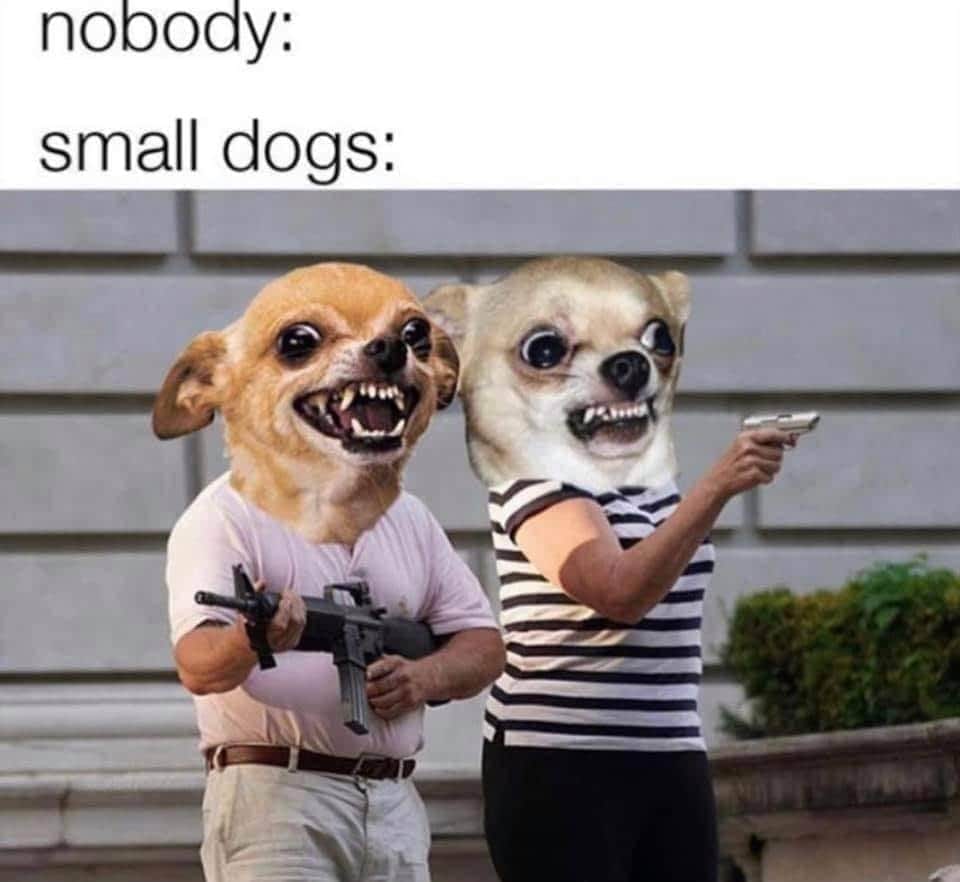
The meme is a humorous image of two small dogs, one with a menacing expression and a gun, and the other with a similar expression and a gun, as if they're in a standoff. The text above the image reads "nobody: small dogs:". The meme is poking fun at the idea that small dogs are often perceived as cute and harmless, but in reality, they can be fierce and intimidating.
detailed-analysis (gemma3-27b-vision)
Okay, here's an analysis of the image, broken down into sections relevant to the requested theoretical frameworks. Be aware that applying these complex theories to a meme is somewhat playful and involves stretching interpretations. I'll indicate where connections are tenuous.
Visual Description
The image is a digitally manipulated meme. It features two chihuahua heads photoshopped onto the bodies of men (apparently in a posed recreation of a scene from the film Scarface, a classic gangster film). Both "chihuahuas" are depicted in aggressive stances, baring teeth and wielding firearms: one holds an automatic rifle and the other a handgun. They stand in front of a suburban, brick facade and well-manicured shrubbery. The text "nobody:" is placed above, followed by "small dogs:" below, creating a humorous juxtaposition. The lighting is bright, typical of the original movie still being referenced. The humor derives from the incongruity of small, typically "cute" dogs being portrayed as dangerous criminals.
---
Foucauldian Genealogical Discourse Analysis
This meme, while seemingly simple, can be approached via Foucault’s genealogical method. The meme examines the historical discourse surrounding "small dogs" and "dangerous individuals." Traditionally, small dogs are associated with cuteness, domesticity, and a lack of threat. Criminality and violence, historically, are associated with particular bodies and masculinities.
The meme interrupts this discourse by juxtaposing these two historically constructed concepts. It reveals how the category of “small dog” is not fixed, but rather a product of social construction, capable of being associated with characteristics normally considered outside that category (violence, aggression).
The genealogy would trace the power dynamics that have historically defined these categories, and how this meme operates as a challenge to that order. The "chihuahuas" are performing a traditionally masculine role, challenging the assumed connection between gender/body size and power/violence.
---
Critical Theory
Through a Critical Theory lens, specifically drawing on the Frankfurt School, the meme can be interpreted as commentary on the performativity of hypermasculinity and the commodification of danger. The original film (Scarface) represents a specific fantasy of power and wealth achieved through violence. Replicating this image with chihuahua heads subverts the intended meaning.
The meme could be seen as a critique of the societal fascination with violent imagery and how easily this imagery is divorced from any genuine meaning. The small dogs parody the tropes of the gangster film, highlighting the superficiality of these presentations of power. It questions the cultural narratives that equate physical dominance with actual power. The meme’s humor arises from the sheer absurdity of the image, forcing the viewer to confront the inherent illogicality of the violent fantasies portrayed in the original film.
---
Marxist Conflict Theory
A Marxist interpretation, while somewhat strained, could explore the meme as a reflection of class anxieties. The original Scarface film is about a Cuban immigrant (Tony Montana) rising through the criminal underworld. This rise is fueled by a ruthless pursuit of wealth and power.
The chihuahua’s appropriation of this imagery could be interpreted as a subtle commentary on the desire for upward mobility and the willingness to employ any means necessary to achieve it. The small dog, traditionally a symbol of domesticity and lack of power, is claiming power through the appropriation of violent imagery. This could be seen as a metaphor for the marginalized groups seeking to disrupt the existing power structures.
However, this connection is fairly tenuous, as the meme does not explicitly address economic or class-based conflict.
---
Postmodernism
The meme exemplifies several key postmodern themes:
- Pastiche/Intertextuality: The meme relies heavily on the viewer's prior knowledge of Scarface and the cultural stereotypes associated with small dogs. It's a remix of existing cultural references.
- Irony & Parody: The humor relies on the incongruity of the image. It parodies the tropes of gangster films and the expectations associated with small dogs.
- Deconstruction of Meaning: The meme destabilizes the traditional associations between body size, power, and danger. The meaning is not fixed but is constructed through the juxtaposition of these elements.
- Simulation & Hyperreality: The meme is a simulation of a dangerous scenario, divorced from any real-world consequence. It exists as a form of hyperreality, where the image and the reality it represents become increasingly blurred.
---
Queer Feminist Intersectional Analysis
This is perhaps the most complex connection. The meme could be read as a subtle disruption of traditional gender and power dynamics. Traditionally, both small dogs and femininity are associated with a lack of power, passivity, and domesticity. The meme’s representation of the chihuahuas as aggressive and armed can be seen as a rejection of these stereotypes.
From a queer perspective, the meme challenges the assumed connections between gender, sexuality, and power. The chihuahuas, by appropriating the tropes of hypermasculinity, are performing a gender that is not traditionally associated with their bodies. This can be seen as a form of gender transgression.
From an intersectional perspective, it is important to consider how the meme’s representation of the chihuahuas might intersect with other forms of social inequality. For example, the meme could be interpreted as a commentary on the ways in which marginalized groups are often forced to perform dangerous roles in order to survive. The chihuahuas, by appropriating the tropes of violence, are claiming a space for themselves in a society that often denies them power.
Disclaimer: Applying these complex theoretical frameworks to a meme can be somewhat interpretive and playful. The connections I’ve made are based on my understanding of these theories and may not be universally agreed upon. The beauty of art and culture, even in its memetic form, lies in its open-endedness and capacity for multiple interpretations.
simple-description (llama3.2-vision)
This meme is a humorous image of two dogs, one small and one large, in a pose that suggests they are about to engage in a violent or intimidating situation. The text "nobody: / small dogs:" appears above the image, implying that the image is a satirical commentary on the stereotype that small dogs are fierce or aggressive. The image is likely intended to be humorous and ironic, rather than a serious commentary on dog behavior.
tesseract-ocr
noboay: small dogs: f Gre — 7 or ———_— a '