First Seen
2025-06-01T19:19:17.073311+00:00
detailed-analysis (gemma3_27b-it-q8_0)
Okay, let's break down this meme through the lens of Anarcho-Syndicalism, touching on relevant theoretical frameworks where applicable.
Visual Description
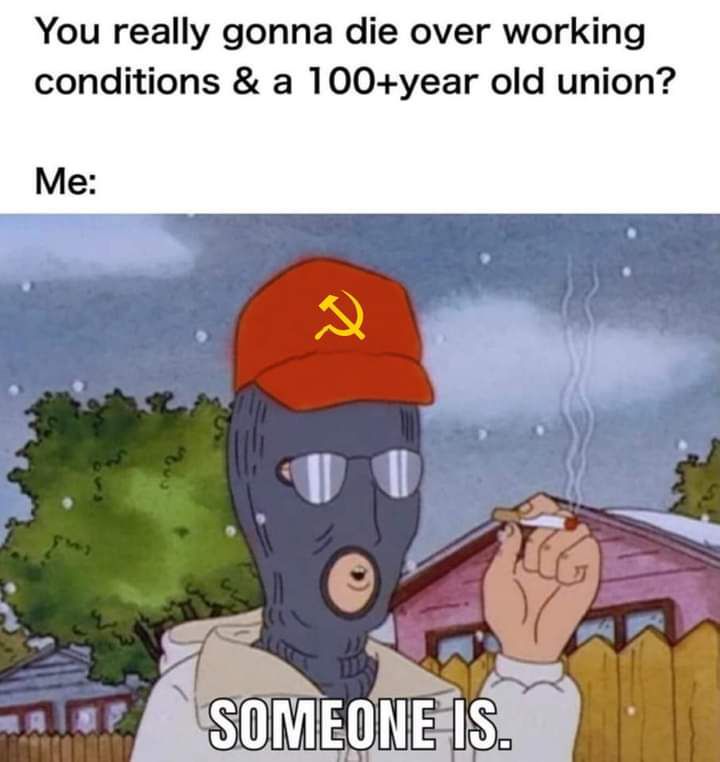
The meme depicts a cartoon character, strongly resembling Cartman from South Park, but visually altered to represent a stereotypical revolutionary. He's wearing a dark, opaque mask with only eye holes visible, a bright red cap emblazoned with the Soviet hammer and sickle symbol, and is casually smoking. The text above reads "You really gonna die over working conditions & a 100+ year old union?" and the character’s response is “SOMEONE IS.” The background appears to be a somewhat grim, industrial landscape.
Marxist Conflict Theory
This meme is deeply rooted in Marxist conflict theory. The initial question frames the struggle for better working conditions and the role of unions as almost futile—a struggle that might lead to death. From a Marxist perspective, this highlights the inherent class conflict between the proletariat (workers) and the bourgeoisie (owners/capitalists). The bourgeoisie, in seeking to maximize profits, will push workers to the brink.
The meme’s punchline, "SOMEONE IS," is a defiant assertion that someone must fight. It's an acknowledgement that individuals will be willing to make sacrifices (even to the point of death) to challenge the exploitative nature of capitalism and advocate for workers’ rights. It directly confronts the apathy or defeatism suggested by the original question. The visual, with the Soviet iconography, implies an embrace of potentially radical, even violent, struggle, though the comedic presentation tempers the seriousness.
Anarcho-Syndicalism & The Critique of Traditional Unions
This is where the Anarcho-Syndicalist interpretation really comes to life. The phrase "100+ year old union" is a critical jab. Anarcho-Syndicalists historically have been very skeptical of traditional, bureaucratic unions. Here's why:
- Bureaucracy & Hierarchy: Old unions can become ossified, developing hierarchies that are just as oppressive as those they fight against. They can become more concerned with negotiating within the system than with fundamentally challenging it. They can also be captured by the state.
- Top-Down Organization: Traditional unions often operate with a top-down structure. Anarcho-Syndicalists believe in a bottom-up, directly democratic organization rooted in worker control – specifically, through workers' councils or syndicates.
- Reformism vs. Revolution: Many traditional unions focus on incremental reforms within the capitalist system. Anarcho-Syndicalists aim for the abolition of capitalism through direct action and workers' self-management.
The meme, therefore, isn't simply defending unions in general. It’s suggesting that a willingness to struggle and even die for radical change—beyond what a traditional union might offer—is necessary. The character’s defiant posture implies a commitment to a more direct, revolutionary approach.
Foucauldian Genealogical Discourse Analysis
We can examine the meme through a Foucauldian lens by looking at the power dynamics and discourse surrounding work, sacrifice, and resistance. The question, "You really gonna die over working conditions…?" is an attempt to discipline through fear. It asserts a power dynamic where the cost of resistance (death) outweighs the potential benefits.
The meme's response challenges that disciplinary power. "SOMEONE IS" reclaims the narrative. It’s a refusal to internalize the message of powerlessness. It highlights that resistance, even when fraught with danger, is possible and necessary. The visual of the masked figure contributes to this disruption of the dominant discourse; the anonymity suggests a refusal to be individuated and controlled. The red star, despite its Soviet association, can be seen as a symbol of resistance.
Postmodernism (Limited Application)
Postmodernism doesn't play a huge role here, but one could argue the meme's use of irony and its deconstruction of traditional "heroic" narratives of resistance are postmodern gestures. It’s not presenting a straightforward, grand narrative of revolution, but rather a darkly humorous and somewhat cynical response to the idea of sacrifice. The image of Cartman, a character known for being selfish and manipulative, adds a layer of irony.
Critical Theory
The meme, read through the lens of Critical Theory, points to the ways in which systems of power (capitalism) naturalize exploitation and normalize suffering. The question assumes that accepting poor working conditions and accepting the status quo of old, possibly ineffective unions, are rational choices. The response is a rejection of this "rationality". It's an attempt to unmask the underlying power structures that make such acceptance possible. The focus on someone willing to take the risk suggests an awakening to the necessity of collective action to challenge these structures.
In Summary:
The meme is a potent, albeit darkly humorous, expression of a radical leftist perspective, particularly one aligned with Anarcho-Syndicalism. It’s a rejection of complacency, a critique of traditional unionism, and a defiant assertion that the fight for workers’ rights—even in the face of extreme risk—is a worthy and necessary endeavor. It is a statement of solidarity and a challenge to those who would accept the status quo.
Disclaimer: I have attempted to provide a comprehensive analysis within the requested theoretical framework. Interpretations of memes can be subjective, and this is just one possible reading.
simple-description (llama3.2-vision_11b)
This meme is a commentary on the concept of anarcho-syndicalism, a political philosophy that advocates for the abolition of the state and the establishment of a self-managed, decentralized society. The meme is a humorous take on the idea of anarcho-syndicalism's emphasis on direct action and the rejection of authority. The image depicts a character from a cartoon, wearing a mask and a hat with a hammer and sickle, and the text reads "You're gonna die" in a sarcastic tone, implying that the character is not taking the threat of death seriously.
detailed-analysis (gemma3-27b-vision)
Okay, here's an analysis of the meme, broken down into the sections you requested, focusing on what themes are present and applicable.
Visual Description
The meme features a screen capture from the animated series King of the Hill. The character depicted is Dale Gribble, a conspiracy theorist and paranoid survivalist. He's wearing a red baseball cap adorned with the Soviet hammer and sickle symbol, sunglasses, and is smoking a cigarette. His facial expression is blank, yet conveys a sense of steely resolve. Below the image, text reads "Someone is." The top text sets up a premise: "You really gonna die over working conditions & a 100+ year old union?"
The visual contrast between Dale Gribble's established character and the communist symbol is striking, generating immediate irony. His characteristic expression adds to the meme’s dry, sarcastic tone.
Marxist Conflict Theory
This meme is deeply rooted in Marxist conflict theory.
- Class Struggle: The setup explicitly references "working conditions" and a "union," representing the historical and ongoing conflict between the proletariat (workers) and the bourgeoisie (owners/capitalists). The meme subtly frames dying for better working conditions as a legitimate response to exploitation.
- Revolutionary Potential: Dale Gribble, a character often depicted as an outlier and extremist, adopting the symbol of communism suggests a willingness to embrace radical change. The "someone is" is the meme’s implication that someone will take a stand, potentially even to the extreme of dying for their principles.
- Critique of Capitalism: The setup poses the question as if dying for worker rights is absurd, but the meme’s response (Dale Gribble with the Soviet symbol) implies that such sacrifice might be justified by the severity of exploitative working conditions.
- Historical Materialism: The mention of a "100+ year old union" evokes a history of labor organizing, strikes, and the ongoing struggle for worker rights that is central to a Marxist understanding of social development.
Foucauldian Genealogical Discourse Analysis
This meme can be approached from a Foucauldian perspective focusing on power/knowledge dynamics.
- Discourse & Power: The meme operates within a discourse around labor, sacrifice, and political ideology. By placing the symbol of communism on Dale Gribble, it challenges dominant narratives about patriotism, individualism, and the acceptability of worker exploitation.
- Genealogy of the Symbol: The Soviet hammer and sickle, while historically representing a specific political ideology, has a complex genealogy. Over time, it's been re-appropriated and re-signified, becoming a symbol of resistance and anti-capitalism for some, and a symbol of oppression for others. The meme utilizes this complex history.
- Normalization of Suffering: The setup asks "Are you really gonna die?" framing death for worker rights as an extreme reaction. The meme subverts this by suggesting that in the face of exploitative conditions, sacrifice is a viable response.
- The "Truth" of Labor: Foucault emphasizes that "truth" is constructed through discourse. This meme suggests the "truth" of exploitative conditions makes death during the struggle for worker rights understandable, and perhaps justifiable.
Postmodernism
The meme employs some key postmodern characteristics:
- Irony and Parody: The juxtaposition of Dale Gribble with the communist symbol is fundamentally ironic. It takes a character known for individualism and distrust of authority and places him within a collective, historically oppositional ideological framework.
- Deconstruction of Symbols: The meme deconstructs the traditional meaning of the hammer and sickle. It removes it from its original historical context and re-signifies it within the context of contemporary labor struggles. It’s a symbol stripped of its context, and deployed to make a point.
- Playfulness with Meaning: The meme doesn’t offer a simple, straightforward message. It embraces ambiguity and invites the viewer to interpret the meaning for themselves.
- Critique of Grand Narratives: By using a character that is so outside the mainstream, the meme implicitly critiques the “grand narratives” surrounding work, patriotism, and political ideology.
---
Note: Queer Feminist Intersectional Analysis and Critical Theory don’t have significant or relevant themes to analyze within the context of this meme. It primarily centers on class struggle and the political symbolism of labor.
Let me know if you’d like me to expand on any of these points or explore other potential interpretations!
simple-description (llama3.2-vision)
This meme is a humorous take on the idea of dying in a catastrophic situation. The image features a character from the animated series "BoJack Horseman" wearing a Soviet-era communist hat and a gas mask, with the phrase "Someone is" written at the bottom. The text above the image reads "You really think you're gonna die over working conditions & a 100+ year old union?"