First Seen
2023-05-10T21:03:32+00:00
simple-description (llama3.2-vision_11b)
The meme is a play on the phrase "I can smell the desperation" from the 1990s TV show "The X-Files." It's a humorous and satirical take on the idea of an anarcho-syndicalist movement, implying that the movement is so desperate for a new generation of workers that it's resorting to using a 90s TV show reference to get their attention.
detailed-analysis (gemma3-27b-vision)
Okay, here's an analysis of the tweet, broken down into sections based on the theoretical frameworks you requested. I'll indicate where a framework doesn't readily apply to the content.
Visual Description
The tweet features a profile picture of a person with dark hair and light skin, appearing in a close-up shot. They are smiling and wearing a dark-colored jacket. The visual presentation suggests a personal, rather than institutional, voice engaging with the message. The platform is Twitter (now X), marked by the profile icon and tweet format.
---
Foucauldian Genealogical Discourse Analysis
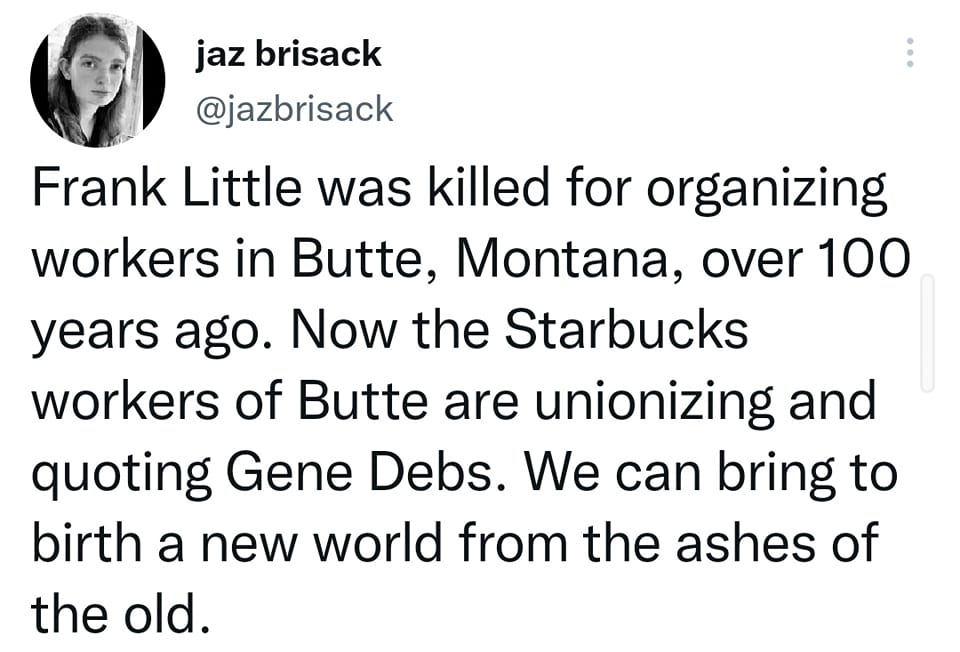
This tweet lends itself well to a Foucauldian genealogical analysis. The tweet establishes a discourse around labor organizing, resistance, and historical continuity.
- Power/Knowledge: The reference to Frank Little's killing demonstrates how power historically manifested through violence against those who organized workers. Little's death isn't just a historical fact, but an example of how power constructs its own legitimacy through suppression. The act of mentioning this history is a reassertion of the power of remembering and naming those suppressed.
- Genealogy: The tweet traces a genealogy of resistance. It doesn’t present a linear progression, but rather a connection between a past event of violent repression and a contemporary moment of worker organizing. The Starbucks workers aren't simply inspired by Little, they are part of a continuous, albeit fragmented, historical chain of labor struggle.
- Discursive Formation: The act of quoting Gene Debs reinforces a particular way of speaking about labor, socialism, and justice. The use of Debs is not merely rhetorical; it positions the present Starbucks unionization effort within a historically defined ideological and linguistic framework.
- Disruption: The claim "We can bring forth a new world from the ashes of the old" positions the present moment as a potentially disruptive force challenging established power structures. This is a claim to change the way power operates, to create a different mode of societal organization.
---
Critical Theory
The tweet embodies core tenets of Critical Theory, particularly Frankfurt School thought:
- Critique of Domination: The reference to Frank Little’s murder immediately establishes a critical perspective on the history of labor relations, which were—and arguably still are—built on exploitation and repression.
- Emancipatory Interest: The tweet clearly expresses an emancipatory interest – a desire to overcome existing forms of oppression and create a more just society. The "new world" mentioned suggests a vision of a better future beyond the limitations of the present.
- Ideology Critique: The framing of the current Starbucks unionization as connected to historical figures like Gene Debs functions as an implicit critique of the prevailing ideology that justifies existing inequalities. By invoking these figures, the tweet suggests that the present struggle is part of a longer, ongoing effort to challenge dominant power structures.
- Reason and Enlightenment: The attempt to forge a "new world" based on a history of labor struggles resonates with critical theory’s commitment to the ideals of reason and enlightenment as tools for social transformation.
---
Marxist Conflict Theory
This tweet is strongly rooted in Marxist conflict theory:
- Class Struggle: The historical reference to Frank Little, a labor organizer, directly relates to the core concept of class struggle. Little was killed for advocating for the rights of workers, placing him squarely within the history of conflict between capital and labor.
- Historical Materialism: The tweet demonstrates an understanding of history as shaped by material conditions and economic forces. Little’s struggle and the current Starbucks unionization are understood as outcomes of the inherent contradictions within the capitalist system.
- Exploitation: The underlying message acknowledges that workers are subjected to exploitation and that resistance – through unionization – is a necessary response.
- Revolutionary Potential: The call for a “new world” suggests a belief in the possibility of fundamental social change – a potential overturning of the existing order. This aligns with the revolutionary element often found within Marxist thought.
---
Postmodernism
While elements could be read through a postmodern lens, it’s not the primary framework for this tweet. A postmodern interpretation might focus on the deconstruction of grand narratives and the acknowledgement of fragmented identities. However, the tweet actively invokes a historical narrative and proposes a collective future (“We can…”). It isn't necessarily rejecting grand narratives, but rather reclaiming and repurposing them for contemporary struggle. A postmodern analysis would need to be stretched to be fully applicable here.
---
Queer Feminist Intersectional Analysis
While the tweet doesn't explicitly address gender, sexuality, or intersectionality, it’s possible to apply an intersectional reading. The history of labor organizing often excluded or marginalized women and queer workers. Framing this connection to a "new world" potentially implies a more inclusive and equitable labor movement. However, this is an interpretive extension rather than a directly inherent aspect of the tweet itself. More context would be needed to fully explore these dimensions.
Let me know if you'd like me to elaborate on any of these points or explore another theoretical framework!
simple-description (llama3.2-vision)
This meme is a humorous comparison between the 2020 death of the owner of a Starbucks in Oregon, who was killed in the crossfire of a robbery, and the 1900s death of the founder of the company. The meme states that the owner of the Starbucks in Oregon was killed "in the crossfire of a robbery" and compares it to the 1900s death of the founder of the company, saying that we can "bring to birth a new world from the ashes of the old".
tesseract-ocr
«) jaz brisack t @jazbrisack Frank Little was killed for organizing workers in Butte, Montana, over 100 years ago. Now the Starbucks workers of Butte are unionizing and quoting Gene Debs. We can bring to birth a new world from the ashes of the old.