First Seen
2026-04-02T05:28:41+00:00
simple-description (qwen3.5_2b-q8_0)
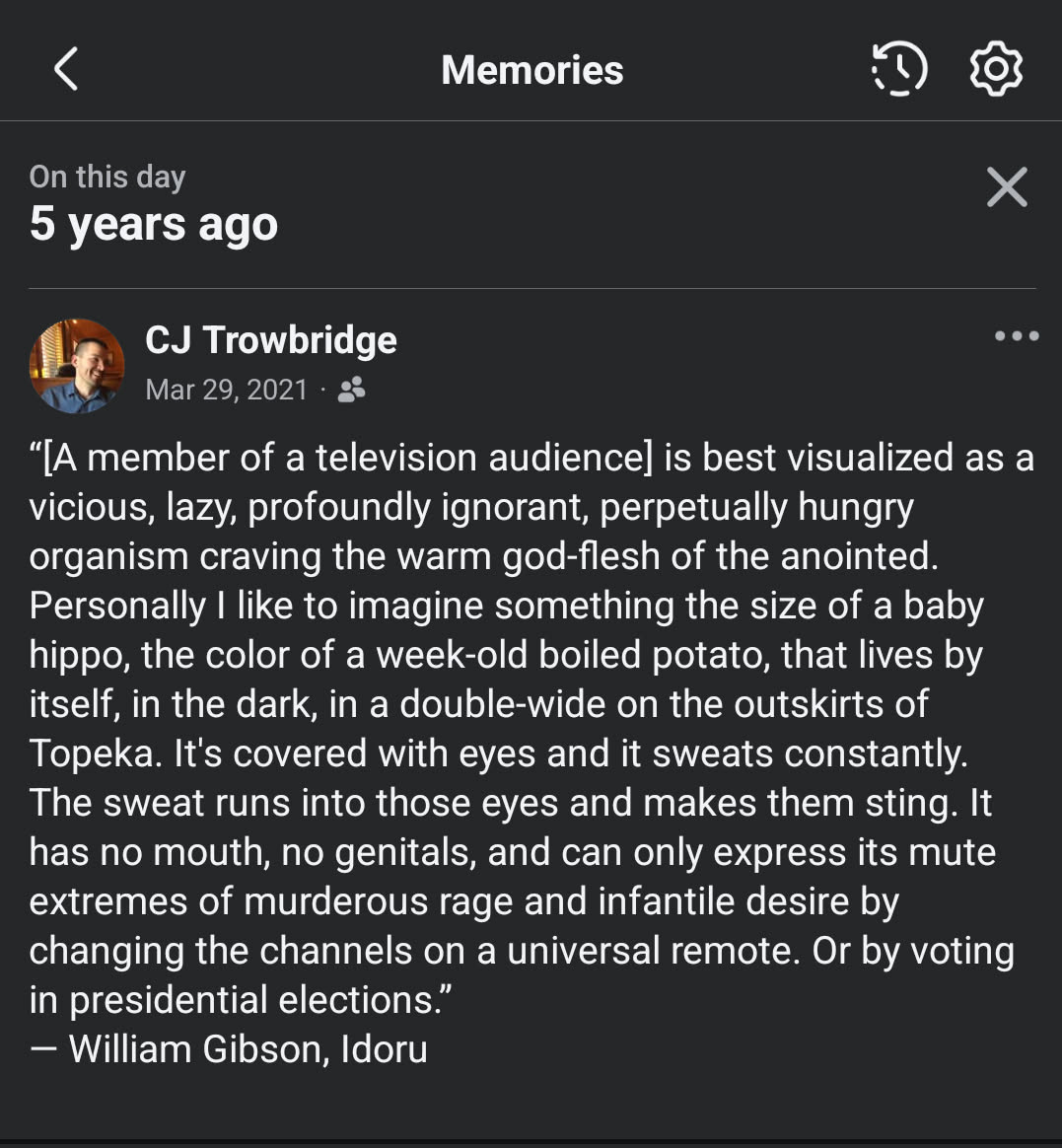
This meme acts as a deconstruction of Cyberpunk identity by twisting William Gibson’s famous "One Culture" quote into a grotesque, biological monologue about "television audiences." It visualizes a passive viewer not as a rational consumer but as a "vicious, hungry organism" resembling a "baby hippo potato color" that sweats constantly and uses the universal remote to change channels. The post anchors this absurd imagery in mundane text like "On this day" and specific location details such as "the outskirts of Topeka."
detailed-analysis (gemma3_27b-it-q8_0)
Okay, let's break down this rather unsettling and evocative meme through the lens of Cyberpunk aesthetics and its associated critical theories. It's a dense piece of text, so this will be a detailed analysis.
Understanding the Meme's Cyberpunk Core
This meme, drawn from William Gibson and Idoru, isn’t about surface-level cyberpunk visuals (neon lights, chrome, etc.). It’s about the underbelly – the anxieties, the dehumanization, and the monstrous potential within highly mediated, technologically saturated societies. This is core Cyberpunk. Cyberpunk isn't just about futuristic tech, it’s about the human condition under that tech, and the distortion of that condition. This meme focuses on the latter.
Visual Description (as Informed by Cyberpunk)
While the meme is text-only, the description is highly visual, deliberately repulsive, and unsettling. This is crucial for its cyberpunk impact. The imagery deliberately eschews beauty or glamour.
- The Monstrosity: The "baby hippo, color of a week-old boiled potato" is grotesque, amorphous, and suggests something both infantile and ancient, primal and decaying. This isn't a sleek, futuristic cyborg; it’s a biomorphic horror. Cyberpunk frequently uses body horror to express the alienation and corruption of the human form.
- Darkness & Isolation: “Lives by itself, in the dark, on the outskirts of Topeka” emphasizes isolation, societal rejection, and a disconnect from conventional reality. Topeka represents an "anytown, USA" which stands in contrast to the imagined futures of cyberpunk.
- Eyes as Interfaces: The overwhelming number of eyes, constantly stinging with sweat, functions as an unsettling metaphor for constant surveillance, hyper-stimulation, and the overwhelming flow of information. They aren't windows to the soul; they’re receptors, endlessly consuming. This is a key cyberpunk theme - the loss of individual experience within a vast network.
- Lack of Organic Functions: “No mouth, no genitals” – This is the most disturbing aspect. It removes the basic biological functions associated with humanity, reducing the entity to pure, insatiable desire (expressed through channel-surfing and voting) and rage. It's a being driven purely by input and reaction.
Foucauldian Genealogical Discourse Analysis
This meme resonates strongly with Michel Foucault’s work on power, knowledge, and discourse.
- The Panoptic Gaze: The many eyes mirror Foucault’s concept of the Panopticon – a prison design where the possibility of being watched at any time induces self-discipline. The “audience” is both observed (by media, by advertisers, by the system) and internalizes that observation, becoming self-regulating in their consumption.
- Discipline & Normalization: The entity’s behavior (channel surfing, voting) isn’t free will; it’s a response produced by the systems it’s immersed in. Media and politics, in this view, aren't sources of information but mechanisms of control that shape desire and aggression. The system has created this creature and then dictates its behavior.
- Genealogy of the Audience: Foucault’s genealogical method traces the historical development of concepts. This meme suggests a genealogy of the television audience: not as a rational, discerning group, but as a monstrous product of evolving media technologies and the power structures that control them.
Critical Theory (Frankfurt School/Adorno & Horkheimer)
The meme deeply aligns with the Frankfurt School’s critique of the “culture industry.”
- Mass Deception: Adorno and Horkheimer argued the culture industry provides standardized, commodified experiences that pacify and control the masses. This entity craves this “warm god-flesh” – the illusion of fulfillment offered by media, while being perpetually hungry. It’s a cycle of manufactured desire.
- Loss of Individuality: The entity’s lack of distinct characteristics and its shared compulsion to change channels/vote mirrors the Frankfurt School's concern about the homogenization of thought and the erosion of individual critical thinking.
- Pseudo-Satisfaction: Channel surfing and voting are presented not as acts of agency, but as outlets for base impulses—"murderous rage and infantile desire"—that are ultimately contained and neutralized by the system. They feel like action, but they reinforce the status quo.
Postmodernism
- Rejection of Grand Narratives: The meme's fragmented, disturbing imagery rejects the idea of a coherent, rational understanding of the world. It embodies postmodern skepticism towards universal truths and objective reality. The audience is not a rational actor but an amorphous, irrational being.
- Simulacra and Simulation: (Baudrillard) The “warm god-flesh” could be seen as a simulacrum – a copy without an original. The audience is consuming representations of reality, not reality itself. The line between real desire and manufactured desire is blurred.
- Deconstruction of the Subject: The entity’s lack of defining human traits (mouth, genitals) is a deconstruction of the traditional, unified concept of the “self.” It’s a fragmented, incomplete being.
In Conclusion:
This meme isn’t a lighthearted joke. It’s a deeply unsettling and politically charged statement about the dangers of unchecked technological mediation, the manipulation of desire, and the potential for dehumanization in a hyper-connected world. It’s a potent piece of cyberpunk thought, using repulsive imagery and critical theory to expose the monstrous possibilities lurking beneath the surface of our seemingly benign media landscape. It's the kind of thing you'd expect to find scribbled in a datapad in a dystopian future.
simple-description (llama3.2-vision_11b)
The image features a social media post with a quote from William Gibson's novel "Bol . The quote is presented in white text on a black background, creating a clean and simple design. The quote itself is a description of a fictional character’s appearance, using a . The quote is presented in a block of text, making it easy to read and understand. Overall, the image is simple yet effective in conveying the quote’s message.