First Seen
2023-09-29T08:01:16+00:00
simple-description (llama3.2-vision_11b)
The meme is a screenshot of a Reddit comment from the user "Aesthetics" in the r/Cyberpunk subreddit. The comment reads: "Cyberpunk is aesthetic, but it's also a genre of sci-fi that explores the dark side of technology and its impact on society. It's not just about pretty visuals, it's about the human condition and the consequences of playing god with technology." The image is a photo of a character from the game Cyberpunk 2077, with a caption that says "Aesthetics" in a bold font.
detailed-analysis (gemma3-27b-vision)
Okay, here's an analysis of the image and accompanying text, broken down into the requested theoretical frameworks, only including those that apply. It's a bit of a niche piece, so some of these sections will be more developed than others.
Visual Description
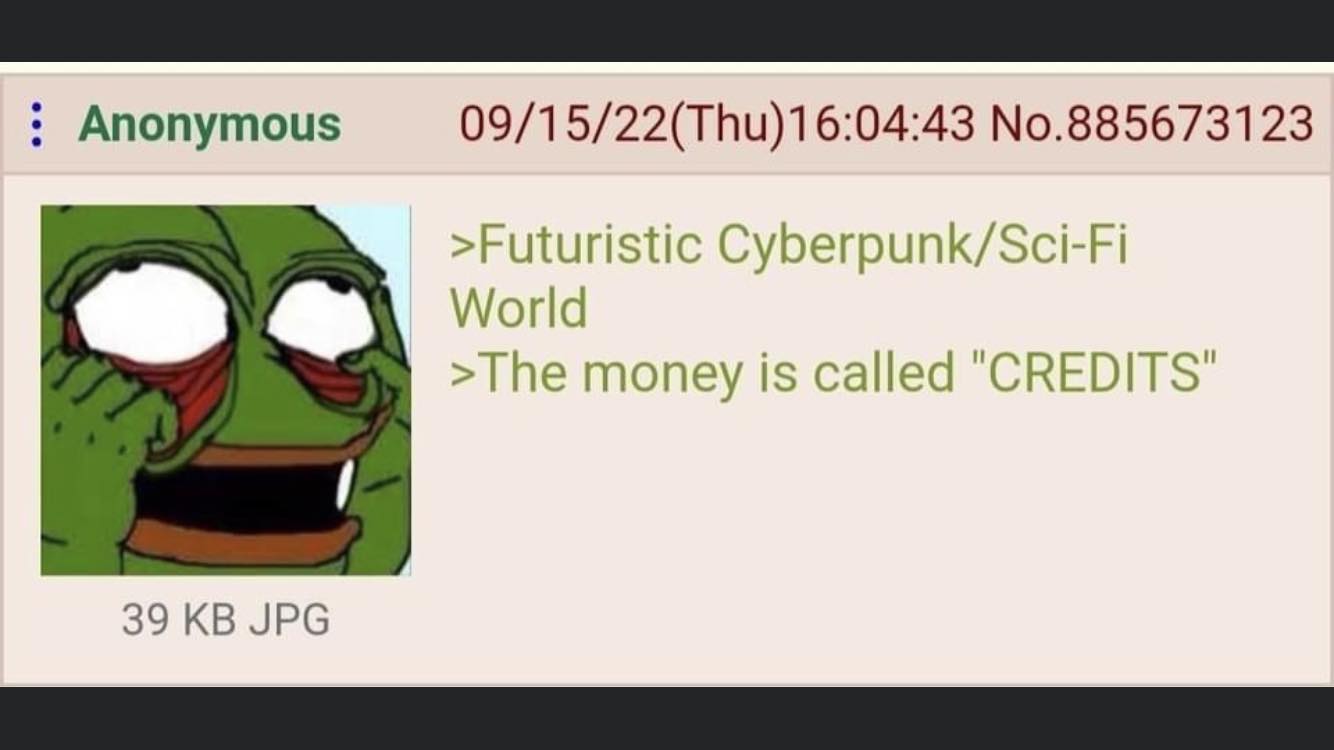
The image is a crude, digitally drawn cartoon of a Pepe the Frog variant. The frog is green with extremely exaggerated features: bulging, bloodshot eyes, a gaping, toothy mouth filled with sharp teeth, and a generally distressed, almost manic expression. The style is typical of internet "shitposting" and meme culture—intentionally low-quality and deliberately provocative. The accompanying text is a short line reading ">Futuristic Cyberpunk/Sci-Fi World" and ">The money is called 'CREDITS'". The post itself appears to be from an anonymous internet forum, indicated by the header with timestamp and a number.
Foucauldian Genealogical Discourse Analysis
This image lends itself to a Foucauldian analysis due to its origins within a specific discourse—internet meme culture, and particularly the subculture surrounding Pepe the Frog. A genealogical approach would trace the history of the image and how its meaning has evolved.
- Origin & Transformation: Pepe the Frog, originally a benign cartoon character, was appropriated by alt-right groups, transforming it into a symbol of hate. The current image traces a modification of that original meaning, now leaning into dystopian and cyberpunk tropes. It uses the established visual vocabulary of Pepe (distorted expressions) to signal a particular worldview.
- Power/Knowledge: The very act of using the Pepe image, despite its problematic history, is an assertion of power. It's reclaiming a symbol, but doing so within a specific framework. The framing within “cyberpunk” implies an acceptance, even a glorification, of marginalized or anti-establishment themes.
- Discipline & Subjectivation: The image itself can be seen as a mode of discipline, shaping the viewer’s perception of the future. The exaggerated emotions subjectivate the viewer, suggesting a certain emotional response to the imagined “cyberpunk world”
Critical Theory
This image is ripe for analysis through the lens of Critical Theory, specifically focusing on the production and consumption of culture within capitalist systems.
- Culture Industry: The image, born from meme culture, is a product of the contemporary “culture industry”. It is a deliberately disposable and quickly-consumed piece of content, intended to generate engagement. This is particularly visible in the context of anonymous internet forums.
- Commodification of Rebellion: The cyberpunk aesthetic, often associated with anti-establishment themes, is heavily commodified in contemporary culture. This image appropriates that aesthetic, potentially neutralizing its radical potential by reducing it to a visual trope.
- Spectacle & Simulation: The image, like many forms of digital content, contributes to the “spectacle” described by Guy Debord. It presents a simulation of a futuristic world—an image devoid of depth or meaningful engagement. The “credits” money system highlights this hyperreality as it’s just a concept and image.
Marxist Conflict Theory
The image and accompanying text, despite being simplistic, resonate with key themes within Marxist conflict theory.
- Class & Economic Systems: The explicit mention of “credits” as currency immediately points to a focus on economic systems. Within a Marxist framework, this suggests a power structure based on control of resources and the means of production. The dystopian visual style hints at a potentially exploitative or unequal distribution of wealth.
- Alienation: The exaggerated and distressed expression of the frog symbolizes the alienation experienced by individuals within capitalist systems—a sense of disconnection from labor, products, and other people.
- Ideology: The image functions as an ideological statement, promoting a certain view of the future. This view, while not explicitly stated, suggests a world defined by economic control, perhaps even surveillance or oppression.
Postmodernism
The image embodies several key characteristics of postmodernism:
- Pastiche and Intertextuality: The image blends elements from different sources—internet meme culture, cyberpunk aesthetics, dystopian tropes. It's a playful, fragmented combination of signs and symbols.
- Deconstruction of Grand Narratives: The image implicitly rejects any unified or totalizing vision of the future. It presents a fragmented, uncertain, and potentially bleak outlook.
- Hyperreality & Simulation: The image contributes to the creation of a “hyperreality”—a world where simulations and representations have become more real than reality itself. The “credits” and the overall aesthetic reinforce this.
Queer Feminist Intersectional Analysis (less applicable, but a possibility)
While not immediately obvious, a Queer Feminist Intersectional reading could be applied, though it requires more interpretive work.
- Dystopian Futures & Marginalization: Dystopian settings often magnify existing forms of oppression and marginalization. A queer feminist reading could examine how the imagined “cyberpunk world” might disproportionately impact vulnerable communities (e.g., queer people, people of color, disabled individuals).
- Body Horror & Control: The exaggerated features of the frog could be interpreted as a form of “body horror,” representing the anxieties surrounding control, surveillance, and the objectification of bodies.
- Challenging Normative Futures: By presenting a bleak and unsettling vision of the future, the image challenges conventional narratives of progress and utopia.
Important Note: Much of this analysis is interpretive. The image is intentionally ambiguous and open to multiple readings. The theoretical frameworks provide tools for understanding its potential meanings and implications.
Hopefully, this detailed breakdown provides a comprehensive analysis of the image based on the frameworks you requested! Let me know if you'd like me to elaborate on any specific aspect.
simple-description (llama3.2-vision)
This meme is a screenshot of a 4chan post, which is a text-based image board. The image is a picture of Pepe the Frog, a cartoon character, with a shocked expression. The text accompanying the image reads: " >Futuristic Cyberpunk/Sci-Fi World >The money is called "CREDITS""
tesseract-ocr
: Anonymous 09/15/22(Thu)16:04:43 No.885673123 >Futuristic Cyberpunk/Sci-Fi World >The money is called "CREDITS" 39 KB JPG