First Seen
2024-02-12T06:39:32.953962+00:00
simple-description (llama3.2-vision_11b)
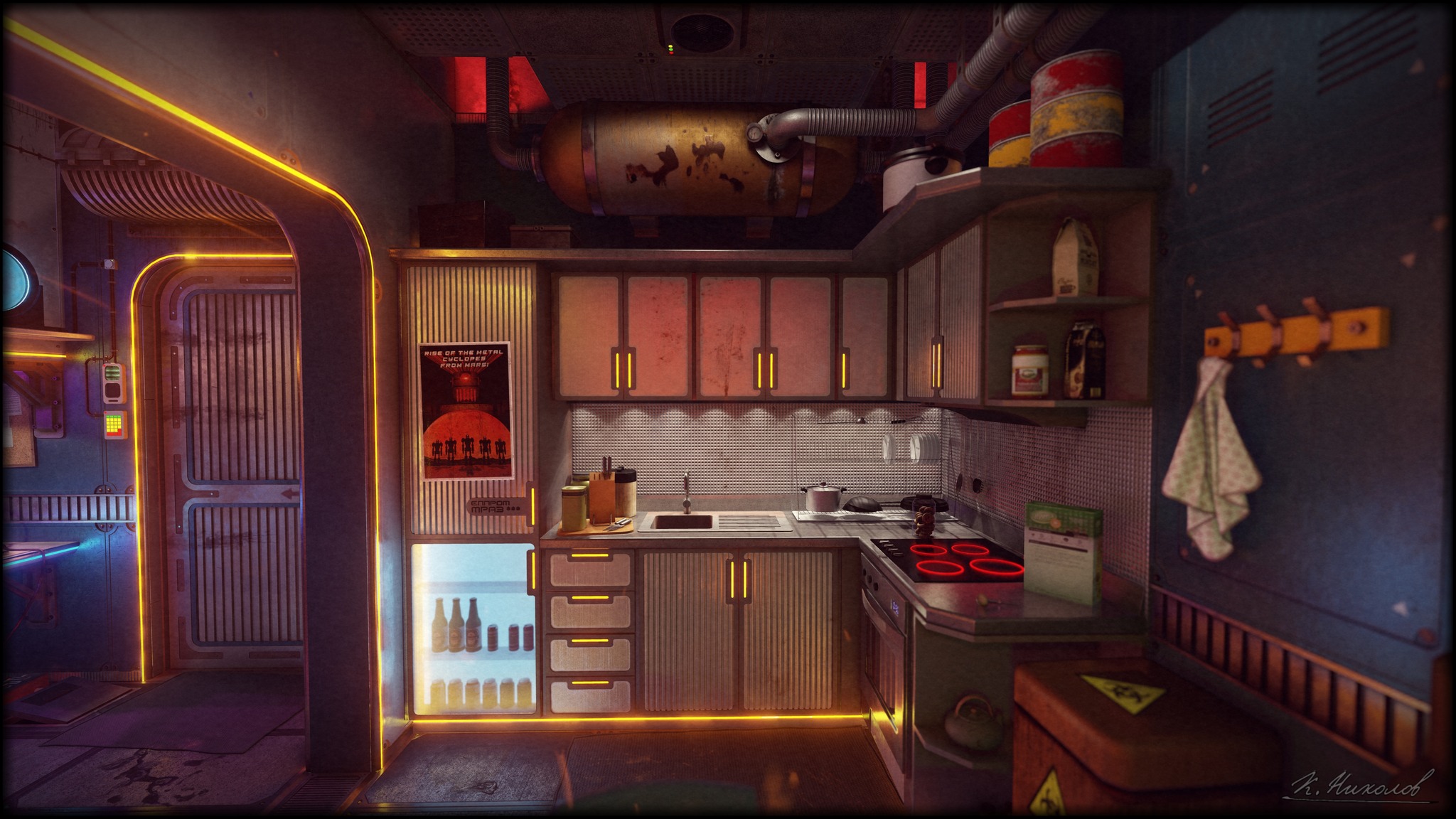
The meme is a screenshot from a video game, specifically a cyberpunk-themed game, showcasing a futuristic kitchen with a neon-lit, industrial-chic aesthetic. The image features a sleek, high-tech kitchen with a large, flat-screen TV and a futuristic-looking cooking station. The text "KITCHEN: WHERE THE FUTURE OF COOKING WILL BE MADE" appears in the top-left corner of the image, poking fun at the idea of a futuristic kitchen being a hub for innovation.
detailed-analysis (gemma3-27b-vision)
Okay, here's an analysis of the image, broken down into the requested sections. Given the nature of the image, some sections will be more robust than others. I'll strive for nuanced interpretations, but remember this is based on visual cues and requires assumptions.
Visual Description
The image depicts a cramped, utilitarian kitchen interior within what appears to be a futuristic, possibly space-faring, vessel. The space is dominated by a metallic color palette – primarily grey, silver, and a warm, almost brassy, yellow glow emanating from integrated lighting. The walls and surfaces are heavily textured with visible rivets, pipes, and conduits. This gives the impression of a heavily engineered, functional environment, lacking in aesthetic indulgence.
The kitchen itself is compact, with fitted cabinetry, a small sink, and what looks like an induction hob (cooktop). The materials seem durable, designed for repeated use and perhaps resistance to harsh conditions. There's a noticeable contrast between the heavily industrial structure and small signs of domesticity: a dishcloth hanging on a cabinet, a knife on the counter, and various food items (jars and boxes) stored in the cupboards. A vintage-style poster is seen on the wall.
The lighting is dramatic, with strong highlights and shadows, emphasizing the mechanical details and creating a sense of claustrophobia. The framing of the image, a slightly angled perspective, further enhances the sense of being inside this enclosed space. The overall impression is one of practicality blended with an underlying sense of being confined or isolated.
Foucauldian Genealogical Discourse Analysis
This kitchen is a fascinating site for exploring Foucault’s concepts of power/knowledge. The very design of the space embodies disciplinary power.
- Surveillance & Normalization: The visible plumbing, wires, and structural elements imply constant monitoring and a rigid system of control. The emphasis on functionality over comfort suggests the inhabitants are subjects of a process of normalization – their behavior is shaped by the demands of the environment and the presumed needs of the vessel/system they inhabit.
- Panopticism: While not a perfect example, the arrangement of the kitchen could be viewed through a panoptic lens. The feeling of potential observation – through sensors or cameras implied by the visible systems – encourages self-regulation. The individual is always aware of being potentially watched, thus modifying behavior to conform to expected norms.
- Genealogy of the Kitchen: Historically, kitchens have been sites of gendered labor and social control. This futuristic kitchen replicates that history, but through different means. While it appears advanced, it still functions as a space for the preparation and control of sustenance, perpetuating a discourse of domesticity – albeit within a radically different setting. The efficiency and utilitarian design prioritize function over aesthetic pleasure, reinforcing the expectation of productive (and likely gendered) labor.
- Discourses of Efficiency and Control: The design communicates the ideology that everything has a purpose. There is no ornamentation or space for leisure, just the machinery of sustenance. This emphasizes a culture of control and optimization.
Critical Theory
The kitchen can be seen as a microcosm of the broader social system within the world the image depicts. Applying a critical theoretical lens:
- Alienation: The highly functional, impersonal environment suggests alienation – a separation of the inhabitants from their labor and from each other. The kitchen isn’t a home in the traditional sense; it’s a workspace. This is a core concept in the Frankfurt School’s critique of modernity. The inhabitants are likely seen as parts of a larger machine, valued for their function rather than their individuality.
- Commodification: Even in a futuristic setting, the need to prepare food represents the commodification of basic needs. Sustenance isn’t a gift or a natural right, it's something that must be produced (through labor, and likely requiring the acquisition of resources). The kitchen is a place where value is created, reinforcing the logic of capitalism (or whatever economic system governs this world).
- The Technological Imperative: The over-reliance on technology and the complete lack of "natural" elements implies a society where technology dictates life rather than serves it. This echoes critiques of technological determinism.
Marxist Conflict Theory
The kitchen embodies class and labor dynamics.
- Means of Production: The kitchen is a miniature “means of production,” where labor is performed to create sustenance. The owner/controller of the vessel/facility likely controls these means of production, thereby controlling the access to food and, ultimately, the lives of the inhabitants.
- Class Division: The stark practicality of the kitchen suggests a clear division of labor and class structure. Those who use the kitchen are likely a working class, providing the labor necessary to maintain the vessel and its operations. Those who designed and control the space likely belong to a ruling class, benefiting from the labor of others.
- Exploitation of Labor: The efficiency-focused design could be seen as a tool for maximizing the exploitation of labor. By streamlining the food preparation process, those in control can extract more work from those who perform it.
Postmodernism
While seemingly futuristic, there's an element of postmodern pastiche present:
- Blending of Styles: The overall aesthetic combines industrial functionality with what appears to be a retro-style poster. This mixing of styles disrupts the expectation of a purely futuristic aesthetic.
- Simulacra & Simulation: The kitchen simulates domesticity but lacks the warmth and comfort of a traditional home. It's a representation of a representation – a constructed space that evokes feelings of home but doesn’t actually provide them. The image highlights the way signs and symbols become detached from reality.
- Deconstruction of Narrative: The image doesn't tell a clear story. It presents a fragment of a world, leaving the viewer to construct their own narrative. This open-endedness is characteristic of postmodern art.
Queer Feminist Intersectional Analysis
This section requires some extrapolation, but it's important to consider:
- Gendered Space: Historically, kitchens have been heavily gendered spaces, associated with female domestic labor. While this is a futuristic setting, the kitchen still carries that historical baggage. The image prompts questions about who performs the labor in this kitchen and whether traditional gender roles persist in this world.
- Intersectionality & Marginalization: The cramped, utilitarian design could reflect a system that marginalizes certain groups. Who is assigned to live and work in the most confined spaces? What access do they have to resources and power? The image invites speculation about how factors like race, class, and sexual orientation might intersect to create systems of oppression.
- The Body & Confinement: The narrow space can be interpreted as a metaphor for the confinement and control of bodies – particularly those historically marginalized. The lack of personal space and the emphasis on efficiency could represent a system that prioritizes productivity over individual well-being.
Hopefully, this detailed analysis, broken down by theoretical framework, provides a rich and nuanced interpretation of the image. Let me know if you'd like me to elaborate on any specific section or explore another theoretical lens.
simple-description (llama3.2-vision)
The meme is an image of a kitchen set in a futuristic, industrial-style environment, with a sign on the wall that reads "KITCHEN OF THE FUTURE" in bold, neon-lit letters. The kitchen is equipped with a variety of high-tech gadgets and appliances, including a robotic cooking machine and a food synthesizer. The image is a humorous commentary on the idea of a "kitchen of the future" being a place where all the food is prepared and cooked by machines, with no human involvement.
tesseract-ocr
ri ane — ™ : , ; y £ , B. x " ) | Oe ea ys a Ve. Serres apes rs ee || 110 , ee | eT II eee ETT a ei ee | | , LD ! i = * oe 1 | | } Ra Z | a ea NT “DS hs