First Seen
2024-04-06T19:07:34.071224+00:00
simple-description (llama3.2-vision_11b)
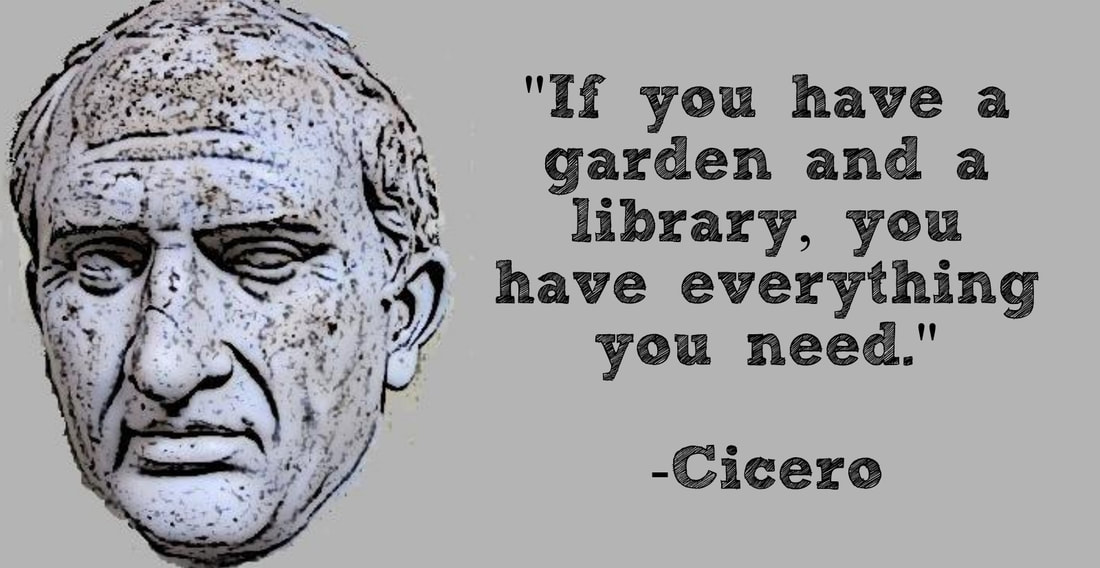
The meme is a play on the idea of a "cottagecore" aesthetic, which emphasizes a cozy and rustic lifestyle. The image features a quote from Cicero, a Roman philosopher, but with a humorous twist: it's about gardening and reading, not just having a garden and a library. The meme is poking fun at the idea that having a garden and a library is all you need, implying that you're complete and self-sufficient.
detailed-analysis (gemma3-27b-vision)
Okay, let's break down this image and quote through the lenses you've provided. Note that some lenses will be more applicable than others.
Visual Description
The image features a bust of Marcus Tullius Cicero, a Roman statesman, lawyer, scholar, and philosopher. It appears to be a marble or stone rendering, with a heavily shadowed profile displaying classical features, a pronounced nose, and deeply etched lines suggesting age and perhaps gravitas. The background is a neutral, flat grey. Superimposed on the right of the bust is a white quote in a bold sans-serif font: "If you have a garden and a library, you have everything you need." The quote is attributed to Cicero. The overall impression is one of antiquity, wisdom, and a sense of intellectual self-sufficiency.
Foucauldian Genealogical Discourse Analysis
This quote, viewed through Foucault, isn’t about a literal need for plants and books. Instead, it's a historical construction of “the good life” within a specific power/knowledge regime.
- Discourse: Cicero's statement contributes to a discourse of otium (leisure, withdrawal from public life) prevalent in Roman elite circles. This discourse constructs "the ideal life" as one of intellectual contemplation and cultivation of the self through access to nature and knowledge. It's a discourse heavily tied to property ownership. Only those with the means to acquire land and maintain a collection of books could participate in this ideal.
- Power/Knowledge: The statement reinforces a particular power structure. Those who have access to gardens and libraries are positioned as self-sufficient, wise, and therefore implicitly possessing authority. It reinforces the legitimacy of the social order that allows for such concentrated ownership.
- Genealogy: A genealogical analysis would trace how this ideal evolved over time. The concept of otium itself had a complex history, and this particular formulation might be seen as a way for the Roman elite to legitimize their withdrawal from civic duty and focus on self-cultivation. It's not a natural state, but a historically constructed one.
Critical Theory
From a critical theory perspective (influenced by the Frankfurt School), this quote is ripe for deconstruction.
- Ideology: The statement presents what seems like a simple, benign desire. However, it operates ideologically by masking the deep social inequalities that make it inaccessible to most people. It naturalizes a privileged position. The idea that a garden and library constitute everything you need obscures the fundamental material needs – food, shelter, healthcare – that are denied to many.
- Domination & Control: The quote implicitly supports a system of domination. Those who lack access to these resources are implicitly positioned as needing something. The focus on self-sufficiency can be seen as a way to deflect attention from the structural inequalities that create dependence.
- Reason & Enlightenment: Critical theorists might question whether this form of self-sufficiency, rooted in private ownership and individual contemplation, truly represents enlightenment or merely a form of escapism from the complexities of social and political life.
Marxist Conflict Theory
From a Marxist perspective, this statement is a clear manifestation of class ideology.
- Material Conditions: The statement ignores the vast majority of the population who lack the material resources to own land and build a library. It’s a statement made from a position of privilege and obscures the fundamental economic inequalities that shape people's lives.
- False Consciousness: The idea that a garden and library constitute everything you need promotes a form of "false consciousness," masking the true sources of alienation and exploitation. It encourages a focus on individual self-sufficiency rather than collective struggle for social justice.
- Class Struggle: This statement subtly reinforces the existing class structure by presenting the lifestyle of the elite as the ideal and ignoring the needs of the working class.
Postmodernism
A postmodern analysis would focus on the instability of meaning and the deconstruction of grand narratives.
- The "Everything" Claim: The claim that a garden and a library constitute "everything" is inherently problematic. Postmodernists would challenge this totalizing claim, arguing that meaning is contingent and contextual. What constitutes "everything" depends on individual experience, cultural context, and historical circumstances.
- Discourse as Construct: The statement itself is a linguistic construction, a product of discourse. Postmodernists would focus on the power relations embedded in this discourse and how it shapes our understanding of “the good life.”
- Rejection of Universal Truth: There's no universal truth about what constitutes happiness or fulfillment. The statement privileges a particular (elite) worldview, ignoring other forms of meaning-making.
Queer Feminist Intersectional Analysis
This is the most challenging lens to apply, but can be insightful.
- Exclusionary Nature: The ideal presented (garden, library) historically excluded many groups – women, people of color, the poor. These spaces were often controlled by men, and access was restricted based on social status. The quote reinforces a norm centered around a privileged, likely male, position.
- Intersectionality: The lack of access to these resources intersects with other forms of oppression. For example, women were often denied access to education and land ownership, limiting their ability to cultivate intellectual pursuits or engage with nature on their own terms.
- Privilege & Power: The statement reinforces the privileges of those who already have access to these resources and ignores the systemic barriers that prevent others from achieving the same. It normalizes a hierarchy where some are deemed “complete” due to ownership, while others are not.
In conclusion, while seemingly benign, this quote is laden with historical, social, and political implications. Analyzing it through these various lenses reveals the power dynamics and ideological underpinnings that shape our understanding of what constitutes “the good life.”
simple-description (llama3.2-vision)
This meme is a play on the ancient Roman philosopher Cicero's quote, "If you have a garden and a library, you have everything you need." The meme takes this phrase and applies it to a modern-day situation, implying that if you have a garden and a library, you have everything you need.
tesseract-ocr
FE vf, Gp Sy "If you have a ee Aw garden and a res iS. S| library, you res a) have everything K. mA oC you need. sy -Cicero