First Seen
2025-07-21T17:13:29+00:00
simple-description (qwen3.5_2b-q8_0)
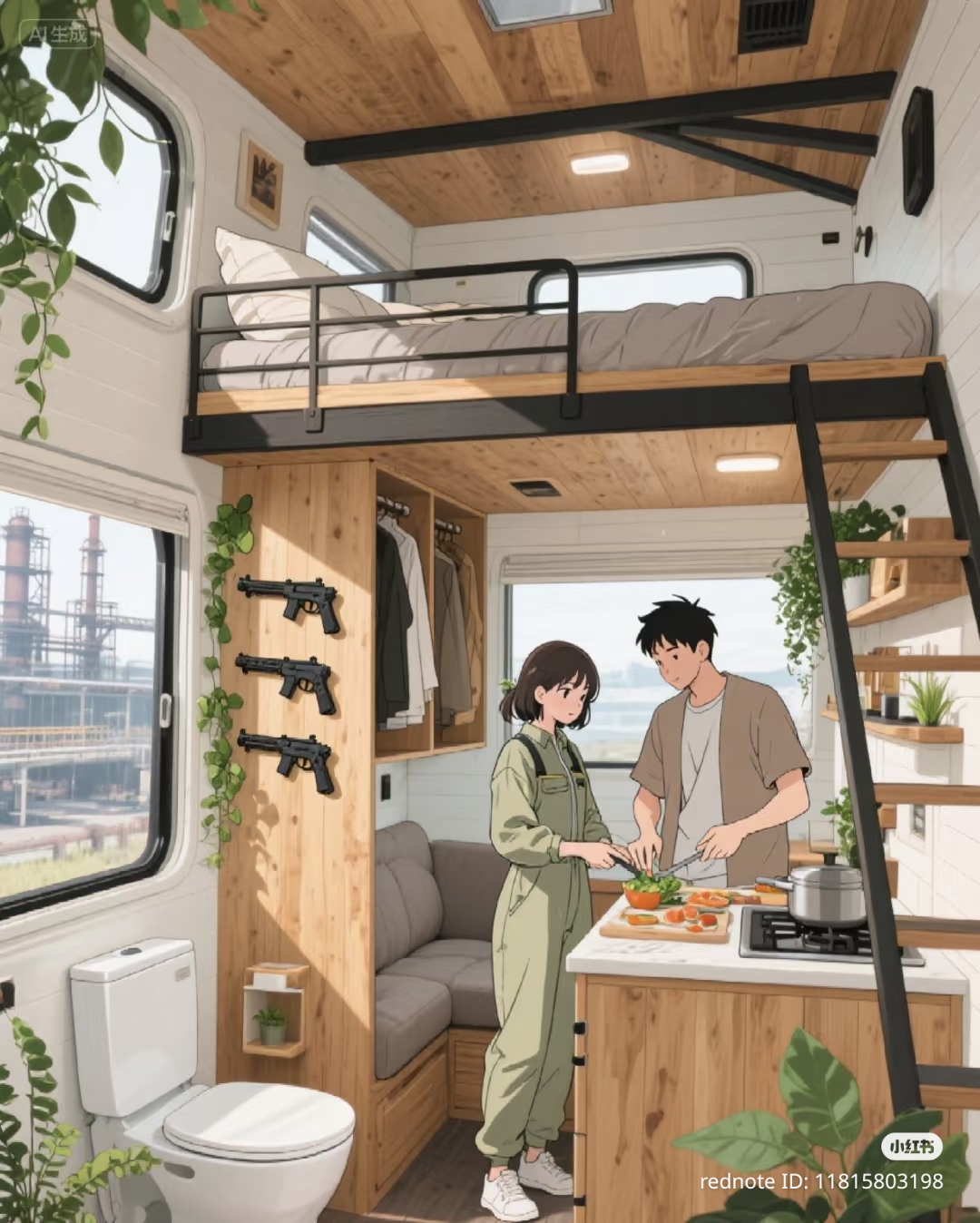
This meme, known as the "Guns on the Wall," plays on the humorous contradiction popularized by the retro-cottagecore and vanlife aesthetics. It presents a picture of a cozy camper van interior featuring warm wood paneling, hanging plants, and a bed—but instead of just decor, it displays three military-style assault rifles mounted vertically on the wall. The joke is that modern "cool" design has treated the living space as a tactical bunker, blending retro camping vibes with aggressive militarism for comedic effect. (Note: The image also bears an "AI 生成" watermark and a rednote ID in the bottom right corner.)
detailed-analysis (gemma3_27b-it-q8_0)
Okay, let's break down this image through the lens of the "Aesthetics - Cottagecore - Vanlife" category, using the requested theoretical frameworks where applicable. It's a complex image that generates a lot to unpack.
Visual Description
The image depicts a highly stylized interior of what appears to be a converted van or tiny home, heavily emphasizing a blend of rustic and modern aesthetics. The core aesthetic is undeniably cottagecore – the extensive use of wood paneling, the small potted plants, the domestic scene of food preparation, and a generally cozy, curated atmosphere all contribute to this. It's also vanlife inspired; the compact space, the integrated storage, the view from a window hinting at mobility are all hallmarks of this lifestyle aesthetic. However, the image is notably jarring. A rack of several firearms is mounted prominently on the wooden wall, directly contrasting with the soft, peaceful vibes of the rest of the scene. The couple within—a woman in workwear (likely representing practical skills) prepping food, and a man leaning in, perhaps watching—appear oblivious or accepting of this juxtaposition. The background reveals a stark industrial landscape, sharply contrasting with the interior. The overall aesthetic is hyper-curated, looking like a digital painting rather than a photograph of a lived-in space. The style is akin to a concept art illustration.
Foucauldian Genealogical Discourse Analysis
This image invites a genealogical analysis, particularly looking at the discourses of security, domesticity, and masculinity. Michel Foucault’s work asks us to trace the historical shifts in how certain concepts are understood and regulated.
- The Discourse of Domesticity: Traditionally, the home, and particularly the kitchen, has been heavily regulated by notions of femininity, nurturing, and safety. This image disrupts that, imbuing it with an element of perceived threat. The presence of guns immediately rewrites the rules of this safe haven.
- The Discourse of Security: The guns are not merely "objects," but rather embody a discourse of self-reliance and the need for protection. Foucault would ask how this discourse has emerged. Has it been shaped by anxieties about crime, political instability, or a broader cultural embrace of individual power?
- The Discourse of Masculinity: The guns are strongly associated with traditional notions of masculinity—power, control, protection. The man in the image subtly reinforces this. The contrast with the woman, engaged in a typically 'feminine' task (food prep), is notable, yet the acceptance of the guns suggests a blurring or negotiation of these gendered roles, where even within a seemingly progressive framework, traditional power dynamics are present.
- Power/Knowledge: This image showcases how power operates through knowledge. The knowledge/belief that having firearms equates to security, autonomy, and control (even within a domestic space) is crucial to understanding this configuration.
Critical Theory
From a Critical Theory perspective (drawing on the Frankfurt School), the image can be seen as representing a specific form of false consciousness. The "idyllic" cottagecore/vanlife aesthetic functions as a screen, obscuring underlying social and political anxieties.
- Commodification of Counterculture: Vanlife and cottagecore, initially seen as alternatives to mainstream consumer culture, have become heavily commodified. The image reinforces this by presenting a highly stylized and potentially unattainable lifestyle (the perfect tiny home, perfect clothes, perfect food presentation). The guns, in this context, can be read as another commodity—a symbol of security that is ultimately a product of a capitalist system that generates the very insecurities it promises to solve.
- Reification: The guns, rather than being understood as tools of violence, become reified—objects stripped of their historical and social context, presented simply as aesthetic elements. This detachment allows for the normalization of violence and potentially even fetishizes it.
- Hegemony: The image suggests a certain hegemonic acceptance of gun culture. The fact that the couple seems unfazed by the presence of firearms indicates that this worldview has become normalized, even within a seemingly progressive and "alternative" lifestyle.
Marxist Conflict Theory
A Marxist reading focuses on the underlying class and power relations.
- Class and Self-Reliance: The "self-sufficiency" promoted by the vanlife aesthetic, and the perceived need for firearms, might be understood as a response to systemic failures. A distrust of institutions (police, government) may be rooted in a lack of access to social safety nets. The ability to afford to create this independent lifestyle (the van conversion, the equipment) is inherently class-based.
- Control of the Means of "Protection": The guns, from this perspective, represent control—the ability to defend oneself and one's property. But this control is unevenly distributed, reflecting existing power imbalances within society. Those with economic resources are more likely to be able to afford firearms and the associated training.
- Ideology and Legitimation: The aestheticization of the guns within a cozy, idyllic setting serves to legitimize them. It frames them not as tools of violence but as necessary components of a self-reliant and "free" lifestyle, obscuring the social and economic structures that perpetuate inequality and insecurity.
Postmodernism
Postmodernism would focus on the image's blurring of boundaries, ironic juxtapositions, and the disintegration of grand narratives.
- Pastiche & Intertextuality: The image is a pastiche—a mixture of styles and references (cottagecore, vanlife, industrial landscape, gun culture). It deliberately creates a jarring combination, highlighting the fragmentation of contemporary culture.
- Deconstruction of Meaning: The image actively resists a single, coherent interpretation. The contradiction between the idyllic setting and the menacing presence of firearms challenges our expectations and destabilizes meaning.
- Simulacra & Simulation: The hyper-real quality of the image—its polished, digital aesthetic—suggests that it is a simulacrum—a copy without an original. It's a representation of a lifestyle, but one that is likely far removed from the lived experiences of most people.
In conclusion:
This image isn’t merely a cute aesthetic post; it is a powerfully provocative statement. By placing guns within a setting traditionally associated with peace, domesticity, and nature, it forces us to confront complex questions about security, masculinity, power, and the contradictions of modern life. The "Aesthetics - Cottagecore - Vanlife" category, when coupled with these critical frameworks, reveals the image’s potential to be a commentary on anxieties about safety, the commodification of alternative lifestyles, and the enduring legacy of societal power structures.
simple-description (llama3.2-vision_11b)
The meme features a cartoon image of a couple living in a tiny home, with a kitchen and a bed, but with a unique twist - the kitchen is filled with guns and the bed is above a toilet. The image is captioned "Vanlife, but with a twist" and shows the couple cooking and eating in the kitchen, with guns on the wall and a bed above the toilet. The meme is a humorous take on the popular "vanlife" lifestyle, but with a darker and more absurd twist.