First Seen
2023-05-10T21:03:32+00:00
simple-description (llama3.2-vision_11b)
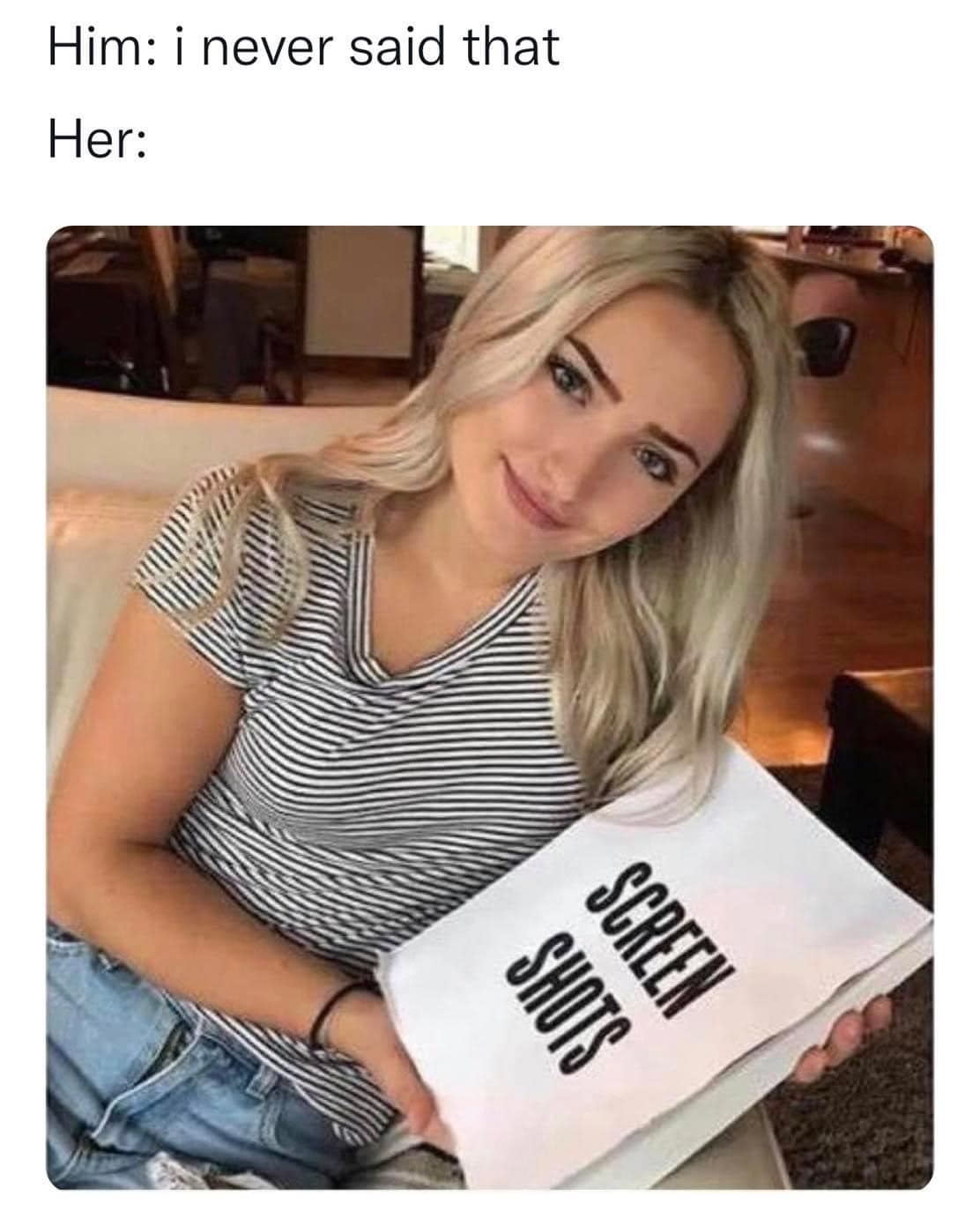
The meme is a play on the concept of accountability and culture. The image is of a woman holding a "screen shots" folder, implying that someone has been taking "screen shots" of her, likely in a relationship or online context. The text "he said he didn't" above the image is a humorous way of saying that someone has been caught in a lie, and the folder is a visual representation of the "evidence" that proves it.
detailed-analysis (gemma3-27b-vision)
Okay, here's a breakdown of the image based on the frameworks you requested, focusing on how they potentially apply to the visual and the implied context ("Him: I never said that. Her:"). I'll skip sections if a framework doesn't seem particularly relevant.
Visual Description
The image depicts a conventionally attractive, young, white woman sitting and holding a book titled "SCREENSHOTS." She is looking directly at the viewer with a slight smirk. Her clothing consists of a striped shirt and light-wash denim shorts. The background is a somewhat blurred, relatively well-lit interior setting. The overall aesthetic leans heavily into contemporary social media influencer tropes: posed, filtered, and conveying a sense of self-assured confidence.
Foucauldian Genealogical Discourse Analysis
This image strongly lends itself to a Foucauldian analysis. The phrase "Him: I never said that. Her:" paired with the image of her holding "SCREENSHOTS" immediately indicates a power dynamic centered around discourse and truth.
- Discourse & Power: Michel Foucault argued that power isn't simply repressive but is productive, operating through discourses (ways of speaking, thinking, and knowing). The act of taking screenshots and presenting them is a deployment of power – a challenging of a narrative, a claiming of evidence. It is asserting an alternate version of “truth.”
- Genealogy of “Truth”: Foucault’s genealogical method would explore how the very concept of “truth” is constructed and changes over time. Here, “truth” is not absolute, but a contestable claim established through evidence (the screenshots) and displayed publicly.
- Surveillance & Documentation: Screenshots are a form of digital surveillance and documentation. Foucault's work on the panopticon (a prison design enabling constant observation) becomes relevant. Screenshots create a similar dynamic—the potential for capture and the awareness of being observed, shifting behavioral power dynamics.
The image isn’t about what was said, it's about the act of proving what was said, and the power associated with holding the ‘evidence’. The woman's expression seems to suggest a smug enjoyment of this power, emphasizing the control over the narrative.
Critical Theory
The image can be examined through the lens of Critical Theory, particularly its focus on ideology and the reproduction of power structures.
- Ideology: The image reinforces an ideology that centers on individual accountability and a desire to “win” arguments. It assumes that truth is readily accessible (through screenshots) and that individuals have the agency to expose falsehoods. This can conceal broader systemic issues at play.
- Domination and Resistance: The woman's act of presenting screenshots can be seen as a form of resistance against a perceived power imbalance. However, it's a localized resistance. Critical Theory would prompt us to question whether this ‘winning’ a specific argument truly challenges broader patterns of domination.
- Commodification of Conflict: The image's aesthetic – polished, influencer-like – suggests that even conflict is becoming commodified. The woman's self-presentation implies that ‘winning’ arguments is also about enhancing her personal brand.
Postmodernism
The image aligns well with several key concepts of Postmodernism.
- Deconstruction of Truth: Postmodernism challenges the idea of objective truth. Here, ‘truth’ isn’t a fixed entity but a construct, a narrative shaped by perspective and evidence. The screenshots don’t prove an absolute truth; they prove a specific instance of communication.
- Simulation & Hyperreality: The image itself is a simulation – a carefully constructed representation of a situation. The polished aesthetic and the influencer-like pose contribute to a sense of hyperreality – a simulation that feels more real than real.
- Emphasis on Discourse: Like Foucauldian analysis, Postmodernism highlights the importance of language and discourse in shaping reality. The image suggests that the way something is said (or captured and presented) is often more important than what is said.
- Meta-narratives: The "He said/She said" structure is a breakdown of grand meta-narratives of power dynamics. It’s a localized powerplay, and the screenshots act as the evidence.
Queer Feminist Intersectional Analysis
While the image doesn’t explicitly depict queer or trans identities, an intersectional analysis can still illuminate power dynamics.
- Gendered Power Dynamics: The “He said/She said” dynamic is traditionally framed through gendered expectations. Women are often expected to be agreeable and avoid direct confrontation, whereas men are often expected to dominate the discourse. Presenting screenshots could be an act of reclaiming agency and challenging this expectation.
- Surveillance and Control: The act of taking screenshots and presenting them can be framed as a form of surveillance and control, historically used to police women's behavior and silence their voices. However, in this context, the woman is wielding that power, potentially subverting it.
- Performative Activism: The image's aesthetic raises questions about performative activism. Is the woman genuinely challenging power imbalances, or is she simply projecting an image of empowerment for social media validation? Intersectionality would ask how the woman's privilege (whiteness, conventional attractiveness) shapes her ability to wield this power and the potential impact of her actions.
Let me know if you’d like me to elaborate on any of these points or explore another theoretical lens!
simple-description (llama3.2-vision)
This meme is a humorous exchange between two people. The top text reads, "Him: I never said that. Her: Screen shots." The image below shows a woman holding a large book titled "Screen Shots." The joke is that the woman is implying that the man's denial is not believable, and she has evidence (or "screen shots") to prove it.
tesseract-ocr
Him: i never said that Her: SL IY =)» SS A ~~ S 2 * a ~~ | G,? Ma