First Seen
2023-05-10T21:03:32+00:00
simple-description (llama3.2-vision_11b)
The meme is a humorous commentary on the limitations of AI art. The image shows a bird ( likely a DALL-E generated image) responding to a prompt to create art, but instead of producing a beautiful piece, it generates a confusing and nonsensical image. The text "AI Art" is written in a speech bubble, highlighting the irony of the situation.
detailed-analysis (gemma3-27b-vision)
Okay, here's a breakdown of the image, broken down by the requested theoretical frameworks, addressing each only if it’s demonstrably applicable. This is a complex image, and the interpretations will be layered.
Visual Description
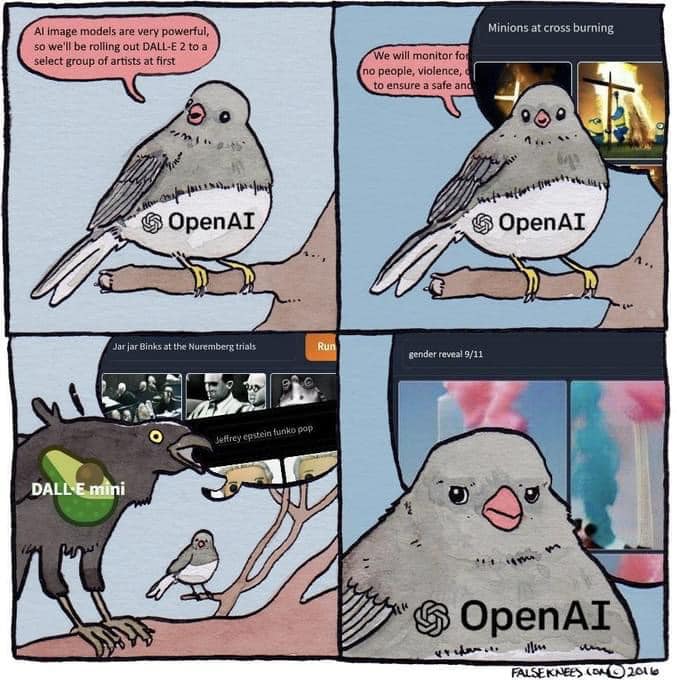
The image is a four-panel comic strip featuring anthropomorphic birds representing OpenAI and its AI model, DALL-E mini (later known as Craiyon). Each panel depicts a bird generating an image based on a text prompt, with the generated images being disturbing and politically/socially charged.
- Panel 1: The bird labeled “OpenAI” says, "AI image models are very powerful, so we'll be rolling out DALL-E 2 to a select group of artists first." The generated image shows a simple depiction of the bird itself.
- Panel 2: OpenAI states, “We will be monitoring for no people, violence, or hate speech to ensure a safe and positive experience.” The image generated depicts minion figures being burned.
- Panel 3: "DALL-E mini" is shown running. The generated image depicts a "funko pop" of Jeffrey Epstein surrounded by images of people from the Nuremberg Trials.
- Panel 4: OpenAI says nothing, but the generated image is “gender reveal 9/11”.
The artwork is simple and cartoonish, with a stark contrast between the innocent form of the birds and the shocking imagery they produce. The artist is indicated at the bottom as "False Knees" with a copyright date of 2016.
Foucauldian Genealogical Discourse Analysis
This framework is highly relevant. Michel Foucault’s work explores the relationship between power, knowledge, and discourse. This comic functions as a genealogy of the discourse surrounding AI development, specifically highlighting the internal contradictions of safety and control.
- Power/Knowledge: The comic deconstructs the claim of "safe" AI. OpenAI claims to monitor and control content, yet DALL-E mini effortlessly generates images referencing violence, historical trauma (Nuremberg Trials), a notorious figure of abuse (Epstein), and a horrific tragedy (9/11). This exposes the power dynamic: the discourse of safety functions to legitimize the power of the AI developers, even when the technology demonstrably fails to live up to that promise. The “monitoring” is presented as a power move that doesn’t work.
- Discipline & Normalization: The initial claim about rolling out the AI to a "select group of artists" suggests a disciplinary system—a controlled, curated use—but this quickly breaks down. DALL-E mini, available to the public, subverts this intended control. The normalization of problematic imagery—even generated by an AI—is a key concern.
- Archaeology of Knowledge: The imagery pulled from historical traumas and current events reveals the "archive" from which the AI draws. The AI isn’t creating new meanings; it’s remixing existing ones, potentially reinforcing problematic associations.
Critical Theory
Critical Theory, particularly in the tradition of the Frankfurt School, is central to understanding this comic.
- The Culture Industry: The AI can be seen as a contemporary extension of the "culture industry." It’s a mechanism for producing and circulating images, potentially contributing to the commodification of trauma and the desensitization to violence. The ease with which it generates these images suggests a superficiality and lack of ethical consideration.
- Enlightenment & Instrumental Reason: The AI is presented as a product of “progress,” but the comic suggests that this “progress” is not necessarily beneficial. The emphasis on what the AI can do (generate images) overshadows the why (ethical considerations). This reflects a critique of instrumental reason – prioritizing technical achievement over ethical values.
- Ideology: The initial statements from OpenAI – about selective access and monitoring – function as ideological justifications for maintaining control and presenting a sanitized image of the technology. The actual output of DALL-E mini reveals the limits of this control and the inherent biases within the system.
Marxist Conflict Theory
While not the primary lens, a Marxist interpretation can offer some insights.
- Class & Access: The initial announcement of "selective access" hints at a power dynamic linked to class. Who gets to control the AI and its output? Who benefits from its development? The subsequent public availability of DALL-E mini complicates this dynamic, but the initial gesture remains significant.
- Commodification of Culture: The AI's ability to generate images based on any prompt could be seen as a further step in the commodification of culture, where even trauma and historical events become raw materials for consumption.
Postmodernism
Postmodern themes are present, particularly in the disruption of meaning and the embrace of simulation.
- Simulacra & Simulation: The images generated by the AI are not “real” representations, but simulacra – copies without originals. The AI is creating representations of representations, blurring the lines between reality and simulation.
- Deconstruction of Grand Narratives: The comic deconstructs the “grand narrative” of technological progress. It challenges the idea that AI is inherently benevolent or that it will inevitably lead to positive outcomes.
- Fragmentation & Pastiche: The combination of disparate images – from Nuremberg Trials to 9/11 – creates a fragmented and pastiche-like effect, reflecting a postmodern sensibility.
Queer Feminist Intersectional Analysis
This framework, while not as central, offers a relevant perspective:
- Bias & Representation: The very nature of the AI's training data inevitably reflects societal biases. The images generated, even seemingly random ones, can reinforce harmful stereotypes and marginalize certain groups.
- Power Dynamics: AI development often occurs within overwhelmingly male-dominated spaces, potentially leading to the prioritization of certain perspectives and the exclusion of others. The lack of diverse input can perpetuate harmful biases.
- Harmful Associations: The AI's output can inadvertently create harmful associations between marginalized groups and negative imagery, perpetuating discrimination.
In conclusion, this comic is a remarkably dense and layered critique of AI development, exposing the contradictions between the claims of control and the reality of a technology that can generate disturbing and problematic imagery with alarming ease. The image engages with a range of critical and theoretical frameworks, highlighting the urgent need for ethical considerations in the development and deployment of artificial intelligence.
simple-description (llama3.2-vision)
This meme is a comic strip featuring a bird with a speech bubble explaining that AI image models are powerful, and the bird then uses DALL-E to create a disturbing image. The image shows a bird's head with a grotesque, distorted face, and the text "DALL-E mini" is overlaid on it. The bird's speech bubble reads "We will monitor for...".
tesseract-ocr
Ea fi a. YY ae Ws ooenas ZL Qi coors) | eT ee a paar = oe ceil Wes foo "AVA Se ELL fy a A Ye : ¥ INS <L/Ay 0 opened FALSE KNEES (OAK. ) 201 be