First Seen
2025-03-27T22:56:32.214614+00:00
detailed-analysis (gemma3_27b-it-q8_0)
Okay, let's break down this meme through the lens of "AI Art - Ghiblification," and apply relevant theoretical frameworks where appropriate.
Visual Description
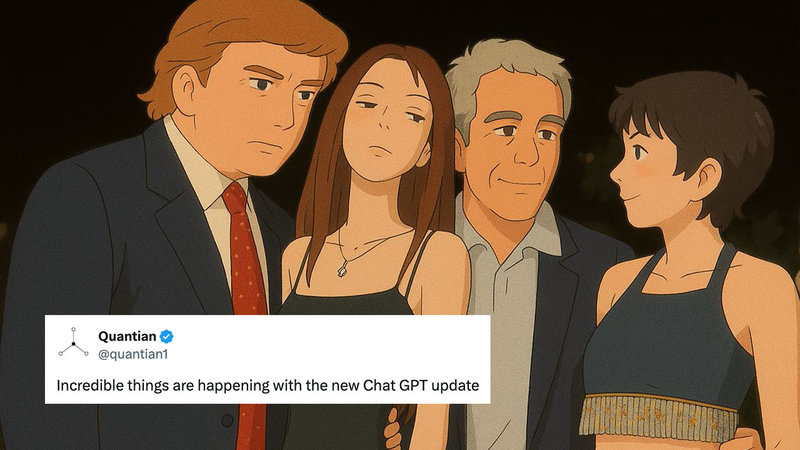
The image presents four figures rendered in a distinct style strongly reminiscent of Studio Ghibli animation—particularly the character design found in films like Whisper of the Heart or From Up on Poppy Hill. The figures appear to be in a somewhat awkward family or group portrait setting, gazing forward. Notably, the characters depicted are recognizable public figures:
- Donald Trump: Rendered with the characteristic Ghibli face, though still bearing his signature hair and slightly stern expression. He is in a dark suit.
- Ivanka Trump: Standing beside her father, with a neutral expression and wearing a dark outfit.
- Bill Clinton: A slightly smiling Clinton, sporting graying hair and a casual shirt.
- Chelsea Clinton: Appears on the right side of the frame, in a blue top, also with a relatively neutral look.
The background is minimal, a dark blur suggestive of an evening setting. The color palette is muted and warm, typical of Ghibli's aesthetic. The key element here is not the subjects themselves, but the stylistic transformation. It is the incongruity of these figures presented in this gentle, aesthetically pleasing style that drives the humor and commentary.
Postmodernism
This meme is deeply rooted in postmodern sensibilities, specifically the concept of pastiche. The image deliberately blends two vastly different cultural contexts: the realm of American political figures and the aesthetic world of Japanese animation. It takes a highly recognizable style (Ghibli) and applies it to entirely unexpected content (political figures).
- Irony & Playfulness: The meme leans into ironic juxtaposition. Ghibli films generally convey themes of environmentalism, peace, and coming-of-age—values seemingly at odds with the often controversial figures represented. This creates a playful tension.
- Blurring Boundaries: Postmodernism deconstructs grand narratives and rejects absolute truth. This meme subtly mocks the "seriousness" of politics by rendering its key players within a whimsical, apolitical visual language. The boundaries between high and low culture, serious and playful, are blurred.
- Simulation & Hyperreality: The "Ghiblification" process simulates a different emotional and narrative context. It's not simply "Trump as a Ghibli character," but a simulation of what a Ghibli film might feel like, applied to these people. This leads to a sense of hyperreality where the image’s artificiality is openly acknowledged.
Critical Theory
From a Critical Theory perspective, the meme could be understood as a form of cultural critique. The juxtaposition reveals a power dynamic through the imposition of a stylistic "softness" onto figures associated with power and authority.
- Deconstruction of Power: The Ghibli style, often associated with empathy and vulnerability, subtly undermines the traditional image of authority that these politicians cultivate. It makes them appear…less threatening, even somewhat hapless.
- Ideology & Representation: The meme raises questions about how we represent political figures and the ideologies embedded within those representations. By choosing Ghibli, the creator subtly critiques the often-hyperbolic and aggressive ways politicians are typically portrayed.
- Aestheticization of Politics: The meme is essentially aestheticizing politics. By making these figures "beautiful" or "charming" (in a Ghibli sense), it invites a different kind of engagement—one based on aesthetics rather than solely on political ideology.
AI Art - Ghiblification Context
The meme is explicitly linked to the advancements in AI, particularly with the new ChatGPT update. This is key. It's not just about the idea of "Ghiblifying" these figures; it's about the ease with which AI tools now allow anyone to generate images like this.
- Democratization of Art: AI tools like Midjourney, DALL-E, and even ChatGPT with its image generation capabilities, are democratizing artistic creation. Previously, recreating the Ghibli style required significant artistic skill. Now, with a text prompt, almost anyone can generate similar results.
- Algorithmic Aesthetics: The meme highlights the power of algorithms to interpret and replicate artistic styles. It's a demonstration of how AI can "understand" and reproduce the visual language of Ghibli, even if it doesn't understand the meaning behind it.
- The "Uncanny Valley" & Appropriation: There’s a subtle play with the uncanny valley. The image is recognizable as Ghibli-esque but has a slightly off-kilter quality due to the subject matter. It’s a reminder that AI-generated art, while impressive, isn’t always perfect. There's also a question of cultural appropriation, given that the meme takes a distinctly Japanese aesthetic and applies it to Western political figures—though in this instance, it's arguably done in a playful, critical way.
In conclusion, this meme isn't just a funny image; it’s a cultural artifact that speaks to the intersection of AI technology, artistic style, and political commentary. The "Ghiblification" of these figures is a postmodern gesture that invites us to rethink how we represent power, engage with politics, and understand the changing landscape of art creation.
simple-description (llama3.2-vision_11b)
The meme is a still image from the movie "Princess Monokoto" by Hayao Miyazaki, with the addition of a text box containing a quote from a hypothetical AI chatbot, "DALL-E" (a large language model for text generation). The quote reads: "Incredible things are happening with the new Chat GPT update". The image is a humorous take on the idea that AI models are becoming more human-like, with the added caption implying that the AI is now capable of creating art that rivals the work of a human.
detailed-analysis (gemma3-27b-vision)
Okay, here's an analysis of the image and its accompanying tweet, broken down into sections based on the requested theoretical frameworks. I'll note upfront that some of these frameworks don't immediately scream relevance, but I'll explore potential applications. I'll also preface by saying that this is interpretive, and different readings are possible.
Image & Tweet Overview:
The image presents a stylized, seemingly anime or graphic novel-inspired rendering of four figures: Donald Trump, a woman who appears to be Ivanka Trump, Bill Gates, and a woman appearing to be Sam Altman. They are depicted in a close, somewhat tense grouping. The tweet accompanying the image claims "Incredible things are happening with the new Chat GPT update." This sets a specific context linking these figures with AI development, specifically OpenAI's ChatGPT.
1. Visual Description
- Style: The image is rendered in a flat, illustrative style reminiscent of anime or graphic novels. Colors are muted, with a warm palette. This aesthetic is notable as it intentionally distances the depiction from photorealism or traditional portraiture, suggesting a narrative/symbolic intent rather than a straightforward documentation.
- Composition: The tight framing and the way the figures are grouped together is significant. They are physically close, but not necessarily displaying intimacy or warmth. The arrangement suggests a potential alliance or a power dynamic, though it's ambiguous.
- Facial Expressions: The facial expressions are subtle but noteworthy. Trump and the woman in the middle (Ivanka) seem mildly displeased or concerned. Bill Gates appears amiable and Sam Altman's expression is unreadable.
- Symbolism: The choice of these four individuals is central. They represent a nexus of power—politics (Trump), wealth/philanthropy/tech investment (Gates), and AI innovation (Altman).
2. Foucauldian Genealogical Discourse Analysis
This framework is perhaps the most directly applicable.
- Discourse of Technological Advancement: The image and tweet participate in a discourse surrounding the development of AI, positioning these figures as key architects of this technology. We can trace the genealogy of this discourse – how it has evolved from earlier utopian or dystopian visions of AI, through hype cycles, and into the current focus on Large Language Models (LLMs) like ChatGPT.
- Power/Knowledge: Foucault argued that power and knowledge are inseparable. This image can be seen as a visual representation of that connection. The individuals depicted hold immense power (economic, political, technological), and that power is linked to the knowledge and control over AI. The tweet reinforces this by associating them with the latest “incredible” developments.
- Surveillance & Control: AI, specifically LLMs, is increasingly linked to questions of data collection, algorithmic bias, and potential for surveillance. The image implicitly connects these figures to the systems that are being built, raising questions about who controls the technology and how it will be used.
- Disciplinary Power: The increasing pervasiveness of AI (and the systems behind it) can be seen as a form of disciplinary power, shaping our behavior and normalizing certain ways of thinking. These individuals, as drivers of AI, contribute to that power dynamic.
3. Marxist Conflict Theory
While not immediately obvious, a Marxist reading is possible:
- Class Struggle: The image embodies the concentration of wealth and power in the hands of a few individuals. These figures represent the capitalist class—those who own the means of production (in this case, the technology and resources required to develop AI).
- Alienation: The tweet, and the promotion of AI, can be linked to Marxist ideas about alienation. As AI automates tasks and potentially displaces workers, it exacerbates feelings of disconnection and powerlessness.
- Ideology: The enthusiastic claim of “incredible things” happening with ChatGPT can be interpreted as an ideological tool to legitimize and normalize the development of AI, masking potential negative consequences. The image reinforces this by presenting these individuals as benevolent innovators.
- Control of the Means of Communication: The platform of Twitter itself, where the image is posted, is a key site of ideological struggle. The access and reach afforded to these individuals contribute to their ability to shape public opinion and control the narrative around AI.
4. Postmodernism
Postmodernist interpretations are more subtle:
- Simulacra and Simulation: The image can be seen as a simulacrum—a copy without an original. The stylized rendering doesn't attempt to be a realistic depiction, but rather a constructed representation. This emphasizes the constructed nature of reality and the increasing difficulty of distinguishing between the real and the simulated.
- Meta-Narratives: The claim of "incredible things happening" could be seen as a fragment of a broader meta-narrative about technological progress. Postmodernism critiques these grand narratives, questioning their truth claims and exposing their underlying power dynamics.
- Deconstruction: A deconstructive reading could focus on the contradictions and ambiguities within the image and tweet. For example, the seemingly positive message about AI clashes with the potential for job displacement and algorithmic bias.
- Intertextuality: The image draws upon existing cultural references (e.g., the public perception of these figures) and creates a new meaning through their juxtaposition.
5. Queer Feminist Intersectional Analysis
This is the most challenging framework to apply directly, but still possible:
- Power Dynamics and Representation: The image is overwhelmingly male-dominated. The presence of Ivanka and Sam Altman is tokenizing; the visual dominance is still with the male figures. This highlights the ongoing underrepresentation of women and marginalized groups in the tech industry and decision-making roles.
- Algorithmic Bias: AI systems are often trained on biased data, perpetuating harmful stereotypes. The individuals depicted are at the forefront of developing these systems, and their lack of diversity raises concerns about the potential for further marginalization.
- Intersectionality: The potential harms of AI (e.g., job displacement, surveillance) disproportionately affect marginalized communities. A queer feminist intersectional analysis would focus on how these harms intersect with existing forms of oppression based on gender, race, class, and sexual orientation.
- Critique of 'Tech Bro' Culture: The image subtly embodies the 'tech bro' culture that often dominates the tech industry. The lack of visible emotional range and the focus on technological innovation at the expense of social justice are characteristic of this culture.
In conclusion:
This image and tweet offer a rich site for theoretical analysis. While some frameworks are more directly applicable than others, each one can offer valuable insights into the power dynamics, ideologies, and potential consequences surrounding the development of AI. It’s important to note that these are just interpretations, and other readings are possible.
simple-description (llama3.2-vision)
This meme is a humorous image of the characters from the movie "The Incredibles" looking unimpressed. The text "Incredible things are happening with the new Chat GPT update" is overlaid on the image, implying that the characters' lack of enthusiasm is ironic given the excitement of the new AI technology.