First Seen
2025-03-27T22:56:55.048066+00:00
detailed-analysis (gemma3_27b-it-q8_0)
Okay, let's break down this meme from the perspective of the "AI Art - Ghiblification" category, using the requested theoretical lenses where relevant.
AI Art - Ghiblification: Meme Deconstruction
Visual Description
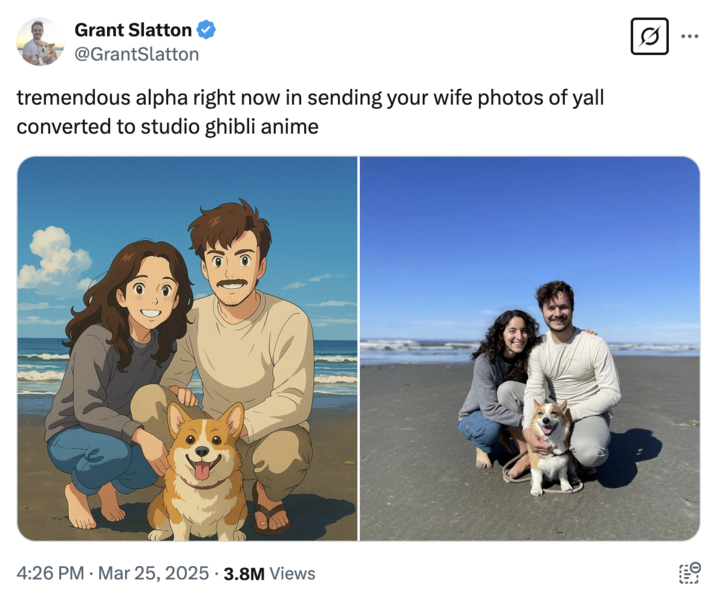
The meme is a diptych (two-panel image). The left panel presents a digital illustration of a couple and their dog on a beach, styled after the art of Studio Ghibli (known for films like Spirited Away, My Neighbor Totoro). The style is characterized by soft lines, expressive eyes, simplified forms, a pastel-leaning color palette, and a sense of idyllic serenity. The pose mirrors the one in the right panel. The dog is a Corgi, which adds a certain "cute" factor common in Ghibli aesthetics. The right panel shows the original photograph of the couple and their dog on the same beach. This stark contrast in aesthetics is the core of the meme’s visual impact. The framing of the beach scene is very similar between both panels.
Foucauldian Genealogical Discourse Analysis
From a Foucauldian perspective, this meme reveals how styles (like the Ghibli aesthetic) are not merely aesthetic choices, but power/knowledge constructs. The meme exploits the cultural authority Ghibli holds - its association with concepts like nostalgia, innocence, handcrafted beauty, and a certain worldview. The very act of "Ghiblification" (using AI to transform an image into that style) highlights the power of this aesthetic as something that can be replicated, consumed, and applied to other images.
The "genealogy" here isn't about a linear history of Ghibli’s art, but how the idea of “Ghibli-ness” has emerged through historical discourses – art criticism, fan culture, film studies, and now, AI development. The ability to easily simulate this aesthetic using AI demonstrates its increasing detatchment from its original context and creator. The meme itself is a node in this ongoing discourse, reinforcing the idea of "Ghibli" as a recognizable style.
Critical Theory
This meme touches on themes central to Critical Theory, specifically regarding the culture industry and the commodification of art. The original photograph represents everyday life, a moment of personal experience. The AI-generated image, however, transforms that moment into a product. It’s a re-presentation filtered through a highly recognizable and commercially successful aesthetic.
The meme subtly critiques how easily we can apply pre-packaged “feelings” or “vibes” to our experiences. "Ghiblification" doesn’t add meaning, it replaces meaning with a manufactured aesthetic experience. It's about the feeling of Ghibli, rather than genuinely engaging with the emotional depth of Ghibli films. The “tremendous alpha” caption suggests a performative gesture—a showing off of one's ability to appropriate and display this aesthetic. This is a key feature of culture industry: a focus on surface level appeal.
Postmodernism
This meme is deeply rooted in postmodern sensibilities. Specifically, it exemplifies:
- Pastiche: The AI-generated image is a deliberate pastiche of Ghibli's style, a playful imitation without necessarily aiming for originality.
- Simulacra and Simulation (Baudrillard): The AI-generated image is a simulacrum – a copy without an original. It's not a genuine Ghibli artwork, but a simulation of it, and increasingly, the simulation may become more “real” or appealing than the original. The distinction between the real and the hyperreal is blurred. The meme doesn't suggest the image is a fraud, but points to a shift in how we experience images.
- The Death of the Author: The AI is the "author" (of sorts) of the Ghibli-style image, yet it lacks intentionality or original creative vision. This challenges traditional notions of authorship and artistic creation.
In Summary:
The meme, viewed through the lens of "AI Art - Ghiblification," is far more than just a cute image. It's a commentary on the power of aesthetics, the commodification of art, the blurring of reality and simulation, and the changing nature of authorship in the age of AI. It’s a microcosm of how AI is re-shaping our relationship with art, culture, and even personal experience. The caption "tremendous alpha" layers in a hyper-masculine framing to the gesture of rendering an aesthetic homage, adding another layer of ironic complexity to the meme's cultural commentary.
Let me know if you'd like any of these sections expanded or further analyzed!
simple-description (llama3.2-vision_11b)
The meme is an image of a woman and a man with a dog on a beach, with the woman's face and body replaced with a character from a Studio Ghibli film, while the man and dog remain in their original form. The text above the image reads "tremendous alpha right now in sending your wife photos of you".
detailed-analysis (gemma3-27b-vision)
Okay, here's an analysis of the social media post, broken down into sections addressing the requested theoretical frameworks, only where applicable. Given the content, some sections will be more robust than others, and some will be absent.
Visual Description
The post presents a side-by-side comparison of two images.
- Left: A digitally illustrated image in the style of Studio Ghibli animation. It depicts a couple sitting on a beach, embracing a Pembroke Welsh Corgi dog. The style is reminiscent of My Neighbor Totoro or Ponyo, with soft lines, bright colors, and a focus on emotional warmth. The couple appears youthful and serene. The backdrop is a blue sea with simple, stylized waves.
- Right: A color photograph of the same couple and their dog, sitting on a beach. The lighting is natural, and the image is more realistic than the illustration. The composition is similar to the animated image, but the details are sharper and less stylized. The sea is a muted gray-blue.
The tweet's caption reads: "tremendous alpha right now in sending your wife photos of yall"
Foucauldian Genealogical Discourse Analysis
This tweet provides a fascinating point for a Foucauldian analysis. The assertion of being a "tremendous alpha" through the act of artistic re-representation taps into the discourse of masculinity and attempts to solidify and project a particular performance of it. The act isn’t simply about presenting a cute picture, but about constructing a specific power dynamic.
- Power/Knowledge: The term "alpha" is borrowed from ethological studies of wolves, historically misapplied to human social hierarchies. This appropriation is an example of power/knowledge: a “scientific” concept used to justify and naturalize dominance. The tweet performs this dominance by framing a gesture as inherently "alpha."
- Genealogy: The idea of "alpha" masculinity has a historical genealogy rooted in ideas of male provision, protection, and sexual prowess. The tweet taps into this history by associating artistic gesture (creating the anime version) with the demonstration of worthiness and desirability. It is a symbolic performance of power rooted in historical and cultural frameworks.
- Disciplinary Power: The act of sending the anime photos implies a desire for approval and validation. The tweet subtly invites a response that affirms the "alpha" status of the sender, effectively subjecting the wife to a disciplinary gaze. It’s less about overt control, and more about the internalisation of a desired power dynamic.
Critical Theory
The post lends itself to a reading within Critical Theory, specifically concerning the commodification of affect and the spectacle.
- Commodification of Emotion: The image (both the original and the anime version) is a carefully curated representation of happiness and domesticity. This presentation isn't about genuine feeling, but about performing a desirable lifestyle for consumption (in this case, online engagement). The “cuteness” of the image becomes a commodity.
- Spectacle: The post contributes to the broader culture of online spectacle. The act of sharing this personalized "art project" isn't about sharing joy, but about seeking validation from an audience. It is a performance staged for the internet, where attention is a form of power.
- Ideology: The tweet, with its "alpha" language, subtly reinforces dominant ideologies about masculinity and romantic relationships. It suggests that romantic gestures should be grand and performative, and that men should take the initiative in demonstrating their worth.
Marxist Conflict Theory
While not central, a Marxist reading could be applied, focusing on the symbolic representation of class and the performance of leisure.
- Symbolic Capital: Creating and sharing personalized art like this requires time, resources (access to digital tools, artistic skill or paying someone to create it), and cultural capital (knowledge of anime aesthetics). These factors differentiate the poster from those without these advantages, highlighting class dynamics.
- Commodity Fetishism: The focus on the "cuteness" of the image and the emotional connection it evokes distracts from the underlying economic and social conditions that make this leisure activity possible.
- Ideological Hegemony: The notion that this act constitutes "alpha" behavior subtly reinforces a capitalist ideology that equates self-promotion and performative gestures with success and desirability.
Postmodernism
The post embodies several hallmarks of Postmodernism.
- Pastiche & Intertextuality: The anime illustration is a clear example of pastiche - a stylistic imitation of another form. It references Studio Ghibli’s aesthetic.
- Hyperreality & Simulation: The anime image isn’t “real,” but a simulation of reality. This simulation then becomes more impactful than the original photograph, suggesting that representations can become more significant than the reality they represent. The performance of this simulated ideal becomes the focus.
- Deconstruction of Meaning: The ironic use of "alpha" - a term rooted in primitive power dynamics – to describe an act of artistic creation undermines its original meaning. The tweet playfully deconstructs traditional notions of masculinity.
Queer Feminist Intersectional Analysis
A Queer Feminist Intersectional analysis could be applied with some nuance, focusing on gender performance and the gendering of emotional labor.
- Gender Performance: While seemingly innocuous, the "alpha" language implicitly reinforces a traditional, heteronormative performance of masculinity. The couple’s presentation—the man initiating the gesture—contributes to this performance.
- Emotional Labor: The act of creating the anime image and presenting it as a romantic gesture can be seen as emotional labor, particularly if it’s done to fulfill expectations or manage the relationship dynamic.
- Intersectionality: This framework would require more context to fully explore, but it could consider how gender interacts with other social categories (race, class, sexuality) to shape the couple's experience and the reception of the post.
I have aimed to provide a comprehensive, though not exhaustive, analysis of the post using the requested theoretical frameworks. It's worth noting that these frameworks aren't mutually exclusive and can often be used in conjunction to provide a richer understanding of the content.
simple-description (llama3.2-vision)
This meme is a humorous comparison of two images. The first image is a classic anime-style illustration of a man and a woman sitting on a beach with their dog, while the second image is a real-life photo of a man and a woman sitting on a beach with their dog. The text at the top of the image reads: "tremendous alpha right now in sending your wife photos of you"