First Seen
2025-03-27T22:59:40.083316+00:00
detailed-analysis (gemma3_27b-it-q8_0)
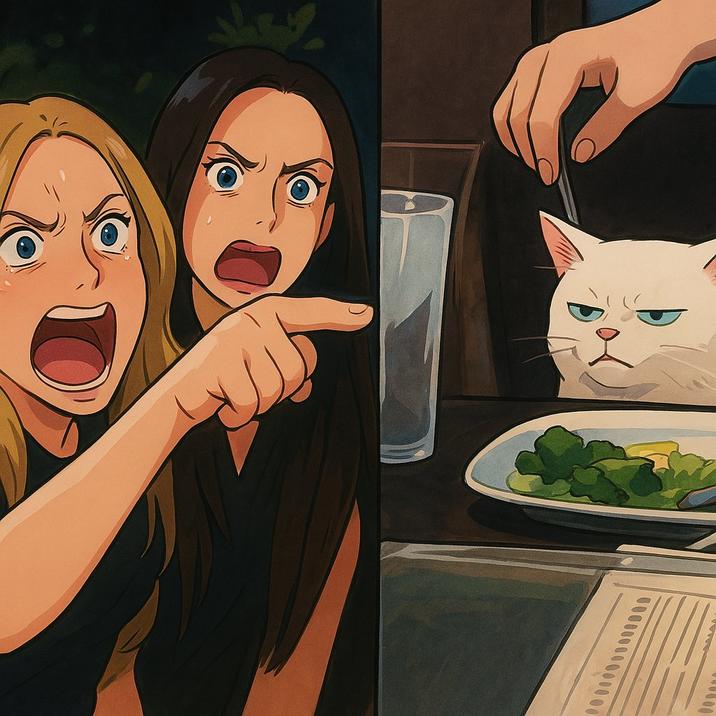
Okay, let’s break down this meme – the “Woman Yelling at a Cat” meme reimagined in a Studio Ghibli style – through the lens of AI Art within the "Ghiblification" category, and applying relevant theoretical frameworks.
Visual Description
The image is a diptych (two panels). On the left, two women, rendered in a distinctly Ghibli-esque animation style (soft lines, expressive eyes, detailed but simplified features), are depicted in a state of fervent agitation. One is shouting with a wide-open mouth, the other is pointing intensely. Their expressions are exaggerated, portraying shock, outrage, or disbelief. The color palette leans toward warm tones, with detailed backgrounds but not photorealistic.
On the right panel, a white cat sits at a dining table, facing a small plate of green vegetables (broccoli) with a notably disapproving expression. A hand is visible, holding a fork partially in the frame, seemingly offering the vegetables to the cat. The background is a dimly lit restaurant interior.
The Ghibli style applied imbues both panels with a certain softness and nostalgia despite the chaotic and tense interaction depicted. The style's characteristic attention to detail and emotional expressiveness heighten the impact of the contrast between the two scenes. This isn't raw, digitally created agitation; it’s a stylized agitation.
Postmodernism
This meme, even more so when "Ghiblifed," is quintessentially postmodern. Several key elements are at play:
- Pastiche & Intertextuality: The meme itself is a remix. It combines a screencap from The Real Housewives of Beverly Hills with a stock image of Smudge the Cat (aka Bubba). Then, this pre-existing remix is further layered with a new stylistic layer—the Ghibli aesthetic. This layering of existing cultural artifacts is typical of postmodern pastiche.
- Loss of Originality: The meme has no "original" meaning outside of its constituent parts. Its power lies in its ability to be applied to any situation where disproportionate outrage is directed at something relatively innocuous. The Ghibli aesthetic further obscures any sense of inherent meaning, prioritizing style over substance.
- Irony & Parody: The core humor comes from the absurdity of the situation, and the juxtaposition of human drama with feline indifference. Applying a wholesome, nostalgic style like Ghibli’s amplifies the irony. It’s a parody of both the reality TV drama source and the earnest emotionality of Ghibli films.
Foucauldian Genealogical Discourse Analysis
We can use Foucault's ideas to examine the ways this meme establishes and reinforces power dynamics. The meme works by constructing a discourse around outrage.
- Power/Knowledge: The women represent a (often stereotypical) form of amplified emotional expression—perhaps a discourse of “correct” behavior or societal expectations. The cat represents a refusal of that discourse, an embodiment of indifference. The meme’s popularity suggests that the refusal of those expectations is a potent form of power.
- Genealogy of Outrage: By recreating the meme in the Ghibli style, there's a questioning of the narrative. The “angry woman” trope often carries negative connotations. Ghibli animation, often associated with themes of empathy and peace, subverts this. The meme asks: what if even heightened emotionality can be softened and recontextualized?
- Disciplinary Power: The meme's repetition and adaptability contribute to a kind of self-discipline. We recognize the dynamic and apply it to our own lives, reflecting on our own moments of disproportionate anger or judgment.
AI Art - Ghiblification Context
The very act of “Ghiblification” (using AI or manual methods to apply the Studio Ghibli aesthetic) is critical.
- Democratization of Style: AI tools make it possible for anyone to recreate the distinctive visual style of a revered animation studio. This raises questions about artistic authorship, the value of original style, and the commodification of art.
- Nostalgia & Affect: Ghibli’s style evokes strong feelings of nostalgia, warmth, and childhood. Injecting this aesthetic into an otherwise cynical meme creates a cognitive dissonance that is part of its appeal. It's a re-appropriation of emotional affect.
- The Algorithm as Interpreter: The AI isn’t just recreating the style; it’s interpreting it. How does the algorithm translate outrage into Ghibli-esque expressiveness? What biases are built into the algorithm that influence the way the image is rendered?
In conclusion, this “Ghiblifed” meme is a complex cultural artifact. It’s a playful, ironic commentary on modern outrage culture, amplified by the stylistic intervention of AI and the nostalgic weight of the Ghibli aesthetic. It simultaneously celebrates and critiques both the source material and the technology used to reimagine it.
simple-description (llama3.2-vision_11b)
The meme is an AI-generated image, a Ghiblification, that reimagines a scene from the movie "My Neighbor Totoro" in a more dramatic and intense way. The image depicts Satsuki, the older sister, looking shocked and horrified as a cat (Totoro) is about to attack her food, with a caption that reads "When you're trying to eat your dinner and your cat is trying to steal it". The image is a humorous take on the classic anime movie, exaggerating the situation for comedic effect.
detailed-analysis (gemma3-27b-vision)
Okay, let's break down this image through several theoretical lenses. This is a tricky image, heavily meme-ified, so the analysis will need to account for its cultural context.
Visual Description
The image is a composite, a popular meme format. It consists of two distinct panels.
- Left Panel: Depicts two women, illustrated in a dynamic, almost anime-like style, in what appears to be a restaurant setting. They are both expressing extreme disapproval or shock, with exaggerated facial expressions. One woman is pointing accusingly, while the other is gaping with her mouth open. They have reddened faces and appear on the verge of an outburst.
- Right Panel: Features a white cat, known as “Woman Yelling at a Cat” (Smudge the Cat), looking unimpressed. A plate with a small portion of green vegetables sits before the cat. A hand, presumably belonging to someone unseen, is attempting to feed the cat with a fork. The setting appears to be a dining table, possibly the same restaurant as the women in the left panel.
The image’s aesthetic is bright and bold, employing strong lines and colors. The composition plays on the juxtaposition of the exaggerated emotional state of the women with the cat’s stoic and dismissive expression. The meme-format itself relies on the viewer bringing their own context and narrative to the juxtaposition.
---
Foucauldian Genealogical Discourse Analysis
This image can be analyzed through Foucault’s lens by examining the discourses surrounding “correct” behavior, expectations, and the policing of those expectations.
- Disciplinary Power: The women represent a form of social control or discipline. They are enacting a judgmental gaze, policing an imagined violation of social norms (what that norm is is flexible and reliant on the caption applied to the meme). The way they scrutinize and react to the "offense" (the cat, in this case) reinforces a system of power based on judgment and correction.
- Genealogy of Disapproval: Tracing the genealogy of disapproval, we see that this meme taps into a long history of social policing – the expectation to uphold standards of conduct, whether that’s around dining etiquette, emotional expression, or perceived proper behavior. The meme ironically highlights the arbitrary and often irrational nature of these expectations.
- The Gaze & Power: The cat’s gaze, though seemingly passive, offers a resistance to the disciplinary power of the women. It refuses to be affected by their outburst, demonstrating a form of power through its indifference. This can be seen as a subversive rejection of the need to justify or conform.
---
Critical Theory
From a Critical Theory perspective (influenced by the Frankfurt School), the image can be seen as a commentary on the culture industry and the commodification of emotion.
- Spectacle & Performance: The exaggerated emotional display of the women becomes a spectacle, akin to a performance staged for consumption. It reflects a society obsessed with drama and performative outrage.
- False Consciousness: The meme’s popularity suggests a degree of “false consciousness.” Viewers readily identify with the women's outrage, even though the context is absurd, reflecting a societal tendency to focus on superficial issues or manufactured conflicts.
- Critique of Rationality: The irrationality of the situation – two women vehemently reacting to a cat simply existing – serves as a subtle critique of the overemphasis on rationality and logic in modern society. It highlights the role of irrationality and emotionality in driving social behavior.
---
Marxist Conflict Theory
A Marxist analysis focuses on the inherent class conflict and power dynamics embedded in the image.
- Power Imbalance: While subtle, there's a power imbalance implied. The women, likely representing a social class accustomed to asserting authority, are directing their displeasure at the cat (which can be seen as representing a marginalized “other” or a symbol of unconstrained natural behavior).
- Ideological Control: The women’s outrage can be interpreted as an attempt to impose their values and ideology on the cat, attempting to "correct" its behavior to conform to their expectations. This aligns with the Marxist concept of the ruling class imposing its worldview on the masses.
- Commodification of Emotion: The meme's popularity as a form of online entertainment can be seen as a commodification of emotional labor. The outrage expressed in the image is turned into a source of amusement and profit.
---
Postmodernism
This image is deeply rooted in Postmodern aesthetics and thought.
- Intertextuality & Pastiche: The image's power lies in its intertextuality. It draws on pre-existing imagery (the women’s expression, the cat’s existing meme status) and combines them in a new, ironic way. It is a pastiche, a playful imitation of existing forms.
- Deconstruction of Meaning: The meme’s open-endedness challenges fixed meanings. The "offense" is deliberately left undefined, allowing viewers to project their own interpretations onto the situation. This deconstruction of meaning is a key characteristic of postmodern thought.
- Simulacra & Simulation: The image can be seen as a simulacrum, a copy without an original. The women's outrage is a performance, a simulation of genuine emotion. The meme itself is a hyperreality, a simulation that has become more real than the “real” situation it depicts.
Important Note: It's crucial to remember that the image's impact is deeply contingent on its meme status. These analyses are interpretations applied to the meme, recognizing that its cultural context fundamentally shapes its meaning.
simple-description (llama3.2-vision)
This meme is a humorous image of a white cat with a shocked expression, sitting in front of a plate of food. The image is captioned "I can explain" and is often used to express that something is not as expected or that there's more to the story than initially thought. The cat's expression is meant to convey a sense of "I know what you're thinking, but you're wrong" or "there's more to this than you're letting on".