First Seen
2023-05-10T21:03:32+00:00
simple-description (llama3.2-vision_11b)
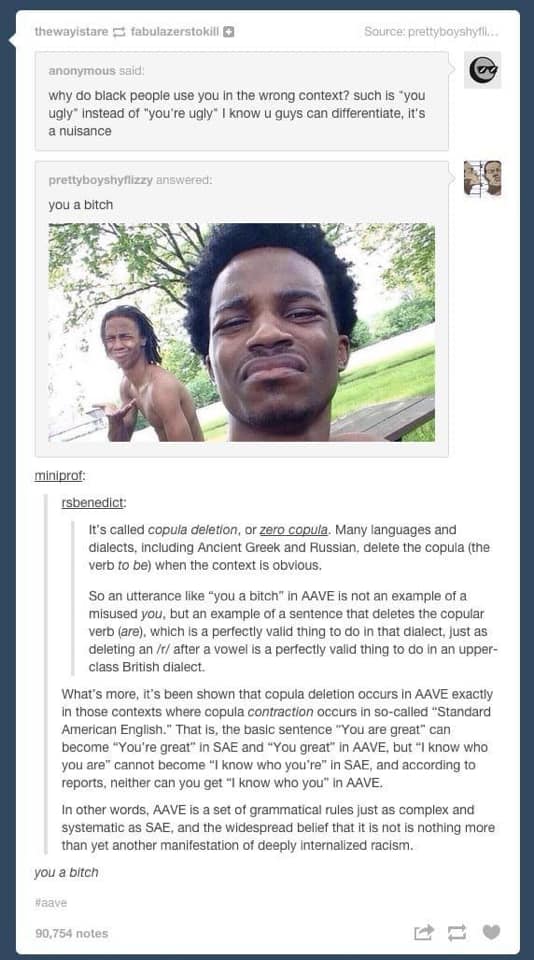
The meme is a screenshot of a Reddit comment thread where someone asks "why do black people use you in the wrong context?" and the response is "you a b**". The image shows a screenshot of a Reddit comment thread with the response "you a b" and a picture of two black men with a caption "you a b". The text in the image reads "you a b**" and the comment is in response to a question about why black people use certain words in the wrong context.
detailed-analysis (gemma3_27b-it-q8_0)
Okay, let's break down this meme from the perspective of its category – AAVE (African American Vernacular English) and related linguistic and socio-cultural understandings. This isn't about finding a typical "meme meaning" but about what this exchange reveals within the context of the ongoing debate around AAVE, linguistic discrimination, and power dynamics.
Visual Description
The meme is a Tumblr post showing a screenshot of a conversation. A user asks why some people misuse AAVE features, specifically the deletion of the verb "to be" ("is," "are," "am") – offering the example of incorrectly saying "you ugly" instead of "you are ugly." The response from the user "prettyboyshyflzy" is simply "you a bitch." Following this exchange is a longer, more analytical response from "rsbenedict" explaining the grammatical principles of "copula deletion" as it exists in AAVE and other languages and dialects, refuting the premise of the first user's question.
The image accompanying the exchange depicts a darkly-skinned, androgynous figure with bright pink lips, appearing to stare intensely at the viewer. This image itself could be interpreted as a statement about visibility, reclaiming identity, and a direct gaze challenging the observer.
Foucauldian Genealogical Discourse Analysis
This meme is powerfully illustrative of a Foucauldian analysis of power and knowledge. The initial question – the complaint about "misuse" – operates within a discourse that positions Standard American English (SAE) as the norm and everything else as a deviation, a "mistake." This normalizes SAE and implicitly delegitimizes other dialects.
The response "you a bitch" is a deliberate disruption of that discourse. It's a blunt assertion of authority, and a refusal to engage in polite explanation within the terms set by the questioner. It's a rejection of the expectation that AAVE speakers must justify their language.
The longer response from "rsbenedict" engages in a genealogy of language, demonstrating that copula deletion isn’t a “mistake” but a systematic, rule-governed feature found in many languages. It challenges the power structures embedded in linguistic judgments, revealing how the designation of AAVE as “incorrect” is a historically contingent and socially constructed one, rather than an inherent property of the language. Foucault would highlight how labeling a language as "incorrect" functions as a form of control and normalization.
Critical Theory
The meme highlights a core tenet of Critical Theory – the idea that seemingly neutral phenomena (like language) are actually deeply entangled with power structures. The question about "misuse" is not simply a matter of linguistic curiosity. It’s rooted in a history of systemic oppression where AAVE has been stigmatized and denigrated as “broken” or “lazy” English. This stigma has real-world consequences, affecting opportunities in education, employment, and social mobility.
The meme demonstrates how the dominant culture (represented by the initial question) polices language, effectively silencing and marginalizing those who speak dialects other than SAE. The combative response and the detailed linguistic explanation are attempts to resist this policing and reclaim linguistic agency. Critical theorists would see this as a struggle against cultural hegemony.
Queer Feminist Intersectional Analysis
While AAVE is not inherently linked to queer or feminist concerns, the meme gains additional layers of complexity when viewed through an intersectional lens. The image accompanying the post, with its androgynous and darkly-skinned figure, suggests a refusal to conform to societal expectations.
AAVE itself can be understood as a form of cultural resistance, a way for Black communities to maintain their identity and solidarity in the face of oppression. The meme can be seen as defending the integrity of a language that is often associated with marginalized communities, and which has historically been a source of pride and resilience.
The direct and unapologetic tone ("you a bitch") can also be read as a reclaiming of power, a refusal to be polite or accommodating in the face of microaggressions and linguistic discrimination. This is a strategy often employed by marginalized groups to challenge dominant norms and assert their own agency.
In essence, this meme is not simply a joke or an insult. It's a complex statement about linguistic justice, cultural resistance, and the ongoing struggle against systemic oppression. It is a clear example of a cultural text speaking to the broader issues of how language is used to enact and maintain power dynamics.
simple-description (gemma3_27b-it-q8_0)
Here's a description of the meme for someone who can't see it:
The image is a Tumblr post responding to a question about why Black people use "you" instead of "you're" in certain contexts. The post, attributed to "prettyboysfrizzy", answers simply with "you a bitch", and then includes a long, academic-style text explaining that this usage (copula deletion) is a grammatical feature found in many languages, including African American Vernacular English (AAVE), and isn't simply "wrong" grammar but a systematic linguistic pattern. The post concludes by arguing this criticism is rooted in internalized racism and is tagged with "#aave".
detailed-analysis (gemma3-27b-vision)
Okay, let's break down this Tumblr post using the requested theoretical lenses. This is a fascinating example of online discourse engaging with issues of language, race, and power.
Please note: This analysis will be complex and may involve interpretation. I'll strive to be thorough, but theory application is often open to debate.
---
1. Visual Description
The Tumblr post features:
* A Screenshot of a Tumblr Ask: A user asks "why do black people use you in the wrong context? such as 'you ugly' instead of 'you're ugly'. I know you guys can differentiate, it's a nuisance."
* A Response: The response is simply the phrase "you a bitch."
* A Follow-up Explanation: A longer text block from a user named “rsbenedict” dissects the linguistic phenomenon at play and frames it within the context of AAVE (African American Vernacular English).
* An Image: A black and white picture of a man with a beard looking toward the left.
* Social Media Interaction: The post has "notes" (reblogs, likes, etc.) indicating engagement within the Tumblr community.
The visual layout highlights the direct confrontation of the initial question, the dismissive response, and then a more reasoned, explanatory follow-up. The image seems to be there as a form of emphasis.
---
2. Foucauldian Genealogical Discourse Analysis
Discourse and Power: This post exemplifies how language itself is* power. The initial question isn't merely a request for linguistic clarification; it's an assertion of linguistic dominance, implying that AAVE is "wrong" or "incorrect" because it deviates from a perceived "standard." The questioner positions themselves as the arbiter of correct language.
Genealogy of "Correctness": A Foucauldian approach would examine how the concept of "correct" English came to be, tracing its historical development within systems of colonial power, standardization, and the establishment of educational institutions. This "standard" English wasn’t naturally occurring; it was constructed* to serve certain social and political purposes—often to marginalize other language varieties.
* Disciplinary Power: The initial question functions as an attempt at linguistic discipline. It seeks to "correct" AAVE speakers and force them to conform to a norm. The rsbenedict response deconstructs this disciplinary power by demonstrating that AAVE isn’t a deviation but a systematic linguistic system.
* The "You a Bitch" as a Disruption: The blunt response functions as a disruption of the power dynamic. It refuses to engage with the question on its own terms. It’s a form of linguistic resistance—a refusal to be corrected or explained.
---
3. Critical Theory
* Hegemony: The question implicitly reinforces the hegemonic power of Standard American English. Hegemony, in the Gramscian sense, is the dominance of one group's ideas and norms as if they were universal and natural. The questioner assumes that "correct" English is the norm, and AAVE is a deviation from it.
* Ideology: The question reveals an underlying ideology that equates linguistic conformity with intelligence, education, and social acceptability. This ideology masks the fact that language is socially constructed and that different varieties are equally valid.
* Critique of Enlightenment Reason: The rsbenedict response challenges the Enlightenment notion of a universal, rational language. It demonstrates that language is always embedded in social and historical contexts, and that linguistic rules are not objective but are shaped by power relations.
Reflexivity: The rsbenedict explanation is* a form of critical self-reflection. It draws attention to the power dynamics inherent in language and challenges us to question our assumptions about what constitutes "correct" English.
---
4. Marxist Conflict Theory
* Power Relations and Social Stratification: The conflict here can be viewed through the lens of class and power. The questioner, often implicitly representing the dominant (often white, middle-class) culture, attempts to impose their linguistic norms on a marginalized group (Black Americans).
* Language as Symbolic Capital: The ability to speak "correct" English becomes a form of symbolic capital—a resource that confers social status and advantages. Those who don’t conform to the norm are disadvantaged.
* Alienation: AAVE speakers may experience alienation from mainstream society due to the constant pressure to conform to linguistic norms that are not their own.
* Resistance: The blunt response "you a bitch" and the detailed rsbenedict explanation can be seen as forms of resistance against this linguistic oppression. They challenge the dominant ideology and assert the validity of AAVE.
---
5. Queer Feminist Intersectional Analysis
Intersectionality: The post is deeply intersectional. It highlights the intersection of race, language, and power. Black Americans, particularly Black women, face unique forms of marginalization due to their race and* their language.
* Subversion of Norms: The response "you a bitch" is a deliberately subversive act. It challenges the norms of polite discourse and refuses to engage with the questioner's demands for linguistic conformity. This disruption can be seen as a form of queer resistance.
* Reclaiming Language: By asserting the validity of AAVE, the post seeks to reclaim language as a tool of empowerment and self-expression.
* Challenging White Linguistic Supremacy: The post directly challenges the notion of white linguistic supremacy—the idea that white ways of speaking are the standard and that other varieties are inferior.
* The Role of Affect: The aggressive response serves a purpose and, from a feminist and queer perspective, can be seen as valid anger towards the presumption of linguistic correction.
---
In conclusion: This Tumblr post, while seemingly simple, is a rich site for theoretical analysis. It exposes the power dynamics inherent in language, the ways in which social norms are constructed and maintained, and the possibilities for resistance and social change. It invites us to think critically about language, power, and the ways in which we interact with each other.
simple-description (llama3.2-vision)
The meme is a conversation between two people on a social media platform. The first person asks why Black people use them in the wrong context, and the second person responds with a photo of two Black men making a "you a btch" gesture, followed by the response "you a btch." The second person then explains that this phrase is called "copula deletion" or "zero copula," and that it is not an example of a misused "you," but rather an example of a sentence that deletes the copular verb (a) which is a perfectly valid thing to do in that dialect, just as deleting an r/ after a vowel is a perfectly valid thing to do in an upper-class British dialect. The second person then explains that copula deletion is a set of grammatical rules just as complex and systematic as SAE, and that it is not an internalized racism, but rather a > > > > > > > > > > > > > > > > > > > > > > > > > > > > > > > > > > > > > > > > > > > > > > > > > > > > > > > > > > > > > > > > > > > > > > > > > > > > > > > > > > > > > > > > > > > > > > > > > > > > > > > > > > > > > > > > > > > > > > > > > > > > > > > > > > > > > > > > > > > > > > > > > > > > > > > > > > > >
tesseract-ocr
why do black people use you In the wrong context? such Is "you ugly” Instead of "you're ugly” | know u guys can differentiate, it's a nuisance you a bitch Soe RW eS rere Be are AN a ee SS a 2s > pe “gee a aR. =e = a i minbrat: rsbenedict I's called copula deletion, or zero copula. Many languages and dialects, including Ancient Greek and Russian, delete the copula (the verb fo be) when the context is obvious, $0 an utterance lke “you a bitch” in AAVE Is not an example of a misused you, but an example of a sentence that deletes the copular verb (are), which is a perfectly valid thing to do in that dialect, just as deleting an /r/ after a vowel Is a perfectly valid thing to do in an upper- class British dialect What's more, it’s been shown that copula deletion occurs In AAVE exactly in those contexts where copula contraction occurs in so-called “Standard American English.” That Is, the basic sentence “You are great” can become “You're great” in SAE and “You great” in AAVE, but “I know who: you are” cannot become “I know who you're” In SAE, and according to reports nether can you get “I know who you" In AAVE. In other words, AVE isa set of grammatical rules just as complex and systematic as SAE, and the widespread belie that itis not is nothing more than yet another manifestation of deeply internalized racism. you abiten 90.754 notes eoe